
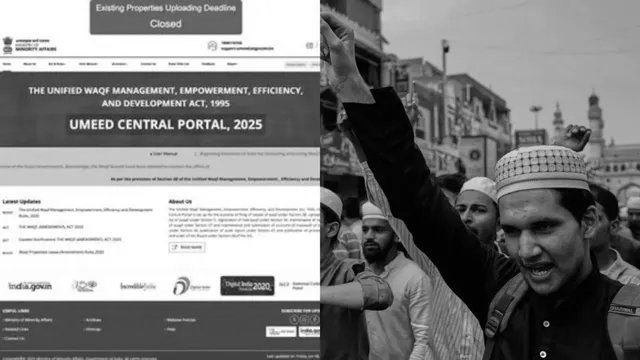
Over 5 lakh Waqf properties registered on UMEED portal as 2.16 lakh approved
More than five lakh Waqf properties have been registered on the UMEED Central Portal during its six-month window, the Ministry of Minority Affairs announced on Monday. According to ministry data, 5,17,040 properties were initiated , while 2,16,905 were approved by designated authorities, marking a significant step toward digitising the management of Waqf assets across India.
Launched by Union Minister Kiren Rijiju on June 6, 2025, the Unified Waqf Management, Empowerment, Efficiency, and Development (UMEED) portal was created to establish a comprehensive digital inventory of all registered Waqf properties in the country. The initiative follows the UMEED Act, 1995 , and Supreme Court directives, aiming to bring transparency, accountability, and efficiency to Waqf property administration. The portal officially closed for uploads on December 6, 2025.
Of the total properties uploaded, 2,13,941 remain in the approval pipeline , while 10,869 were rejected during verification, the ministry said. Officials noted that the pace of uploads accelerated sharply toward the deadline, reflecting focused efforts by both central and state authorities.
To support the nationwide registration exercise, the Ministry conducted continuous workshops and training sessions for State and UT Waqf Boards and Minority Departments. A two-day master trainer workshop in Delhi provided hands-on guidance to officials involved in property uploads. Additionally, seven zonal meetings were held across the country, senior administrative and technical staff were deputed in multiple states, and a dedicated helpline was set up at the ministry to provide technical assistance.
Secretary of the Ministry of Minority Affairs, Chandra Shekhar Kumar, personally chaired over 20 review meetings, monitoring progress, addressing concerns, and motivating officials to meet the tight six-month timeline. These high-level interventions helped streamline the upload process and ensure accuracy in the data collected.
The portal’s state-wise data showed Uttar Pradesh leading the count with 92,830 properties (86,345 Sunni and 6,485 Shia), followed by Maharashtra (62,939) , Karnataka (58,328) , and West Bengal (23,086) .
While Minister Rijiju confirmed that the six-month deadline would not be extended, he assured Waqf property caretakers, or mutawallis, that no penalties would be imposed for the next three months as a humanitarian and facilitative measure.
Before the portal, Waqf property management relied on manual, paper-based records, with limited central oversight. This often led to fragmented administration, delays in approvals, and difficulties in tracking encroachments or misuse. The UMEED portal replaces this system with a centralised, transparent, and efficient digital framework, enabling faster approvals, uniform processes, and better planning for property utilisation.
The ministry said the completion of this phase marks a major milestone in modernising Waqf administration. By maintaining a digital inventory and ensuring accountability, the portal is expected to unlock the developmental potential of Waqf properties, ultimately benefiting minority communities nationwide.
With the successful registration of over five lakh properties, the UMEED portal demonstrates the government’s commitment to transforming Waqf management into a streamlined, transparent, and development-oriented system, setting the stage for data-driven governance and enhanced resource utilisation.