
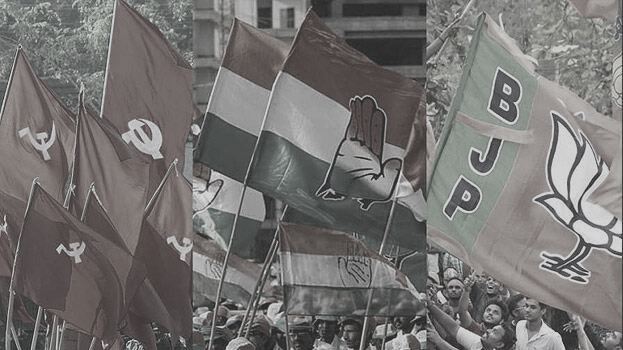
Opposition steps up attack in Kerala: UDF leaders allege CPI(M)–BJP Nexus, Express confidence of big win
Senior Congress leader K. C. Venugopal and RSP MP N. K. Premachandran on Sunday intensified the opposition’s attack on the ruling dispensation in Kerala, alleging an electoral understanding between the Communist Party of India (Marxist) and the Bharatiya Janata Party ahead of the Assembly polls, while expressing confidence that the Congress-led United Democratic Front (UDF) would secure a decisive mandate.
Addressing separate interactions, both leaders claimed that signs of a CPI(M)–BJP “nexus” were visible in the ongoing political developments, though no evidence has been publicly presented.
Venugopal, speaking in Kochi, said such an arrangement would not succeed in Kerala, asserting that voters in the state have historically rejected similar attempts. He alleged that the relationship was reflected in policy positions, candidate strategies, and the pace of central agency investigations, including developments linked to Chief Minister Pinarayi Vijayan.
Echoing similar claims, Premachandran alleged that there was a “give-and-take understanding” between the CPI(M) and the BJP in more than 30 Assembly constituencies. He argued that interactions between Vijayan and central leaders such as Narendra Modi, Amit Shah, and Nitin Gadkari last year pointed to “secret agreements,” now reflected in electoral strategies.
Despite these allegations, both leaders expressed confidence that the UDF would overcome what Premachandran termed an “unholy nexus” and return to power with a comfortable majority. Premachandran projected that the alliance could win around 100 seats in the Assembly.
The opposition leaders also mounted a sharp critique of the ruling Left Democratic Front (LDF), accusing it of governance failures across key sectors including health, education, industry, and finance. Premachandran alleged that the state had witnessed an “autocratic style” of governance over the past decade, leading to widespread public dissatisfaction and strong anti-incumbency sentiment.
He further accused the CPI(M) of corruption and misuse of political power, while claiming that several former party leaders, including G. Sudhakaran, had shifted to the UDF, signalling internal discontent within the Left camp.
Highlighting campaign strategy, Premachandran said the UDF was focusing on a “constructive and positive” outreach, citing the response to its ‘Puthuyuga Yatra’ across districts. He also claimed that younger voters were increasingly receptive to the alliance’s development-oriented policies.
On key issues, Premachandran pointed to alleged irregularities in Devaswom boards and controversies surrounding the Sabarimala Temple, stating that such matters had hurt the sentiments of devotees and exposed the government.
Meanwhile, Venugopal outlined the UDF’s welfare agenda, reiterating the promise of free bus travel for women in services operated by the Kerala State Road Transport Corporation. He said the measure would benefit women in unorganised sectors and ease financial burdens on working families.
He also announced plans to raise welfare pensions to ₹3,000 and introduce a comprehensive healthcare insurance scheme, while dismissing concerns over the financial viability of such initiatives.
Both leaders indicated that the UDF would soon release a detailed manifesto outlining its governance roadmap.
The CPI(M) and the BJP have not responded to the allegations at the time of publication.