
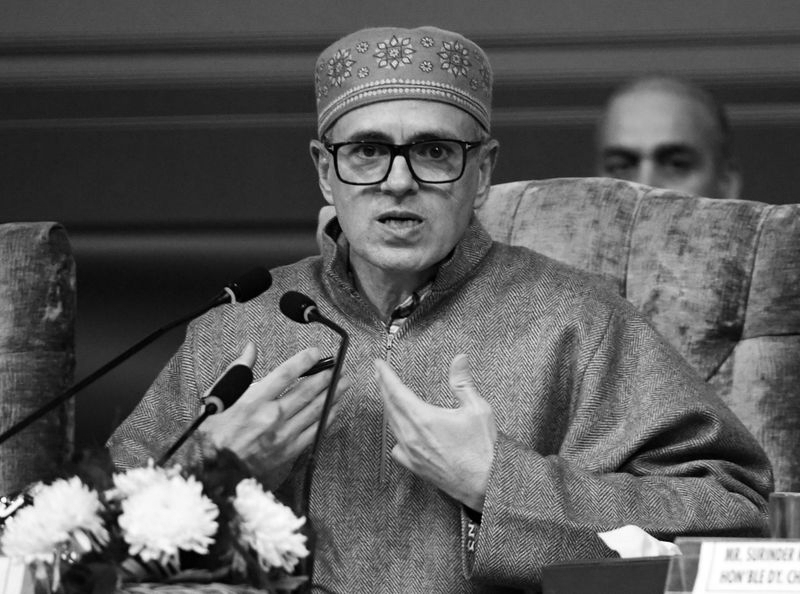
Omar Abdullah rejects land regularisation bill, calls it ‘pro-mafia, not pro-people’
J ammu and Kashmir Chief Minister Omar Abdullah has strongly rejected the state land regularisation bill, 2025, describing it as a move that protects land grabbers rather than the common people.
Speaking to reporters in Ganderbal, he said, “How can we pass a bill meant to help the land mafia, to help those who have illegally occupied land, that doesn’t even confirm whether they are residents of J&K?”
Omar alleged that the bill was brought for political mileage ahead of elections, not public welfare.A bill introduced solely for political gain will harm the people of J&K, and I will not allow my government to do that, he asserted.
The bill, officially titled “The Jammu and Kashmir (Regularization and Recognition of Property Rights of Residents in Public Lands) Bill, 2025,” aimed to grant ownership rights to those living on state, kacharia, common, or shamilat lands, claiming to uphold the “right to shelter” under Article 21 of the Constitution.
Meanwhile, Omar Abdullah also hit back at People’s Conference president Sajad Lone, who called the Rajya Sabha election a “fixed match” between the National Conference (NC) and BJP. Omar accused Lone of “playing a double role,” saying he abstained from voting but now questions the result. “If he really wanted to stop a fixed match, he should have voted. The people of Handwara didn’t elect him to stay silent,” he said.The NC eventually won three out of four Rajya Sabha seats, while the BJP secured one.
Why the land bill became controversial
The land regularisation bill was projected as a welfare measure to help families who had been living for decades on public land gain ownership by paying a small fee, reportedly about one third of the official land rate.
However, Omar Abdullah and several experts argued the bill was legally weak and open to manipulation. They warned it could become a tool to legalise encroachments by wealthy individuals and politically connected people rather than protecting genuine residents.
The Roshni Act’s shadow
To understand the present controversy, it’s important to look back at the Roshni Act of 2001, introduced by Omar Abdullah’s father, Dr. Farooq Abdullah, when he was the chief minister.
The Roshni Act allowed people to purchase the government land they were occupying, aiming to raise around ₹25,000 crore for power projects, hence its name, “Roshni,” meaning “light.” Initially, it was seen as a welfare step to give people land rights and generate funds for development.
But over time, the act turned into one of J&K’s biggest land scandals. Investigations later revealed that prime government land was allotted to influential politicians, businessmen, and bureaucrats at throwaway prices, while the poor got little benefit.The CAG report found massive irregularities and misuse of authority. In 2020, the J&K High Court struck down the Roshni Act, calling it “illegal and unconstitutional.”
When Omar Abdullah recently called the new bill “Roshni se badh ke illegal” (even more illegal than Roshni), many were quick to point out the irony, since the Roshni Act itself was passed by his father’s government. This raised a key question: is the land regularisation bill just history repeating itself under a new political name?
How other states have fared
Several Indian states have experimented with land regularisation, and most have faced the same challenges, good intentions, weak execution, and widespread misuse.
• Andhra Pradesh and Telangana allowed regularisation of encroached government lands, but much of it benefited politically connected realtors.
• Tamil Nadu’s urban land schemes helped slum dwellers, but corruption and undervaluation diluted results.
• Karnataka’s Akrama Sakrama scheme was stayed by courts for encouraging “planned illegality.”
• Maharashtra’s slum regularisation gave land rights to many families, but developers later exploited the same rules to gain land cheaply for luxury projects.
The pattern is clear, wherever power and property meet, the poor rarely gain as much as promised.
If the bill had been passed
If approved, the bill could have given thousands of families legal titles to their homes and ended decades of uncertainty. It might also have helped the administration bring unregistered land under the formal system.But critics say that, like the Roshni Act, it could easily have been misused. With decision making powers lying mainly with top bureaucrats and local committees, the land might have gone to the influential rather than the deserving.Experts note that in a region where land is deeply tied to politics, any regularisation without strict checks is bound to be exploited.
The bill, though presented as a welfare measure recognising housing as a basic right, is fundamentally flawed. It lacks transparency and safeguards, risking a repeat of the corruption and favoritism seen in the Roshni Act. Omar Abdullah’s rejection protects the system for now, but it also delays justice for genuine residents. In reality, no land law ever stays fully honest, where land and power meet, the wealthy always find a way in, while the poor keep waiting.