
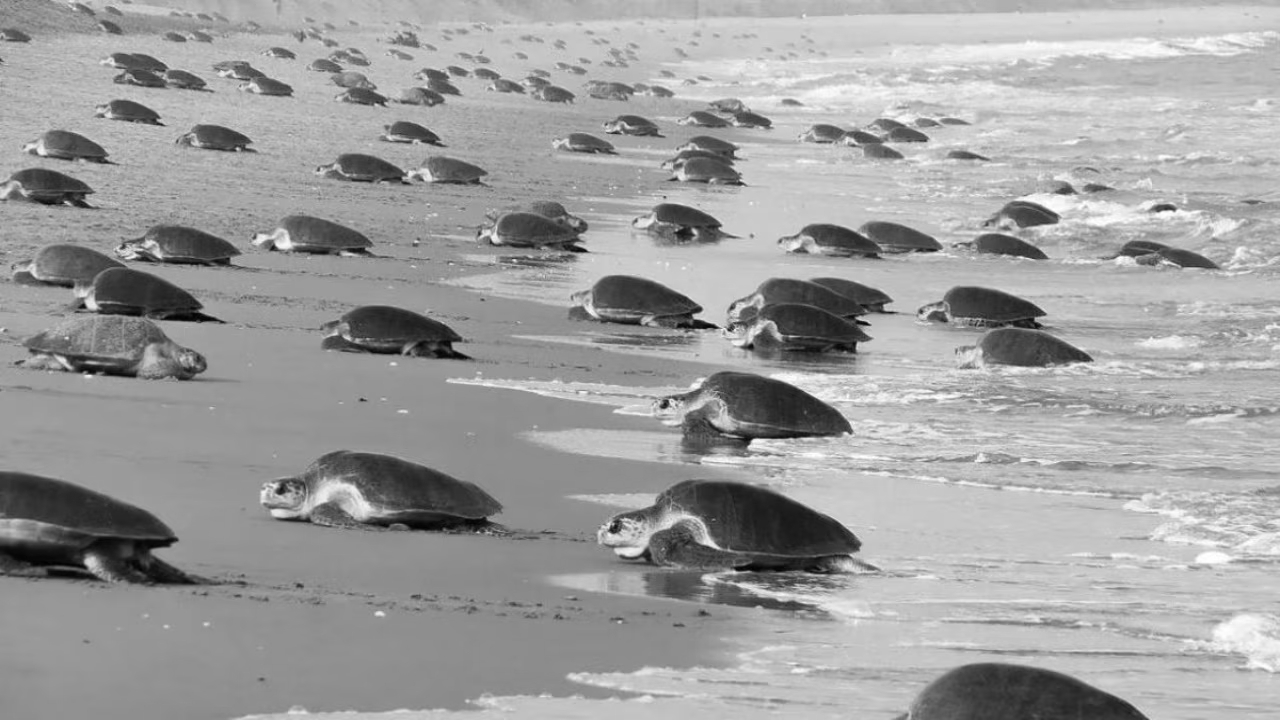
Olive Ridley turtles begin mass nesting at Odisha’s Rushikulya coast
The annual mass nesting of Olive Ridley turtles began at the Rushikulya river mouth in Odisha’s Ganjam district early Sunday, with more than 10,000 turtles coming ashore to lay eggs along the sandy coastline, forest officials said.
According to Berhampur Divisional Forest Officer Sunny Khokkar, about 10,220 female Olive Ridley turtles emerged from the Bay of Bengal under moonlit skies and started laying eggs from around 3 am , marking the beginning of the season’s first phase of the mass nesting event known as ‘arribada’.
The turtles nested along a stretch of beach between Podampeta village and the coastal belt near Bateswar temple , covering nearly five kilometres of the Rushikulya rookery. The egg-laying activity was reported across several segments of the Purunabandha–Bateshwar coastline, officials said.
The mass nesting was followed by sporadic nesting by more than 5,700 turtles, forest officials added.
Wildlife experts said the phenomenon is likely to continue for a few more days if beach and weather conditions remain favourable. Authorities noted that rainfall in nearby parts of Ganjam could affect nesting if it occurs at the rookery, as rain may harden the sand and alter beach temperature, making egg-laying more difficult.
Officials said the nesting began nearly a month later than last year. In 2025, the first phase of arribada started on February 15 and continued till February 22, followed by a second phase between March 21 and March 27, during which more than 9.04 lakh turtles laid eggs at the site.
Regional Chief Conservator of Forests (Berhampur) Vishwanath Neelannavar said February to April is generally considered the ideal period for mass nesting at the Rushikulya rookery, one of the most important nesting grounds for Olive Ridley turtles in the world.
To protect the nesting site, the forest department has deployed 10 protection squads and restricted visitor access along a four-kilometre stretch of beach. Entry points have been set up at Gokharkuda and Podampeta to regulate movement, while an awareness camp has been established at Bateshwar beach. Assistant Conservator of Forests Diby Shankar Behera said the area has been fenced to prevent predators such as wild dogs and jackals, and round-the-clock surveillance is being maintained to safeguard the eggs.
During nesting, female turtles crawl onto the beach, dig pits in the sand and lay around 100 to 150 eggs each before covering them with sand and returning to the sea. The eggs generally hatch after about 45 to 50 days , after which the hatchlings make their way to the ocean without the presence of their mothers.