
Oldest known rock art found in Indonesia rewrites human migration timeline
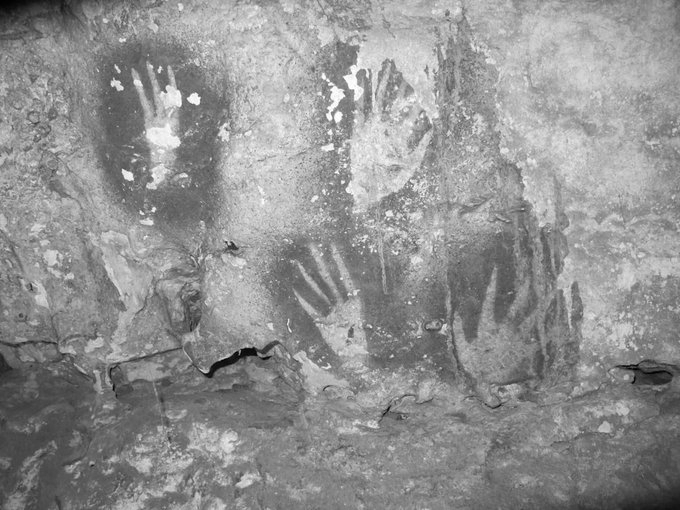
In a limestone cave on Muna, off southeastern Sulawesi, someone once placed their hand against the rock and blew pigment around it. The fingers are deliberately narrowed, resembling claws or talons. Whatever meaning this carried has been lost, but the act itself endures. Research published in Nature shows the hand touched the wall at least 67,800 years ago , making it the oldest dated rock art yet attributed to Homo sapiens , though the exact identity of the maker rests on inference.
Led by Griffith University and Indonesia's National Research and Innovation Agency (BRIN), the team advanced the record by 16,600 years beyond a previous Sulawesi hunting scene from 2024. The stencil’s location and age align with models predicting early human migration to Australia.
Although the hand stencils were first discovered during archaeological surveys in 2017, it has taken nearly a decade of fieldwork, laboratory testing and peer review for scientists to complete the dating analysis, which was published only recently.
For decades, scholars debated when Indigenous Australians arrived. The “long chronology” places them by at least 65,000 years ago, the “short chronology” around 50,000. The Muna stencil strengthens the long chronology, showing humans with symbolic abilities in Wallacea at the right time.
Dating(scientific age determination) did not target pigment but mineral deposits over the art . Calcium carbonate traps uranium, which decays into thorium at a known rate. Analysis of multiple samples confirmed a minimum age of 67,800 years, with the upper bound at 71,600 ± 3,800 years. This method provides a floor, not a ceiling; the stencil could be older.
The most striking feature is the artificially narrowed fingertips. Similar modifications, previously thought to date only 17,000 years, are now pushed back by at least 50,000 years. Professor Adam Brumm suggests the design may symbolize human-animal connection, echoing Sulawesi art depicting part-human, part-animal figures. While the meaning is speculative, it shows deliberate symbolic thinking.
Geographically, the stencil fills a gap in migration evidence. During the Pleistocene(a geological epoch of Earth’s history dating from about 2.6 million to 11,700 years ago), lower sea levels created Sunda (Southeast Asia) and Sahul (Australia and New Guinea), separated by Wallacea(a biogeographical region of islands between Asia and Australia). Crossing Wallacea required voyages of up to 90 km. Two routes are proposed: northern through Sulawesi and western Papua, southern via the Lesser Sunda Islands. The Muna hand placed humans with sophisticated artistic skills on the northern corridor 67,800 years ago. Combined with genetic data estimating Australian settlement around 60,000 years ago, archaeology and genomics now align.
The stencil cannot definitively identify its maker. Attribution to Homo sapiens rests on technical and stylistic complexity and known migration timelines. Archaic hominins were present in Sulawesi over 118,000 years ago, but no symbolic art is linked to them. Similarly, the stencil does not prove migration direction; evidence suggests movement toward Sahul, but the art alone cannot exclude other possibilities.
Future discoveries could revise these conclusions: dated art along the southern route, ancient DNA from Sulawesi, revised Australian settlement dates, or symbolic art from archaic hominins could all alter interpretations. The title of “oldest” remains provisional.
What endures is the hand itself. Whoever pressed their palm against limestone 67,800 years ago could not have imagined that their gesture would one day link continents, descendants, and instruments capable of measuring atomic decay to determine when they lived. They created their mark for reasons that belonged to their world, not ours a testament to humanity’s enduring drive to create and communicate.