
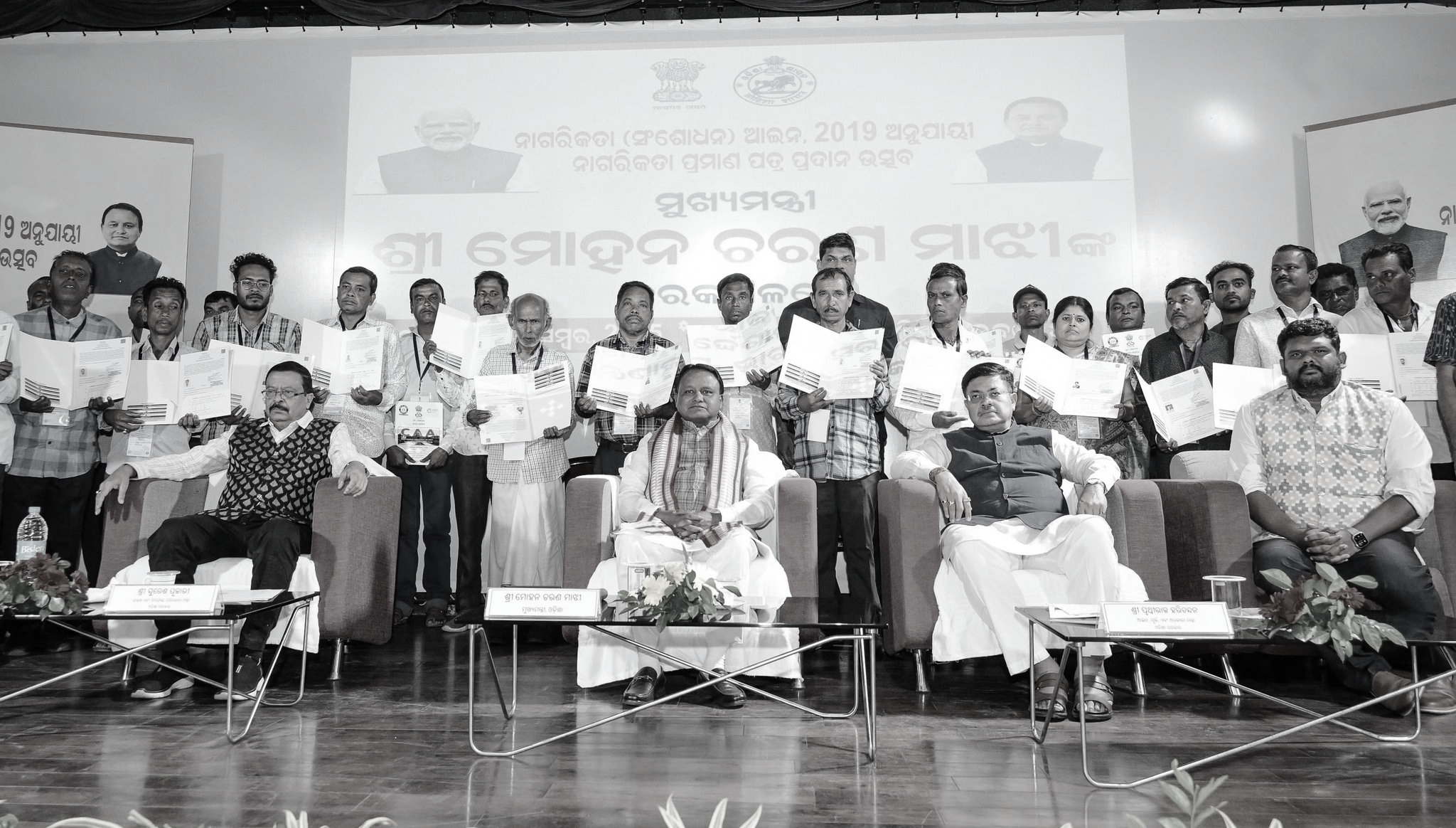
Odisha grants citizenship to 35 refugees under CAA, implementation gains slow momentum nationwide
In a significant development for the implementation of India’s Citizenship (Amendment) Act, 2019 (CAA), Odisha Chief Minister Mohan Charan Majhi handed over Indian citizenship certificates to 35 people from Nabarangpur district at a special ceremony organized by the Odisha Census Directorate and the Union Home Ministry. The recipients, originally refugees from Bangladesh, Pakistan, and Afghanistan, belong to minority religious communities and were formally granted Indian citizenship under the provisions of the CAA.
Addressing the newly naturalised citizens, Majhi described the law as a “ray of hope” for those who endured religious persecution in neighbouring countries, reaffirming India’s historical tradition of offering refuge and humanitarian support.
The Citizenship (Amendment) Act, passed by Parliament in December 2019, amends the Citizenship Act of 1955 to provide a fast-track route to Indian citizenship for non-Muslim refugees from Bangladesh, Pakistan, and Afghanistan. Under CAA provisions, refugees who belong to Hindu, Sikh, Buddhist, Jain, Parsi, or Christian communities and who entered India on or before December 31, 2014, and have lived in the country for the required period are eligible to apply for citizenship. Before CAA, the standard naturalisation requirement was 11 years of residence in India. The amendment relaxes this residency criterion, enabling eligible applicants to be considered after a shorter period of stay.
Although the CAA was enacted in 2019, its practical implementation was delayed because rules for processing and certification were not notified until March 2024. As a result, even applicants who had lived in India for many years could only begin the formal citizenship process after the rule-making. The first set of citizenship certificates under the newly notified CAA rules was handed out in May 2024, when 14 people received certificates in New Delhi. From there, other states began processing applications, though the pace of awards has varied widely.
Nationally, more than 350 people had become Indian citizens under the CAA by mid-2024, with tens of thousands of applications reportedly filed across the country. In Odisha, this week’s ceremony marks the state’s first formal set of CAA citizenship grants and a symbolic milestone in broader rollout. In contrast, Assam, one of the states with historically intense debate around citizenship and migration, has recorded only a few approvals so far, highlighting the uneven pace of implementation across the country.
Those granted citizenship under the CAA receive the full legal status of Indian citizens, enabling them to participate fully in social, economic, and civic life. Officials emphasized that new citizens will be entitled to benefits such as land allocation for the landless and caste certificates where applicable, along with access to regular government welfare schemes.
With thousands of applications reportedly filed under the Act and implementation still unfolding state by state, the CAA’s impact continues to grow gradually. Citizenship distribution ceremonies like the one in Bhubaneswar and large-scale events in states such as Gujarat, where over a hundred certificates were handed over in a single event, indicate that the CAA is transitioning from policy to practice, albeit slowly and unevenly across India.