
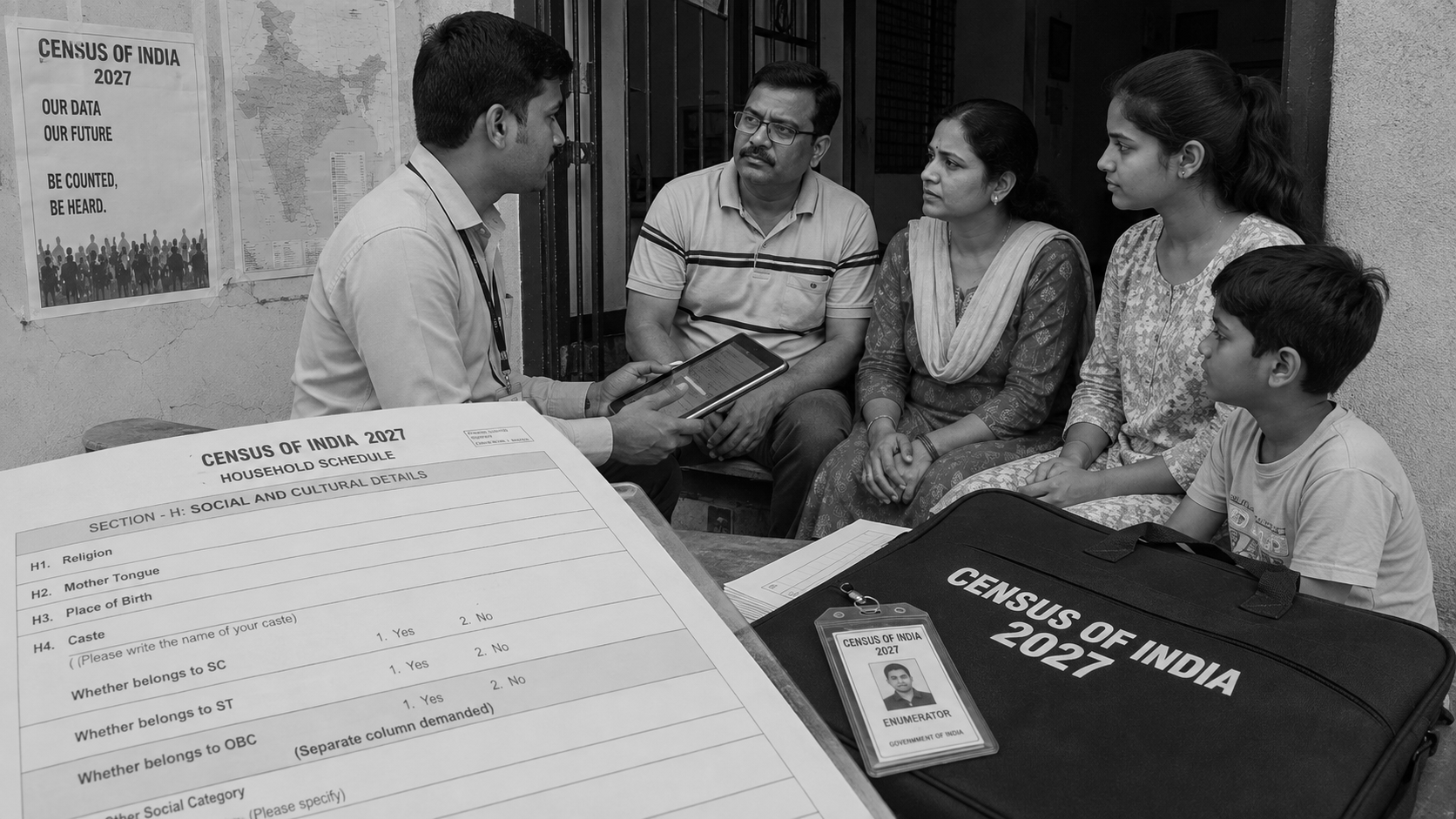
OBC Census Debate: Why a Separate Column Matters for Reservation and Social Justice
India’s decision to collect caste data in the upcoming Census could reshape debates over OBC representation, reservation and social justice, and create policy challenges.
The Centre has notified 40 questions for population enumeration, including an open-ended question on caste for respondents. It will be the first Census to collect caste details beyond SC/ST identification. However, the questionnaire does not provide a separate OBC column, prompting criticism from Congress leader Vijay Wadettiwar. He argues that simply recording caste may not produce an accurate OBC count because castes and sub-castes can have different classifications across states. Congress has also questioned the absence of a prepared caste list, warning that inconsistent self-reporting could complicate data compilation.
Supporters say comprehensive caste data could provide a much-needed evidence base for public policy. Reliable numbers could help assess OBC demographics, representation in education and employment, and whether reservation benefits reach disadvantaged groups. Data could also strengthen arguments for OBC sub-categorisation, allowing governments to identify communities that remain under-represented.
Caste data could influence welfare planning as well. Combined with education, occupation and economic data, it could help governments design targeted scholarships, skills programmes and social-security measures.
But the exercise carries risks. India’s caste system includes thousands of communities, alternative names and regional classifications. Self-declaration alone may create inconsistencies, while translating responses into official categories could be difficult.
Critics also warn that population figures could intensify quota competition and identity politics. Communities may use their numbers to demand greater representation or reservation, triggering political and legal disputes. Moreover, caste alone cannot capture disadvantage: people from the same community can have sharply different incomes, education and opportunities.
The central issue is not simply counting castes but interpreting the data. A credible Census could make social-justice policies more evidence-based, but population figures would not automatically determine reservation levels. Constitutional provisions, socioeconomic disadvantage, representation and judicial scrutiny would still shape policy.