
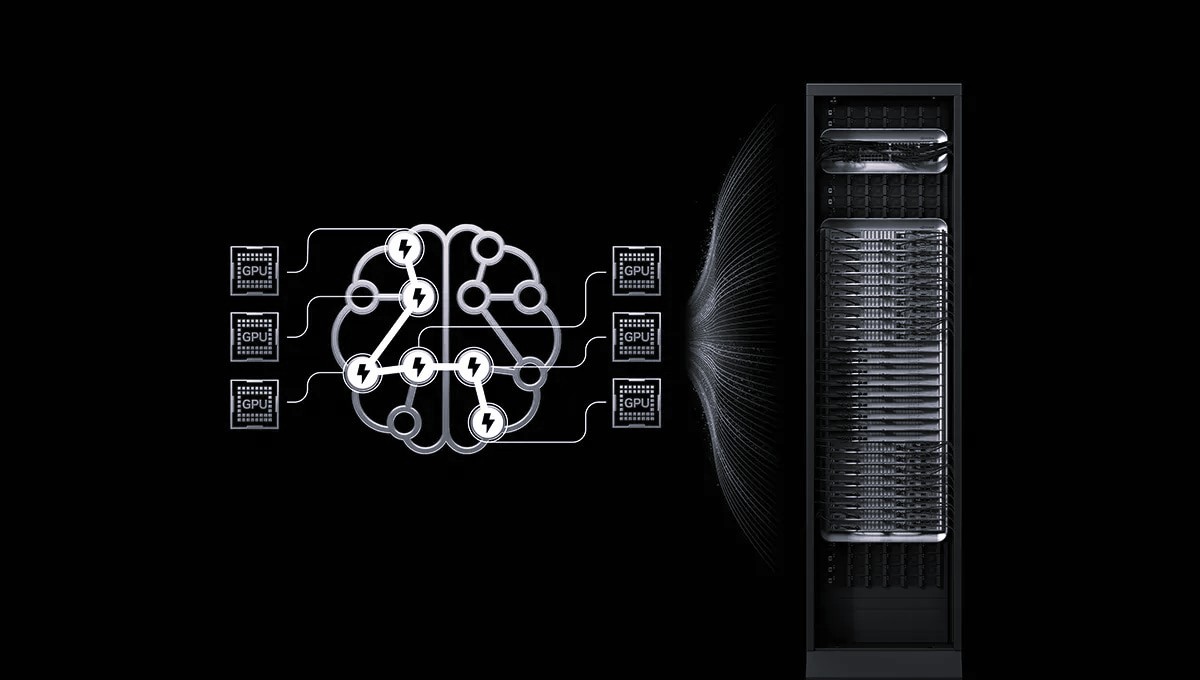
Nvidia’s Blackwell Servers Accelerate AI Models Tenfold
Nvidia on Wednesday revealed that its latest AI server, powered by the Blackwell architecture, can boost the performance of AI models including China’s Moonshoot AI Kimi K2 Thinking model and DeepSeek’s open-source models by 10 times compared to the previous generation. The announcement highlights Nvidia’s growing dominance in AI deployment, as the industry increasingly shifts its focus from training models to serving them to millions of users, a space where competition from rivals such as AMD and Cerebras is intensifying.
The Blackwell architecture, Nvidia’s flagship “black chip,” represents a major leap in semiconductor design. Each GPU integrates over 208 billion transistors, dual-die chip architecture, high-bandwidth interconnects, and specialized low-precision Transformer engines. These capabilities enable massive AI models, including mixture-of-experts (MoE) architectures, to be deployed efficiently, reducing latency and improving scalability across multiple GPUs. Nvidia’s servers, which pack 72 Blackwell GPUs per system, leverage these innovations to handle complex AI workloads, allowing faster real-time responses and large-scale model serving.
Mixture-of-experts models, which route specific tasks to specialized “experts” within a model, have surged in popularity this year. China’s DeepSeek and Moonshoot AI are prime examples, achieving high performance with less training. While such models require fewer resources during training, their deployment at scale benefits significantly from the computational power, memory bandwidth, and interconnect speeds provided by Blackwell-based servers. This explains the reported 10× speed-up for Moonshoot AI’s Kimi K2 Thinking model.
Semiconductor chips like Blackwell are central to modern AI performance. Large-scale models demand intensive computation, fast memory access, and efficient data movement. High-performance AI chips accelerate operations such as matrix multiplications and attention mechanisms while optimizing power and memory efficiency. Without such hardware, scaling AI services to millions of users would remain impractical. Competitors such as AMD are developing similar multi-chip servers, but Nvidia’s integration of compute, memory, and interconnect continues to give it an edge in high-performance AI deployment.
Meanwhile, India is actively building its position in the global AI and semiconductor landscape. The India Semiconductor Mission (ISM) has approved multiple chip manufacturing and packaging units across states including Odisha, Andhra Pradesh, and Punjab. Initiatives such as Tata Semiconductor Assembly and Test Pvt Ltd (TSAT) and the Design Linked Incentive Scheme (DLI) are nurturing domestic chip design capabilities and providing startups and institutions with access to electronic design automation tools and support for AI-focused semiconductors.
India is also expanding its AI infrastructure. Projects like AIRAWAT provide supercomputing resources for research and commercial AI deployments, while partnerships with global tech firms, including Nvidia, are strengthening the country’s capacity to train and deploy AI models. At the same time, India is developing a skilled workforce to manage AI hardware and software systems.
However, India still faces challenges in competing with the most advanced AI-chip nations. Cutting-edge chips, like Nvidia’s Blackwell, require sub-10nm fabrication nodes, massive investments, and complex supply chains. India currently focuses on mid-node chips suited for automotive, telecom, IoT, and general electronics applications. Nonetheless, by combining domestic manufacturing, AI research infrastructure, and a strong software ecosystem, India is positioning itself to participate meaningfully in the AI race, especially in sectors where high-end fabrication is less critical.
Experts view India’s dual-track strategy building semiconductor capabilities and promoting AI infrastructure as a practical path to becoming a global hub for electronics, AI deployment, and chip design. Strategic investments, policy incentives, and international partnerships could enable India to bridge gaps over time, even as global leaders continue to dominate high-end AI chip production.
The Nvidia announcement underscores a broader truth: the AI revolution is now hardware-driven as much as algorithm-driven. High-performance chips, advanced interconnects, and optimized servers are essential for deploying AI at scale. Nvidia’s Blackwell servers set the benchmark, while countries like India are laying the foundations to participate in this high-stakes race, combining talent, infrastructure, and domestic semiconductor development to prepare for the next phase of AI expansion.