
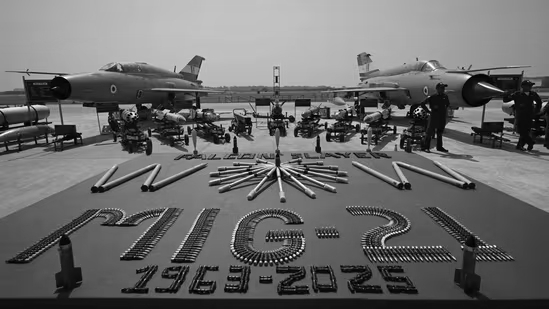
“Nothing better than MiG-21”: Group Captain Malik as IAF bids farewell to a legend
The Indian Air Force (IAF) on Friday bid an emotional farewell to the MiG-21, its iconic supersonic fighter and interceptor that served the nation for over six decades. For veterans like Group Captain Malik (Retd.), who flew all three versions of the MiG-21 for 24 years, the moment was deeply poignant. “It was my life, and now it is going to be a part of my life. Each moment is emotional when we bid farewell to this aircraft, and I swear there is nothing better than this aircraft,” he said at the decommissioning ceremony attended by Defence Minister Rajnath Singh.
The story of a game-changer
The MiG-21 was inducted in 1963 amid India’s urgent need to modernize its air fleet following conflicts with China and Pakistan. Prior jets were subsonic, limiting India’s air combat capabilities. The Soviet-supplied MiG-21, capable of flying twice the speed of sound, marked a breakthrough in speed, agility, and firepower. The first squadron, the 28 Squadron, known as the “First Supersonics” and based in Chandigarh, made India one of the first countries in Asia to operate supersonic fighters. For decades, mastering the MiG-21 became a benchmark for IAF pilots, influencing curriculum design, simulator programs, and combat doctrine. Over its nearly six-decade service, the MiG-21 saw extensive action in multiple operations, including the 1971 war with Pakistan, where it struck the Governor’s residence in Dhaka, contributing to Pakistan’s surrender. It also participated in the Kargil War and has engaged enemy aircraft from F-104s in 1971 to F-16s in 2019, cementing its legacy as one of the most battle-tested jets in IAF history.
Its lightweight frame, high speed, and versatility not only strengthened India’s aerial defense but also reshaped air combat strategy, allowing the IAF to adopt more aggressive interception tactics and multi-role operations. Training programs evolved to meet the MiG-21’s exacting demands, producing pilots skilled in supersonic maneuvering, high-altitude dogfighting, and rapid-response operations. Over the decades, the MiG-21 saw multiple generations and upgrades,from the initial Fishbed models to the later Bison variants,each improving avionics, weapons systems, and combat capabilities. For decades, mastering the MiG-21 became a benchmark for IAF pilots, influencing curriculum design, simulator programs, and combat doctrine.
Combat legacy: 1971, Kargil, and beyond
The MiG-21 saw extensive action in multiple conflicts:
• 1971 Indo-Pak War: It struck the Governor’s House in Dhaka, hastening Pakistan’s surrender. MiG-21s also downed F-104 Starfighters, establishing the aircraft’s reputation for precision and combat effectiveness.
• 1999 Kargil War: It provided critical ground support in the Himalayan terrain during Operation Safed Sagar.
• 2019 aerial engagement: A MiG-21 Bison shot down a modern F-16, highlighting the jet’s enduring effectiveness even decades after induction.
Pilots’ memories: a jet of character Flying the MiG-21 was both thrilling and unforgiving, and pilots recall missions that capture its unique character:
• Heart-pounding supersonic intercepts, with speeds reaching over 2,000 km/h in minutes, demanding absolute focus.
• Group Captain Malik recalls a training sortie in the 1980s where he narrowly avoided a stall during a low-level maneuver over hilly terrain, a lesson in respecting the aircraft’s limits.
• Veterans often recount the dogfights of the 1971 Indo-Pak war, where nimble MiG-21s outmaneuvered heavier enemy jets, demonstrating both pilot skill and aircraft agility.
• The MiG-21 also saw action in the Kargil conflict in 1999, performing air defense and reconnaissance roles.
• More recently, during the Balakot airstrike in February 2019, Wing Commander Abhinandan Varthaman, flying a MiG-21 Bison, successfully engaged enemy aircraft, including shooting down a Pakistani F-16.
• The MiG-21 also tested patience and precision, particularly during landings in turbulent crosswinds, experiences that became legendary training anecdotes.
These stories show why the MiG-21 was more than a fighter; it was a teacher in the sky, demanding skill, courage, and resilience.
Why the MiG-21 is being retired
After over 60 years in the skies, the MiG-21 is being retired due to age, safety, and technological limitations. Most aircraft are over 40-50 years old, with aging airframes prone to fatigue and rising maintenance costs. Spare parts have become scarce, making upkeep increasingly difficult and expensive.
Safety concerns remain a key factor, given the jet’s historically high accident rate. Additionally, modern aerial combat demands advanced avionics, stealth, and multi-role capabilities,features the MiG-21 cannot fully provide. While a stalwart of the Indian Air Force for decades, the fighter jet is now being replaced by more advanced aircraft to meet contemporary operational needs.
Retirement ensures the IAF can focus on modern, safer, and more capable aircraft while honoring the legacy of the MiG-21.
The final flight and decommissioning
The MiG-21’s final decommissioning is ceremonial yet meticulous. Its last operational sortie, often flown by a senior pilot in formation with others, marks the end of active service. The aircraft has a distinguished combat history, including the 1971 Indo-Pak war, the Kargil conflict in 1999, and more recently during the Balakot airstrike in February 2019, when Wing Commander Abhinandan Varthaman, flying a MiG-21 Bison, engaged enemy aircraft and successfully shot down a Pakistani F-16. After landing, the MiG-21 is officially retired, inspected, and either preserved in museums, training facilities, or displayed at IAF bases. Some are painted in historical squadron markings to honor their legacy and educate future generations.
Transition to modern jets
The IAF is gradually replacing the MiG-21 with India-made Tejas Light Combat Aircraft, French-made Dassault Rafale, and the upcoming Advanced Medium Combat Aircraft (AMCA), being developed in Bangalore, Karnataka, by the Aeronautical Development Agency (ADA) in collaboration with Hindustan Aeronautics Limited (HAL). These modern jets offer superior range, advanced avionics, stealth, and multi-role versatility, ensuring India maintains its edge in air power while building on lessons learned from six decades of MiG-21 operations.
A legacy that shaped the IAF
Over six decades, the MiG-21 did more than fight wars; it shaped India’s air combat doctrine, training programs, and strategic planning. Its presence forced the IAF to innovate in tactics, high-speed intercept missions, and supersonic maneuvers. Generations of pilots trained on the MiG-21 became experts in precision flying, quick decision-making, and operational resilience, skills that continue to influence modern training curricula and strategic planning.
As Defence Minister Rajnath Singh said: “The MiG-21 may be retiring, but its legacy will continue to soar with every new aircraft that takes flight.”
From a revolutionary supersonic fighter in the 1960s to its final flight today, the MiG-21 has been more than metal and engine. It has been a symbol of India’s air power, shaping generations of pilots and strengthening the nation’s defense. Its roar may fade, but its influence on the IAF’s future remains indelible.