
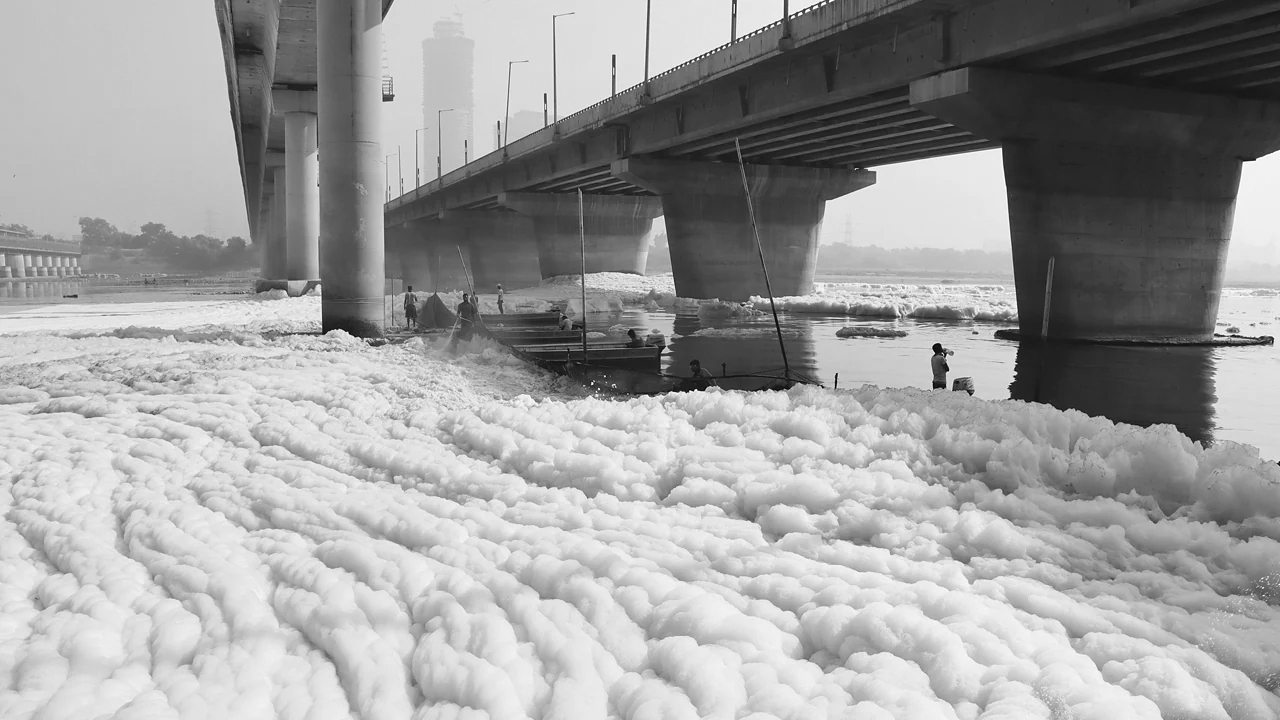
Not Just Air, Water Too! Delhi Gets a One-Two Punch as Ammonia Spikes in Yamuna
Delhi’s crisis is no longer confined to hazardous air its drinking water system is under growing stress too , as pollution in the Yamuna once again disrupts supply across the capital. The Delhi Jal Board (DJB) has warned of significant water supply disruption until February 4 , after at least five major water treatment plants (WTPs) were forced to reduce production due to high ammonia levels in the Yamuna and a drop in raw water availability from Haryana .
The affected plants include Wazirabad , Haiderpur Phase 1 and 2 , Bawana , and Dwarka . Officials said four plants are currently running at only around 75% of their overall capacity , while the Wazirabad WTP has halted production completely . Wazirabad, one of Delhi’s most important facilities, has an overall capacity of 138 million gallons per day (MGD) . DJB stated that operations were temporarily suspended because the raw water entering the plant carried excess ammonia and canal supply was reduced.
As a result, many parts of Delhi could experience low pressure and shortages. Areas likely to be impacted include IGI Airport, Dwarka, Shalimar Bagh, Sultanpuri, Raja Garden, Rajouri Garden, Karala, Bawana, Prashant Vihar, Madhu Vihar, Mangolpuri, Paschim Vihar, Mayapuri, Janakpuri , and adjoining neighbourhoods. DJB has urged residents to use water judiciously , adding that Haryana is supplying additional water to Delhi to partially compensate.
However, this disruption highlights a much deeper and recurring problem: Delhi’s water emergency is closely tied to Yamuna pollution , and it happens repeatedly — especially during winter. When ammonia levels rise beyond manageable limits, treatment plants struggle because most facilities are not designed to handle extremely polluted raw water. Typically, DJB dilutes Yamuna water by mixing it with cleaner raw water from the Munak Canal in Haryana , but diversion or shortage of that supply worsens the impact across multiple plants.
Importantly, this is not the first time Delhi has faced such a disruption . Reports show that ammonia spikes in Yamuna water are a chronic issue. A Hindustan Times report, citing the Wazirabad water quality monitoring laboratory, pointed to 22 ammonia spike episodes spanning 134 days , underlining how frequently the city confronts this threat. Earlier instances include major disruptions reported in 2016 and repeated shutdown-like situations in 2020 and 2024 , when ammonia levels surged and forced DJB to cut output sharply. Officials and water governance bodies have acknowledged that such ammonia rises occur almost every year .
The latest episode reinforces a harsh reality: while smog dominates attention, water pollution silently pushes Delhi into recurring supply crises . Unless pollution in the Yamuna is addressed at the source, the capital may continue to face seasonal water disruptions — making clean drinking water as uncertain as clean air.