
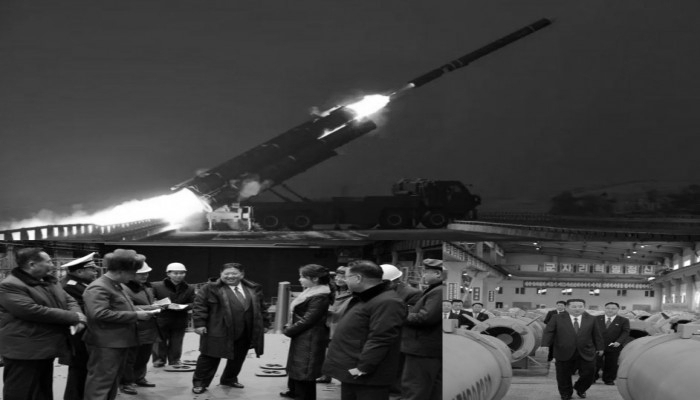
North Korea launches long-range cruise missiles, releases visuals of successful test
North Korea on Sunday test-fired long-range strategic cruise missiles into the sea, describing the exercise as a “nuclear readiness test” aimed at assessing the reliability and strength of its nuclear deterrence. State media reported that Leader Kim Jong-un personally oversaw the launches off the west coast near the Yellow Sea . The missiles reportedly followed pre-programmed routes for nearly three hours before hitting their targets, with analysts noting that the long flight time could indicate capabilities exceeding previous tests.
According to the Korean Central News Agency (KCNA), Kim expressed “ great satisfaction ” over the exercise, describing it as a test not only of weapon reliability but also of the readiness of strategic forces and missile unit training. Pyongyang framed the launch as a responsible demonstration of self-defence and war deterrence amid what it calls hostile external forces, emphasizing the “absolute reliability” and swift response of its strategic arsenal.
In recent days, Kim Jong-un also visited major weapons factories with top officials, instructing them to increase missile production, build new munitions plants, and develop additional weapons. State media released images showing progress on North Korea’s first nuclear-powered submarine, an 8,700-ton vessel that could potentially launch missiles, including nuclear-capable ones, reflecting Pyongyang’s efforts to diversify and harden its strategic capabilities.
Analysts suggest multiple motives behind these tests. North Korea appears to be sending a direct message to the United States and South Korea amid ongoing military exercises while simultaneously refining missile precision and operational readiness. The regime’s growing alignment with Russia may also play a role. Pyongyang has reportedly supplied Moscow with artillery, missiles, and personnel during the Ukraine war , and increasing its missile arsenal could bolster stockpiles for a strategic partner. Frequent missile tests may also draw global attention away from Russia, giving it more operational and diplomatic space, even if direct support is limited.
South Korea ’s Joint Chiefs of Staff confirmed multiple cruise missile launches from Pyongyang on Sunday morning, calling them “ provocative acts that threaten regional peace and security ” and emphasizing full readiness to deter and respond. Seoul highlighted close coordination with the United States. Japan expressed strong concern, calling the tests a “ serious threat to regional security ” and reaffirming its commitment to defend its territory alongside the US and South Korea. The United States condemned the launches as destabilizing, stating that while cruise missile tests are not explicitly banned, they threaten regional stability and violate the spirit of UN resolutions , and reaffirmed close coordination with allies to monitor North Korea’s military developments.
This year, North Korea has conducted dozens of missile launches, including short-range ballistic, hypersonic, and long-range cruise missiles, making 2025 one of its most active years in weapons testing. The regime has maintained a steady pace, with launches nearly every month, ranging from tactical systems to advanced strategic missiles. Recent anti-air launches off the east coast further underline Pyongyang’s focus on weapons development.
The missile tests come ahead of the ninth congress of the ruling Workers’ Party, expected early next year, where Kim is likely to unveil new modernization plans. Observers say North Korea continues to showcase advanced weapons systems to strengthen negotiating leverage with the United States and regional powers. Kim has repeatedly criticized the US focus on North Korea’s “ denuclearisation ,” pointing to what he sees as a double standard given Washington and its allies’ own nuclear programs. He has warned that Pyongyang will not return to negotiations unless the US abandons unilateral denuclearisation demands and provides security guarantees.