
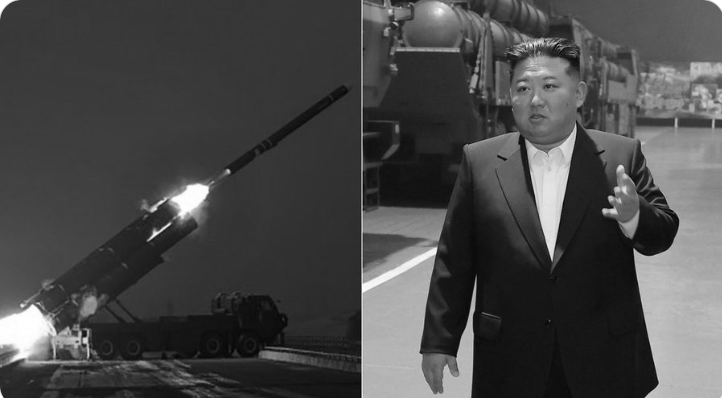
North Korea fires multiple ballistic missiles into eastern waters
North Korea on Sunday fired multiple ballistic missiles toward its eastern waters, South Korea’s military said, in a show of force ahead of North Korea’s ruling Workers’ Party congress , a key political meeting led by leader Kim Jong Un.
South Korea’s Joint Chiefs of Staff (JCS) said it detected several ballistic missile launches from the Pyongyang region at around 7:50 am . The missiles travelled eastward and are believed to have landed in the sea off North Korea’s eastern coast, roughly 200 kilometres from Pyongyang , based on the distance between the capital and the country’s east coast. The military did not disclose the exact range or altitude of the projectiles.
Ballistic missiles differ from cruise missiles in both trajectory and capability. While cruise missiles fly at low altitudes like aircraft and are often used for precision strikes, ballistic missiles are launched high into the atmosphere before descending at high speed toward their targets. Ballistic missiles are considered more destabilising as they can potentially carry nuclear warheads and are harder to intercept, making them a central concern for regional security.
South Korea said it has heightened surveillance and is closely coordinating with the United States and Japan to assess the launches. Japan’s defence ministry also confirmed it detected suspected missile activity by North Korea. No immediate damage or casualties were reported.
The latest launch follows North Korea’s announcement earlier this week that it test-fired long-range strategic cruise missiles into the sea. Pyongyang has also recently released images suggesting progress in the construction of its first nuclear-powered submarine, further underscoring its push to expand both nuclear and conventional military capabilities.
Experts say the timing of the missile tests is closely linked to the upcoming Workers’ Party congress, the first in five years. Such congresses are typically used by North Korean leader Kim Jong Un to showcase achievements in defence and technology, consolidate internal authority, and outline future policy direction. Analysts believe the tests are intended to strengthen Kim’s domestic standing while signalling resolve to external rivals.
Although North Korea has not officially announced the date of the congress, South Korea’s intelligence service has said it is likely to be held in January or February. Observers are watching closely to see whether Pyongyang will unveil a tougher line toward the United States or leave the door open to resuming long-stalled nuclear talks.
The development comes just hours before South Korean President Lee Jae Myung departed for China on a four-day visit, during which he is scheduled to hold talks with Chinese President Xi Jinping . Lee’s office said the South Korean leader would urge Beijing to play a “constructive role” in easing tensions and promoting peace on the Korean Peninsula.
China, North Korea’s closest ally and largest economic partner, is widely viewed as a key player in stabilising regional relations. Seoul hopes Beijing can use its influence over Pyongyang to discourage further provocations and encourage a return to diplomatic engagement, particularly as missile tests risk triggering an arms buildup and deeper geopolitical fault lines in Northeast Asia.