
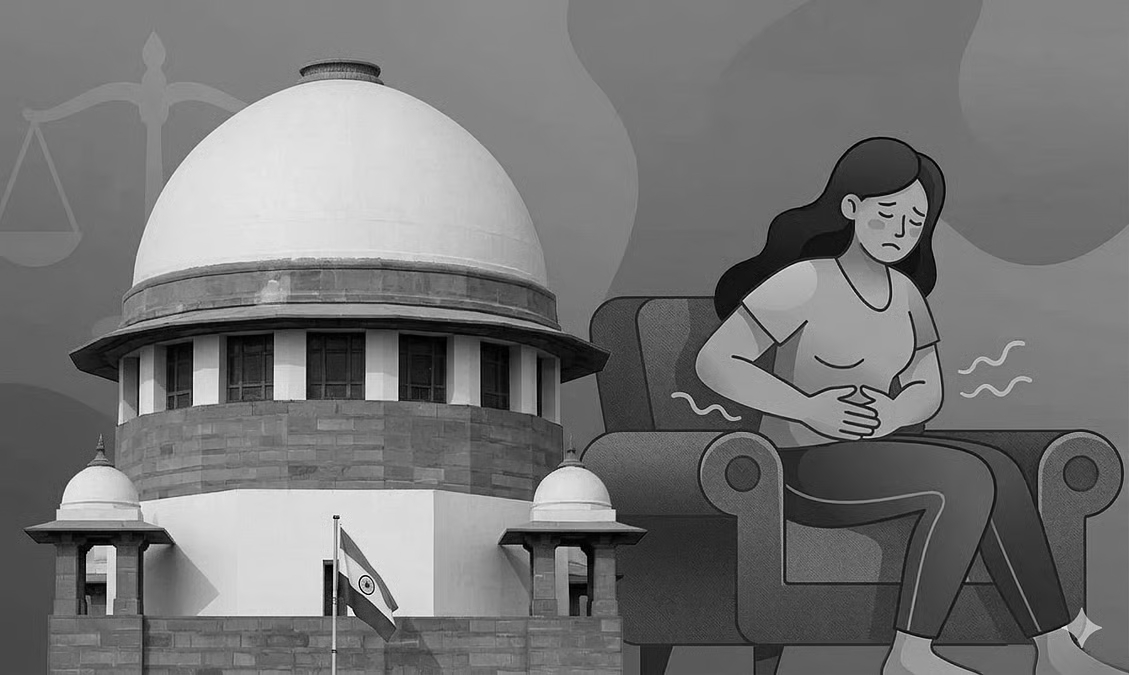
Nobody will hire women: SC rejects menstrual leave plea - debate rages, women wait
The Supreme Court of India on Friday declined to entertain a public interest litigation seeking a uniform national menstrual leave policy, observing that such a mandate could reinforce gender stereotypes and discourage employers from hiring women. The ruling has drawn varied — and at times sharply critical — responses from legal professionals and civil society representatives, and has once again exposed how far India lags behind several other nations on this issue.
Countries such as Japan, South Korea, Indonesia, and Zambia have had menstrual leave provisions enshrined in law for decades. Spain became the first European nation to legislate paid menstrual leave in 2023. Japan has offered "seiri kyuka" — menstrual leave — since 1947. These nations recognised menstruation as a legitimate health matter long before the conversation reached Indian courtrooms. India, by contrast, is still debating whether the issue deserves a policy at all — a dispiriting contrast that reflects both legislative inertia and deep-seated social stigma.
Senior advocate Karuna Nundy proposed one paid day of menstrual leave as a practical starting point. While well-intentioned, critics note that a single day may be wholly inadequate for women suffering from conditions such as endometriosis, reducing a genuine health issue to a token gesture. Activist Yogita Bhayana strongly supported a voluntary option, arguing that severe menstrual pain cripples productivity even when a woman physically reports to work. However, her call to "dictate to corporates," without any concrete enforcement mechanism, risks remaining purely rhetorical. She extended the argument to students — a valid point, yet one that received no substantive elaboration.
Advocate Sunita Sharma sided with the Court, arguing that menstruation is a personal matter and that existing sick leave provisions are sufficient. This position, however, ignores the stigma many women face when disclosing menstrual discomfort under a generic sick leave label — a structural problem that a simple "use sick leave" response fails to address. Her suggestion that such leave could be misused echoes a paternalistic distrust of women's self-reporting that ultimately weakens her argument. Activist Ranjana Kumari called on state governments to legislate or issue executive orders, correctly identifying that labour welfare falls within state jurisdiction. Yet her proposal for penalties against non-compliant institutions, while compelling in principle, offers no detail on implementation, leaving it as aspiration rather than actionable policy.
Law professor Seema Singh raised the most structurally grounded concern: that mandatory provisions without prior societal sensitisation may prompt private employers to quietly reduce their hiring of women. While legitimate, this argument can also serve as an indefinite deferral — if social acceptance must precede law, such protections may never materialise.
The Supreme Court, in declining to intervene, suggested that the competent authority may explore a policy through stakeholder consultation. Though procedurally measured, this effectively passes the responsibility without a timeline or mechanism for accountability, leaving the matter in open-ended deliberation .
In sum, there is broad agreement that a voluntary option is desirable — but the debate reveals a deeper failure. While much of the world has long moved from conversation to legislation, India remains mired in the preliminary question of whether women's menstrual health deserves formal recognition at all. Good intentions, on all sides, have yet to translate into policy.