
Nobel Prize In Physics 2026 Goes To Belgian-American Physicist For Cosmic Neutrino Discovery
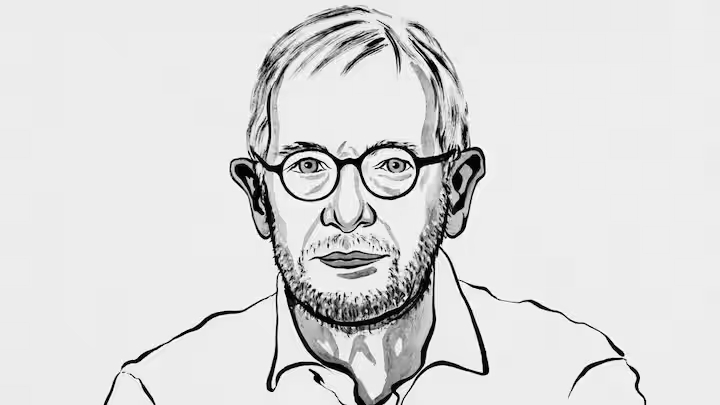
The 2026 Nobel Prize in Physics has been awarded to Francis Halzen for his decisive contributions to the IceCube Neutrino Observatory and the discovery of high-energy neutrinos of astrophysical origin, the Royal Swedish Academy of Sciences announced on Tuesday.
Halzen, a Belgian-American physicist at the University of Wisconsin-Madison, played a central role in turning the vast expanse of Antarctic ice into a giant detector capable of capturing elusive particles known as neutrinos.
Neutrinos are electrically neutral, nearly massless particles that interact extremely weakly with matter. Vast numbers pass through Earth and human bodies without leaving a trace. However, high-energy neutrinos produced by some of the universe's most violent events can carry valuable information about their distant sources.
Halzen first presented his vision for detecting neutrinos at the South Pole in 1988. The resulting IceCube observatory uses about a cubic kilometre of Antarctic ice and 5,160 digital optical modules buried deep below the surface to detect tiny flashes of light produced when neutrinos interact with atomic nuclei.
The observatory made its first detection of high-energy astrophysical neutrinos in 2013, opening a new era of neutrino astronomy and multi-messenger astrophysics. Unlike charged cosmic rays, neutrinos can travel through space without being deflected by magnetic fields, allowing scientists to trace them back more directly to their sources.
IceCube has since helped identify neutrinos associated with powerful cosmic environments. In 2017, it detected a high-energy neutrino linked to a distant active galaxy, while subsequent observations provided evidence of high-energy neutrino emission from another active galaxy and from the Milky Way.
The Nobel recognition therefore marks more than a breakthrough in particle detection. Halzen's work has given scientists a new way to study the universe alongside conventional telescopes, using particles that can carry information from some of its most energetic and mysterious environments.
The Physics Nobel is the second award announced during the 2026 Nobel week, following Monday's Nobel Prize in Physiology or Medicine, which went to Karl Deisseroth, Peter Hegemann and Georg Nagel for discoveries involving light-gated ion channels and optogenetics.