
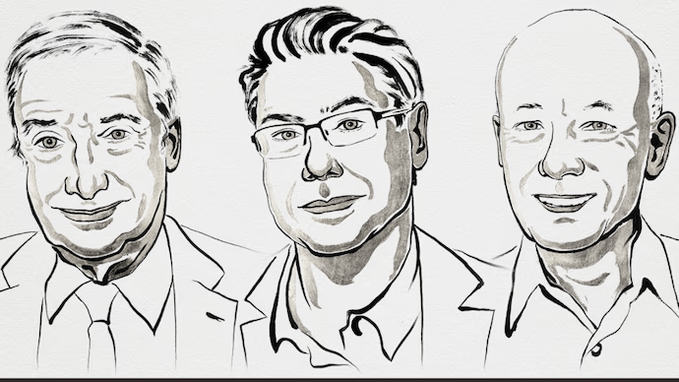
Nobel Prize in Economics 2025 awarded to Joel Mokyr, Philippe Aghion, and Peter Howitt
The 2025 Sveriges Riksbank Prize in Economic Sciences in Memory of Alfred Nobel has been awarded to Joel Mokyr, Philippe Aghion, and Peter Howitt from Netherlands for their groundbreaking work on how innovation drives sustained economic growth. Their research explains how technological advances have transformed economies and societies over the past two centuries.
Nobel Committee's statement on Mokyr
Mokyr used historical sources as one means to uncover the causes of sustained growth becoming the new normal. He demonstrated that if innovations are to succeed one another in a self-generating process, we not only need to know that something works, but we also need to have scientific explanations for why. The latter was often lacking prior to the industrial revolution, which made it difficult to build upon new discoveries and inventions. He also emphasised the importance of society being open to new ideas and allowing change.
About Aghion & Howitt's work
Philippe Aghion and Peter Howitt studied the mechanisms behind sustained growth. In an article from 1992, they constructed a mathematical model for what is called creative destruction - when a new and better product enters the market, the companies selling the older products lose out. The innovation represents something new and is thus creative. However, it is also destructive, as the company whose technology becomes passé is outcompeted.
For most of human history, economic growth was slow and uneven. Societies experienced long periods of stagnation, with minimal improvements in productivity or living standards. Traditional methods dominated, and technological progress occurred only sporadically.
Joel Mokyr received half of the prize for his historical analysis of the relationship between scientific knowledge and technological progress. His work, which took shape in the 1980s and 1990s.Philippe Aghion and Peter Howitt share the other half of the prize for their collaborative work on endogenous growth models.
Once technological innovation became a driving force, economies entered an era of sustained growth. Industrialization, global trade, and improved living standards followed, fundamentally transforming societies. Their research highlights that such growth is not inevitable but results from continuous innovation and adaptive policies.
Their work also introduced methods that are widely applied in today’s economics. Mokyr’s historical analysis, using data and case studies, helps economists understand how past technological advances shape modern productivity, industrial development, and policy. Aghion and Howitt’s endogenous growth modeling and concept of creative destruction are used in modern economic policy, R&D strategies, and corporate innovation planning.
Peter Howitt theoretical framework on innovation and “creative destruction” provides the foundation for understanding how disruptive technologies like AI can drive economic growth.
Their collective contributions provide a deeper understanding of why sustained economic growth is a relatively recent phenomenon and underscore the importance of fostering innovation-friendly environments to ensure continued prosperity.
On Europe’s innovation strategy, Aghion remarked, “Europe should learn from the United States and China to strengthen its technological and innovation capacities.”
The prize totals 11 million Swedish crowns (approximately $1.2 million), with Mokyr receiving half and Aghion and Howitt sharing the other half. This concludes the annual Nobel announcements, which also included awards in medicine, physics, chemistry, literature, and peace.