
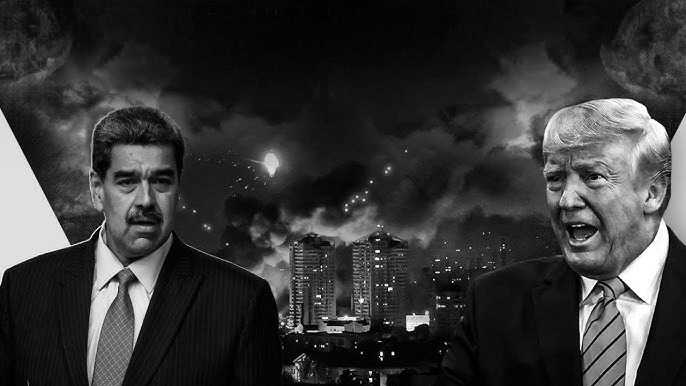
No Pretense, No Justification: US Kidnaps Venezuelan President Maduro
In a dramatic escalation that has shaken Latin America and reverberated across global capitals, the United States carried out direct military strikes on Venezuela in the early hours of January 3 , culminating in the capture and removal of Venezuelan President Nicolás Maduro and his wife Cilia Flores from Venezuelan territory. The operation, publicly acknowledged by U.S. President Donald Trump , marks the most overt American military intervention in the region since the 1989 invasion of Panama.
According to multiple accounts, explosions were heard across Caracas shortly after 2 a.m. local time , with residents reporting low-flying aircraft and targeted strikes near military installations. U.S. officials stated that elite special operations forces , reportedly including Delta Force , were deployed to secure Maduro, who was then flown out of the country. Washington claims the action was linked to long-standing U.S. indictments accusing Maduro of narco-terrorism and drug trafficking , charges Caracas has consistently rejected as politically motivated.
Venezuela’s government denounced the operation as a “kidnapping” and an act of armed aggression , declaring a state of emergency and accusing the United States of violating the country’s sovereignty and the UN Charter. Venezuelan authorities said the action amounted to regime change by force, carried out without international sanction, due process, or multilateral backing.
What distinguishes this episode is not merely the scale of force used, but the absence of diplomatic pretense . There was no United Nations resolution, no coalition mandate, and no attempt to frame the action as collective enforcement of international law. The message was unmistakable: power acts first and explains later . The episode has laid bare a global reality long obscured by rhetoric that the so-called rules-based international order functions selectively, binding weaker states while remaining optional for the strongest.
International reaction has been swift and deeply divided. Brazilian President Luiz Inácio Lula da Silva said the United States had crossed an “unacceptable line,” warning that unilateral military action threatens regional stability. Russia and China condemned the strikes as violations of international law and sovereignty, while Iran and Cuba described them as outright aggression. The European Union urged restraint and respect for the UN Charter, and the United Kingdom was quick to distance itself, clarifying it had no role in the operation.
The action has revived uncomfortable historical parallels. In Panama (1989) , the U.S. invaded to capture Manuel Noriega , who was flown to the United States and tried in an American court. In Iraq (2003) , Saddam Hussein was removed after a war launched without UN approval, later justified on grounds that proved false. In Libya (2011) , a NATO intervention that began as civilian protection ended with the killing of Muammar Gaddafi and the collapse of the state. Each case reinforced a grim lesson: when major powers decide a leader is expendable, sovereignty becomes negotiable.
Yet even against this backdrop, the Maduro operation stands out for its bluntness. Earlier interventions were wrapped in dossiers, speeches, and humanitarian language. This time, there was barely an effort to disguise the act. The transition from hypocrisy to candour is what has alarmed many diplomats. The unspoken rule of the current world order has been stated aloud: money and military power, not law, are the ultimate arbiters .
Against this backdrop, India’s silence has been striking . As of this report, no statement has been issued by Prime Minister Narendra Modi , External Affairs Minister S. Jaishankar , or the Ministry of External Affairs . There has been no expression of concern, no call for restraint, and no invocation of sovereignty or international law . This reticence contrasts sharply with India’s traditional emphasis on non-intervention and strategic autonomy, principles New Delhi has frequently cited in other global conflicts.
India’s quiet posture risks being read as tacit acceptance of unilateral force, particularly at a time when New Delhi seeks a larger role in shaping global governance. Silence, in moments like these, is itself a position one that raises questions about whether commitment to international norms is contingent on the identity of the actor rather than the nature of the act.
As diplomatic activity intensifies at the United Nations and regional bodies, the consequences of this operation remain uncertain. What is clear, however, is that the seizure of a sitting president by a foreign military has redefined the threshold of acceptable conduct in international relations. It has underscored a harsh reality many nations have long understood but rarely confronted so openly: we do not live in an equal world, but a hierarchical one and order is enforced not by law, but by force .