
No LPG, No Waste: The Green Energy Success Story from Gujarat
India today stands at a critical intersection of development and sustainability. As urbanization accelerates and populations grow, the demand for energy continues to rise sharply. At the same time, cities and institutions are struggling with another equally pressing issue mounting organic waste. Traditionally treated as a burden, this waste often ends up in landfills, contributing to pollution, greenhouse gas emissions, and public health risks.
Yet, what if this very waste could become the solution to India’s energy challenges?
In Gandhinagar, Gujarat, an educational institution has quietly demonstrated that this is not just a possibility, but a practical and scalable reality. By converting organic waste into clean fuel, the campus has built a model of self-reliance that blends environmental responsibility with economic efficiency.
Rediscovering a Forgotten Wisdom
Long before sustainability became a global buzzword, Indian communities practiced it as a way of life. Villages functioned as self-sufficient ecosystems where nothing was wasted. Livestock waste, crop residue, and kitchen scraps were all reused either as fuel or as fertilizer.
However, over time, this balance was disrupted. The adoption of LPG and fossil fuels made life more convenient, but it also created dependence on external energy sources. In the process, traditional knowledge systems were sidelined.
Today, with rising fuel prices and environmental degradation becoming impossible to ignore, there is a renewed recognition of these older practices. What is emerging now is not a return to the past, but an evolution where ancient wisdom is enhanced with modern science.
The Gandhinagar Experiment
Located near Adalaj in Gandhinagar district, the Shrimati Manekba Vinay Vihar Educational Complex has become a model for sustainable energy use. Managed by a charitable trust, the institution has taken a bold step: it has completely eliminated the use of conventional LPG for cooking.
Instead, it relies entirely on biogas generated within its own campus.
This is not a small-scale experiment. The institution caters to more than 500 people daily, including hostel students and staff families. Preparing meals at this scale typically requires significant energy resources. Yet, the campus manages it without a single gas cylinder, proving that alternative energy solutions can meet even large institutional demands.
How the System Works
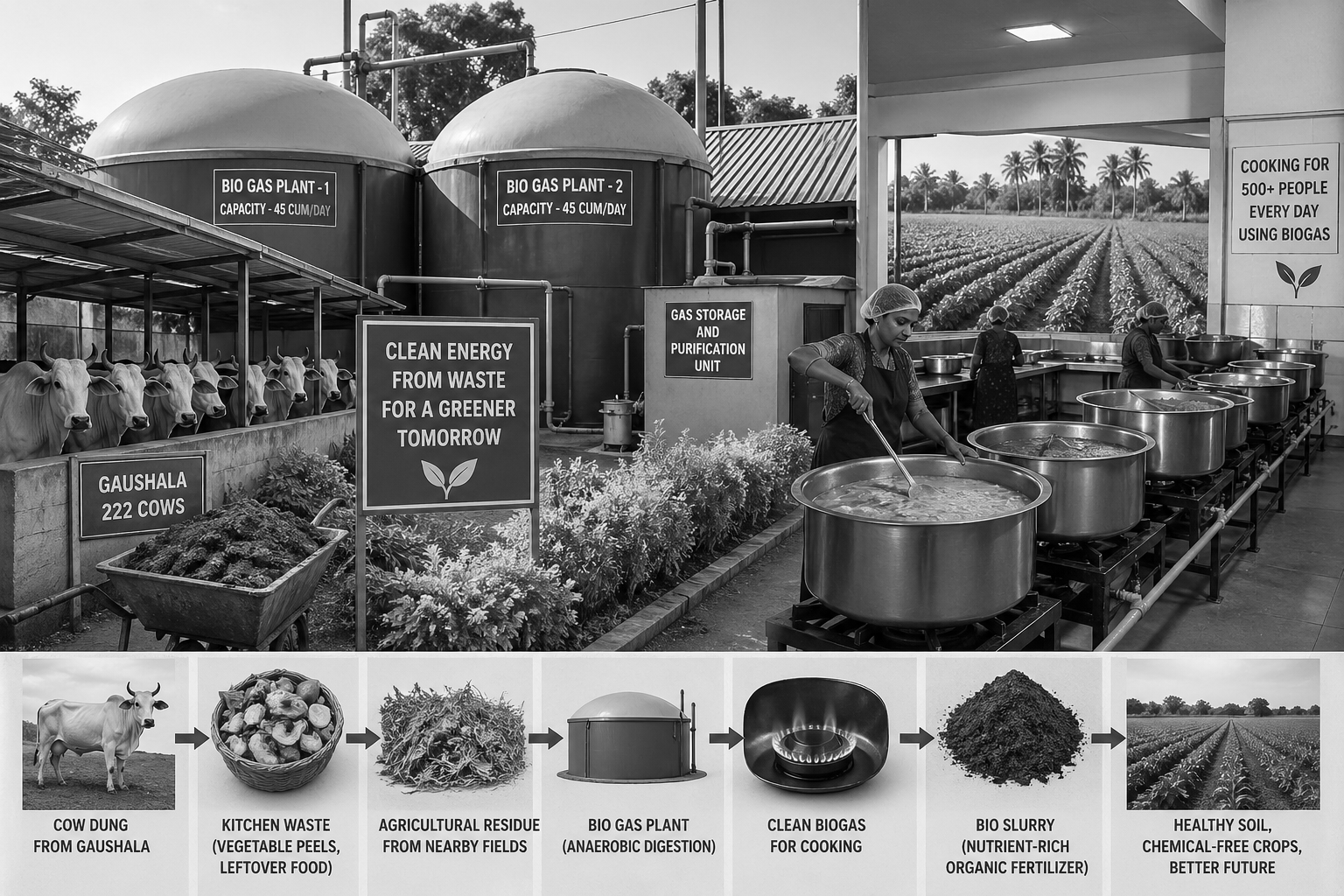
At the heart of this transformation are two biogas plants with a combined capacity of 90 cubic metres per day. These plants operate on the principle of anaerobic digestion—a biological process in which microorganisms break down organic matter in the absence of oxygen, producing methane-rich gas.
The inputs for this system are entirely local and renewable.
A gaushala within the campus houses over 200 cows, providing a steady supply of cow dung, which forms the primary raw material. This is supplemented with kitchen waste such as vegetable peels and leftover food, along with agricultural residue sourced from nearby fields.
All these materials are collected, mixed, and fed into the biogas plants, where they are processed to produce fuel. The generated gas is then piped directly to the kitchen, ensuring a continuous and reliable energy supply.
Economic Benefits That Matter
While the environmental advantages of biogas are well known, what truly makes this model compelling is its financial viability.
Before adopting the biogas system, the institution would have required around 30 LPG cylinders every month. At current market rates, this translates into substantial recurring expenses. By switching to biogas, these costs have been virtually eliminated.
The system requires an initial investment, but once established, it provides fuel at negligible ongoing cost for years. This makes it particularly attractive for schools, hostels, and community institutions operating on tight budgets.
In an era of volatile fuel prices, such predictability offers both stability and long-term savings.
Closing the Loop: A Circular Economy in Practice
The benefits of this system extend beyond energy production. One of its most valuable outputs is the by-product known as slurry a nutrient-rich organic fertilizer.
Instead of being discarded, this slurry is used in the institution’s agricultural fields. It enhances soil fertility, reduces dependence on chemical fertilizers, and improves crop quality.
This creates a closed-loop system where waste is transformed into both energy and agricultural input. It is a practical demonstration of the circular economy concept, where resources are continuously reused rather than discarded.
Health and Environmental Gains
The shift to biogas has also led to significant improvements in health and environmental conditions.
Unlike traditional fuels, biogas burns cleanly, producing minimal smoke. This improves air quality in kitchens and reduces health risks associated with indoor pollution. Utensils remain clean, and the overall cooking environment becomes safer and more efficient.
On a broader scale, the system helps reduce methane emissions that would otherwise arise from decomposing organic waste in landfills. It also prevents soil and water contamination, contributing to a healthier ecosystem.
The food produced using organic fertilizers further enhances the well-being of students and staff, ensuring access to chemical-free, nutritious meals.
Policy Support and Scaling Potential
The success of such initiatives is not happening in isolation. Government support has played a crucial role in encouraging adoption.
In Gujarat, agencies are offering substantial subsidies for setting up institutional biogas plants, particularly for non-profit organizations. These incentives lower the entry barrier and make it easier for schools, colleges, and community centers to transition to sustainable energy systems.
Over the past few years, hundreds of such plants have been established across the state in gaushalas, educational institutions, and ashrams. This growing network highlights the scalability of the model.
At the national level, initiatives focused on converting waste into energy are gaining momentum, reinforcing the idea that waste management and energy production can go hand in hand.
A Model for India’s Future
What makes the Gandhinagar model particularly powerful is its adaptability. It is not limited to one institution or one region. The same approach can be implemented in villages, urban housing societies, schools, and even small towns.
For rural areas, it offers a pathway to energy independence. For cities, it provides a solution to waste management challenges. For institutions, it ensures cost savings and environmental responsibility.
Most importantly, it instills a mindset shift encouraging people to see waste not as a problem, but as a resource.
Turning Possibility into Practice
The story unfolding in Gandhinagar is more than a local success it is a vision of what a sustainable India could look like. It shows that with the right combination of awareness, technology, and intent, it is possible to address multiple challenges simultaneously.
Energy scarcity, waste management, environmental degradation, and rising costs all can be tackled through integrated solutions like biogas systems.
As India moves forward on its development journey, such models will play a crucial role in shaping a cleaner, greener, and more self-reliant future. The lesson is clear: the path to sustainability does not always require new resources sometimes, it begins with rethinking how we use what we already have.