
No law should burden citizens as govt reforms to make life easy: PM Modi to NDA MPs
Prime Minister Narendra Modi on Tuesday emphasised that no law or rule should become a burden on citizens, asserting that his government’s third term is firmly focused on making people’s lives easier through rapid, citizen-centric reforms.
Addressing a meeting of the NDA parliamentary party here, Modi said the country has entered a full-fledged “Reform Express” phase, where reforms are being implemented swiftly and with clear intent. The government’s approach is aimed at removing everyday hurdles so that individuals can realise their full potential, rather than focusing solely on economic or revenue objectives.
Briefing reporters after the meeting, Parliamentary Affairs Minister Kiren Rijiju said the prime minister laid out “very good guidelines” for lawmakers, underlining that the most significant priority of the government’s third term is the “Reform Express.”
“I want to stress that the Narendra Modi government’s ‘Reform Express’ has started to move. It will not stop. This reform is to change the life of every citizen. Reform means improvement in the life of every citizen whether economic, political, administrative or cultural,” Rijiju said.
Quoting the prime minister, he added that no law should contain any provision that harms or inconveniences citizens, and rules should never become a burden on common people. “The rules and laws should be for the convenience of the people and to improve their lives,” Rijiju said, adding that laws must strengthen systems, not harass people without reason.
The government believes that some existing laws burden citizens because they involve cumbersome procedures, redundant rules, repeated data submissions, and bureaucratic delays , which can make compliance stressful. Modi’s message was that all reforms should prioritise ease of life and ease of doing business , ensuring that laws serve the people efficiently.
According to sources, Modi urged MPs to proactively share real problems faced by ordinary citizens so that the “Reform Express” can reach every household and remove day-to-day hardships. He highlighted the need to end long 30–40 page forms and unnecessary paperwork, and to provide services at citizens’ doorsteps.
Recalling the success of self-certification policies, Modi noted that citizens had been trusted to submit information themselves for certain approvals, and the system had functioned effectively for 10 years without misuse. This demonstrated that trust-based governance can reduce bureaucratic hurdles while maintaining accountability.
Rijiju said the reforms will rely on multi-level coordination , with central, state, and local governments, including municipalities and panchayats, working together to implement policies efficiently. Digitalisation and e-governance platforms will also play a major role, allowing citizens to access services more easily and reducing the need for multiple office visits.
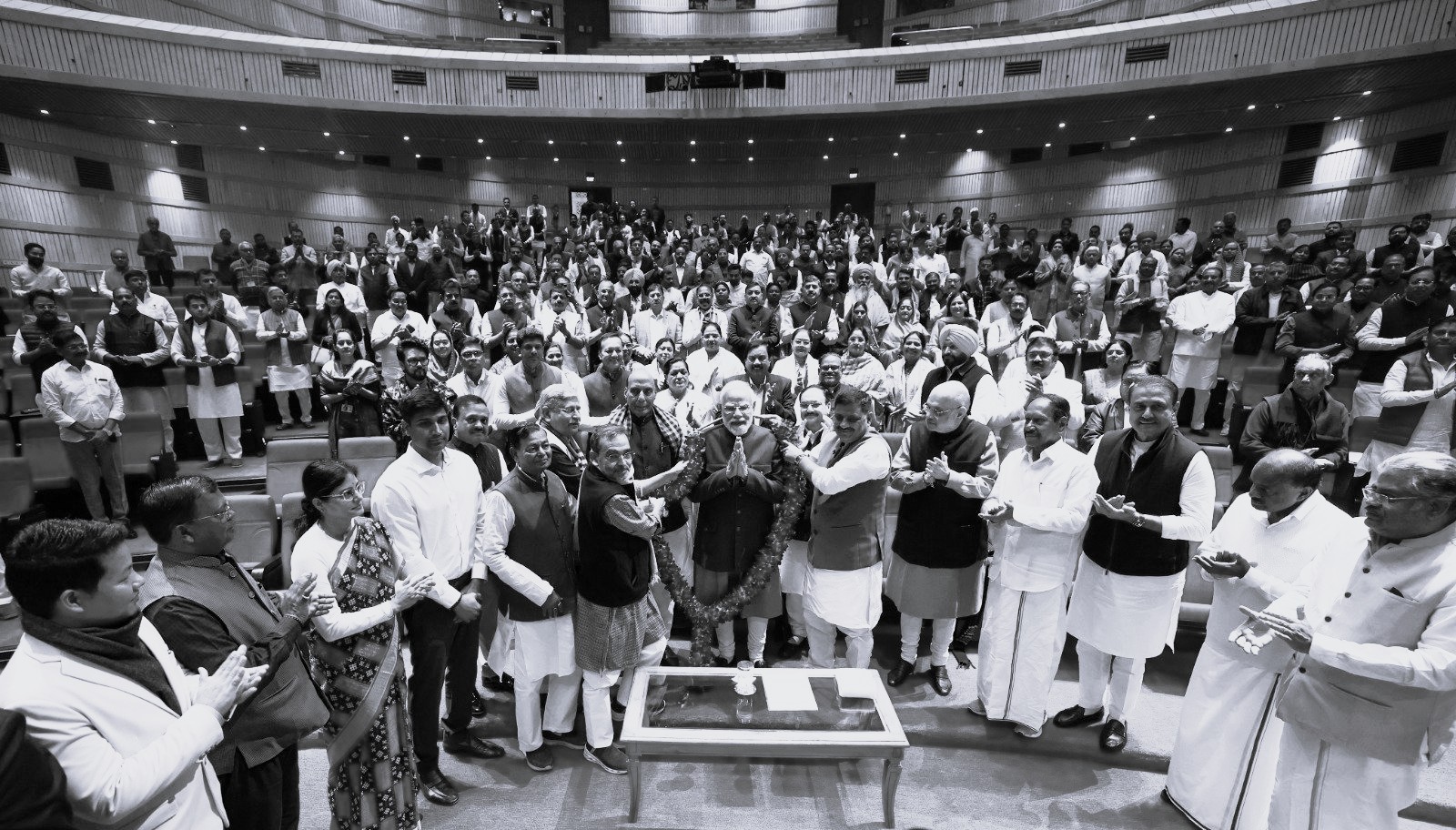
At the meeting, Modi was also felicitated for the NDA’s sweeping victory in the recent Bihar Assembly elections. Union ministers Rajnath Singh, Amit Shah, and BJP president J P Nadda were present. Modi was garlanded by JD(U) leader Sanjay Jha and Rashtriya Lok Morcha chief Upendra Kushwaha, both Rajya Sabha MPs.
In the 243-member Bihar Assembly, the NDA secured 202 seats, paving the way for JD(U) chief Nitish Kumar to return as chief minister for a record 10th term. Among alliance partners, the BJP won 89 seats, JD(U) 85, LJP (Ram Vilas) 19, Hindustani Awam Morcha (Secular) five, and Rashtriya Lok Morcha four.
In summary, PM Modi’s address made it clear that the government intends to transform the way laws and rules are implemented , making governance faster, simpler, and genuinely citizen-focused. The “Reform Express” aims not only to improve policy on paper but to ensure that citizens experience real, tangible benefits in their daily lives.