
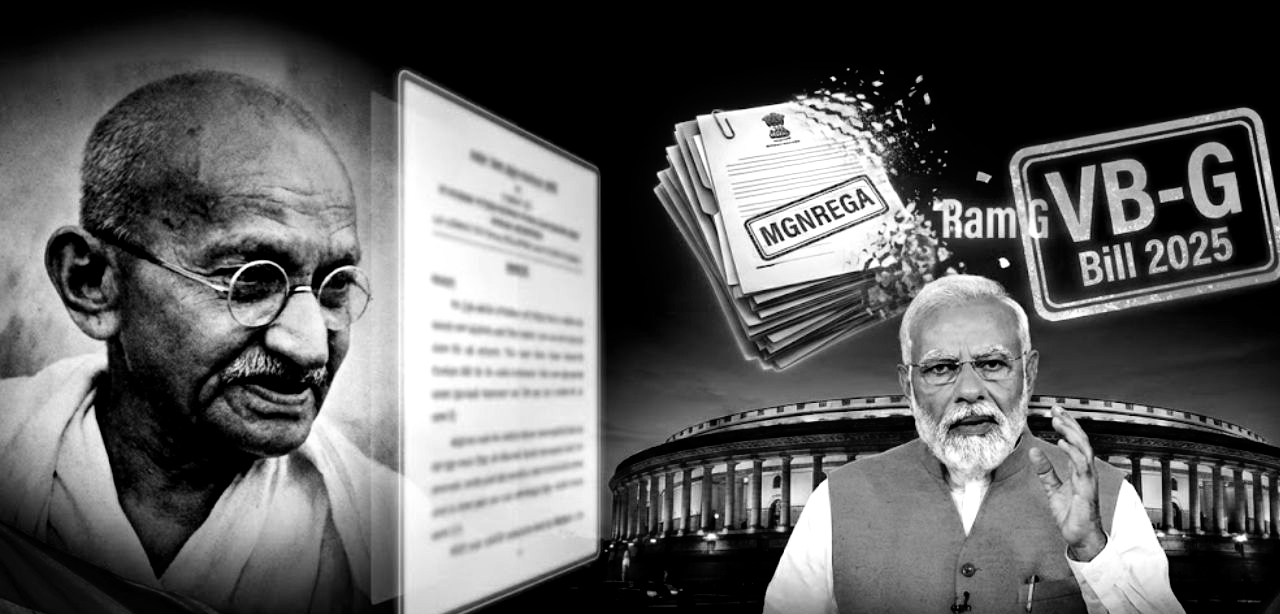
No Gandhi ji, only G RAM G! Parliament passes VB-G RAM G bill replacing MGNREGA amid opposition ruckus
Parliament on Thursday formally replaced the Mahatma Gandhi National Rural Employment Guarantee Act (MGNREGA) with the Viksit Bharat Guarantee for Rozgar and Ajeevika Mission Gramin law (G RAM G) , marking a major shift in India’s flagship rural employment framework even as the move triggered fierce opposition protests and repeated disruptions in the Lok Sabha.
The new legislation, passed amid a ruckus that forced the House to adjourn, promises a statutory guarantee of 125 days of wage employment in a financial year for rural households willing to undertake unskilled manual work. It brings an end to the two decade old MGNREGA , a rights based welfare law widely credited with providing livelihood security to millions of rural families.
Opposition MPs staged a protest march inside the Parliament House complex soon after the Bill was taken up for passage. Holding photographs of Mahatma Gandhi and banners bearing the name of MGNREGA , lawmakers marched from the Gandhi statue at Prerna Sthal to Makar Dwar, accusing the Centre of dismantling a landmark social security law and erasing its legacy.
Congress president Mallikarjun Kharge , AICC general secretary K C Venugopal , senior DMK leaders K Kanimozhi, T R Baalu and A Raja, IUML leader E T Mohammed Basheer, Shiv Sena UBT MP Arvind Sawant and RSP MP N K Premchandran participated in the protest, with senior Congress leader Sonia Gandhi later joining them at Makar Dwar.
Addressing reporters, Venugopal alleged that Parliament was witnessing a “murder of democracy,” arguing that the removal of Mahatma Gandhi ’s name from the rural employment law amounted to an ideological attack on the values associated with the Father of the Nation.
Opposition parties have strongly opposed the new law, contending that it weakens the spirit of the original 2005 MGNREGA by converting a legal entitlement into a renamed administrative framework. They questioned the urgency behind replacing MGNREGA , pointing out that there was no public demand for a new law and no clear enhancement in wages, accountability, or rural livelihoods under the revised scheme.
Trinamool Congress MP Mahua Moitra accused the government of undermining Gandhi’s legacy and said the move contradicted the idea of Ram Rajya in both letter and spirit. Congress MP Jai Prakash termed the removal of Gandhi’s name a grave injustice, warning that the new law could increase financial pressure on states while curtailing the role of gram sabhas in deciding local works.
Defending the legislation, Union Rural Development Minister Shivraj Singh Chouhan said the new law would help realise Mahatma Gandhi’s vision of self reliant villages and ensure all round rural development. BJP MP Brijmohan Agarwal criticised the earlier MGNREGA , alleging it failed to strengthen the rural economy and was plagued by corruption, and argued that the new framework would improve implementation.
Under the G RAM G law, states have been given six months to align their rural employment schemes with the new statutory framework.
Adding to the political sparring, Congress leader Sachin Pilot accused the Centre of renaming MGNREGA to erase the legacy of previous governments and questioned the removal of Mahatma Gandhi’s name from a scheme that continues to provide critical rural employment. Union Minister Chirag Paswan defended the G RAM G law, saying it was designed to strengthen villages and empower the poor, while criticising the opposition for disrupting parliamentary proceedings during its passage.