
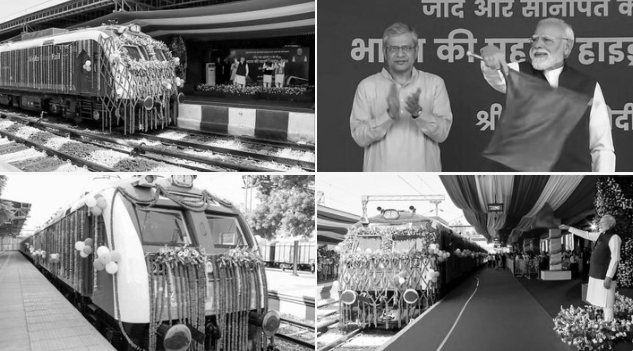
No Diesel, No Smoke: PM Modi Flags Off India's First Hydrogen Train in Haryana
Prime Minister Narendra Modi flagged off India's first hydrogen-powered passenger train on Friday, running between Jind and Sonipat in Haryana, covering 89 km with 12 stops in about two hours. Designed and built entirely in India, the 10-coach train carries around 2,600 passengers on a 1,200-kW fuel-cell system delivering 3,200 HP , which officials call the world's most powerful hydrogen passenger train. Modi also laid the foundation for ₹14,700 crore worth of projects in Haryana and tied the launch to energy security, noting that tensions around the Strait of Hormuz make reducing dependence on imported fuel more urgent.
India's entry comes into a field where a few countries have already tried this technology, with mixed results. Germany got there first, launching the Coradia iLint on a Hamburg-area route in 2022 . However, a larger 27-train order for the Taunus network had to be withdrawn from service in late 2024 due to reliability issues, with diesel trains temporarily brought back while fuel cells and hydrogen tanks were upgraded. Italy's Coradia Stream H , built on similar technology, has been delayed by more than a year and is now expected to begin operations later in 2026 . Japan developed the HYBARI hydrogen-battery hybrid train but has not yet expanded it into a large commercial fleet. France, China and the United States are also testing hydrogen-powered rail projects.
What sets India's hydrogen train apart is its scale. Its 10-coach formation is nearly five times longer than Germany's original two-car hydrogen trains, prompting Railway Minister Ashwini Vaishnaw to describe it as the world's longest hydrogen train . It is also equipped with multi-layer leak, heat, flame and smoke detection systems, supported by a dedicated hydrogen production and refuelling facility at Jind, approved by India's explosives safety regulator.
The launch marks the beginning of a broader vision under Indian Railways' "Hydrogen for Heritage" initiative , which plans to introduce 35 hydrogen-powered trains on hill and heritage routes. The project is estimated to cost around ₹80 crore per train , with an additional ₹70 crore required for route infrastructure. Rather than replacing the country's expanding electric railway network, the hydrogen trains are intended to serve non-electrified routes where overhead electrification is difficult or uneconomical.
The success of the programme will ultimately depend on whether Indian Railways can avoid the reliability issues experienced by Germany's hydrogen fleet while bringing down operating costs as more trains are introduced. The outcome will determine how quickly India's ambitious 35-train hydrogen rollout becomes a reality.