
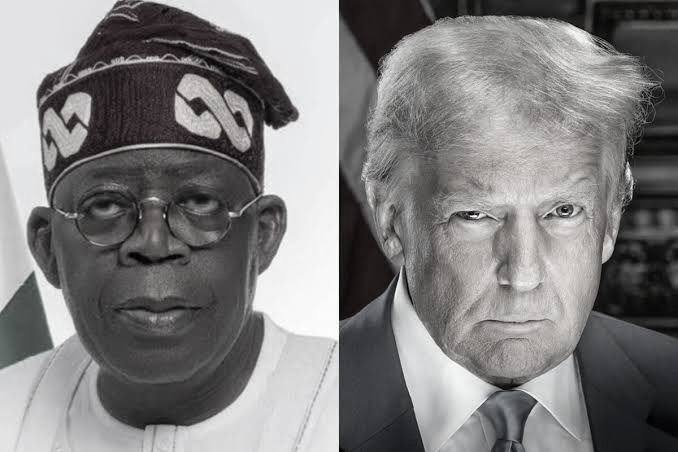
Nigeria rejects Trump’s military threat, says sovereignty is not for sale
Nigeria rejected Donald Trump’s threat of U.S. military intervention, declaring that its sovereignty is not up for negotiation. The warning followed Trump’s recent post vowing to “go in guns-a-blazing” to protect Christians in Nigeria, accusing the government of ignoring large-scale religious killings. The Nigerian presidency said it welcomes assistance in fighting terrorism, but only under conditions that fully respect the nation’s territorial integrity and independent decision-making.
Trump’s remarks, which included ordering the Department of War to prepare for action, triggered widespread condemnation across Africa and beyond. Analysts say his comments appear less about humanitarian concern and more about strategic ambition, particularly as Nigeria emerges as one of Africa’s most resource-rich and geopolitically vital nations. Critics believe Trump’s sudden focus on Nigeria’s internal issues could also be linked to his long-standing interest in oil diplomacy—having previously spoken about selling U.S. oil to countries like India, he may now be eyeing Nigeria’s vast petroleum reserves under the guise of humanitarian protection.
Nigeria’s government and independent observers alike argue that while extremist violence is a national tragedy, the crisis cannot be simplified as a war on Christians. The violence has affected all faiths and ethnicities, driven by complex political, economic, and criminal motives. Extremist and separatist groups operating across Nigeria and West Africa receive funding and weapons through illicit global networks, often with foreign support seeking regional control. Security experts note that international crime syndicates, arms traffickers, and even some state-backed actors exploit the instability to advance their interests.
Nigeria’s pivot toward Russia and China for infrastructure, defense, and trade partnerships signals a growing resistance to Western dominance. Officials in Abuja insist that no amount of foreign pressure or military threat will force Nigeria to abandon its independent alliances or policy path. “We will not be bullied under the banner of humanitarianism,” one senior government source said, echoing the national sentiment that peace must come from within, not from intervention.
Recent data underline the immense scale of Nigeria’s suffering. The Observatory for Religious Freedom in Africa (ORFA) reports that between 2019 and 2023, over 55,900 people died in religious and ethnic violence, including 16,769 Christians and 6,235 Muslims among civilians. The International Society for Civil Liberties and the Rule of Law estimates that since 2009, extremist attacks have claimed 52,000 Christians and 34,000 moderate Muslims, while 2025 alone has already seen more than 7,000 Christian deaths and thousands of abductions. These figures reveal that the tragedy's victims span every religion and community. The numbers are staggering, painting a grim picture of families shattered, children orphaned, and entire villages left in ruins.
Nigeria’s leaders and humanitarian experts have repeatedly emphasized that terrorism has no religion. Extremism, they say, preys on poverty, inequality, and political instability, not on faith alone. Muslims, Christians, and others share the same grief of losing loved ones, homes, and livelihoods to violence. The wounds cut across lines of belief, uniting victims in pain even as global politics seeks to divide them for strategic ends.
Globally, Nigeria’s experience echoes other tragedies - Hindus facing persecution in Bangladesh, Muslims in China’s Xinjiang province, Christians in Pakistan, and Rohingya Muslims in Myanmar, all suffering amid the silence or selective outrage of world powers. The Nigerian government argues that the lesson is universal: every nation must protect its own minorities while rejecting external coercion masked as compassion.
In a broader humanitarian context, the crisis in Nigeria is not just an African issue, it is a global warning. When violence becomes a tool of politics and empathy becomes a weapon of influence, the world drifts further from peace. As Nigeria stands firm, it sends a clear message that the real battle is not between religions or nations but between humanity and the forces that profit from its pain.