
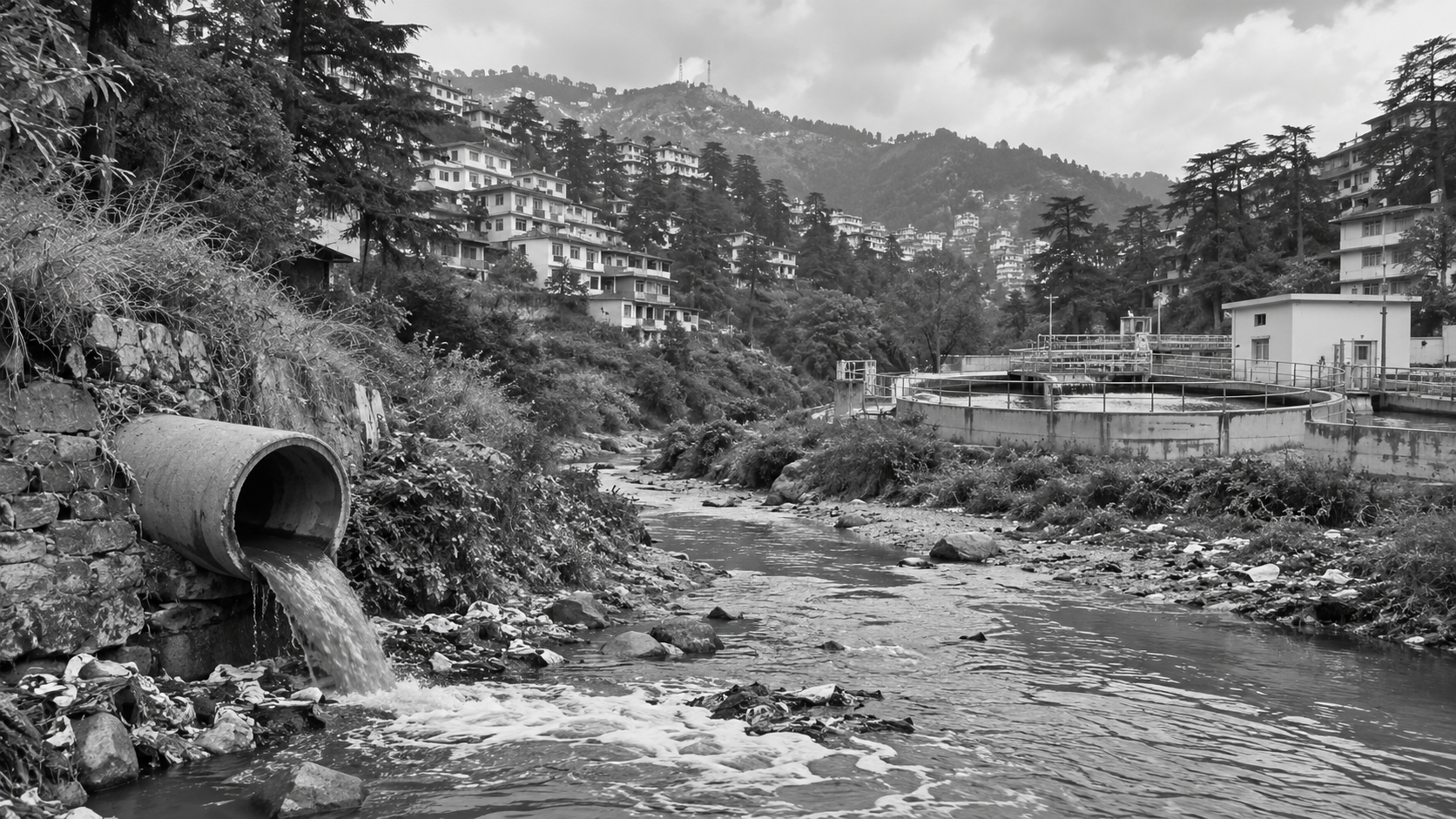
NGT Flags High Pollution in Shimla's Ashwani Khad, Seeks Action
The National Green Tribunal (NGT) has flagged elevated levels of organic pollution at two locations in the Ashwani Khad catchment near Shimla, with biochemical oxygen demand (BOD) reaching 22.4 mg/L at Lift Nullah in Combermere, more than seven times the prescribed limit of 3 mg/L. The tribunal has directed the Himachal Pradesh State Pollution Control Board (HPSPCB) to intensify its investigation into wastewater discharge sources, verify sewage treatment facilities and take action wherever unauthorised discharges or violations are established. The directions were issued by a bench headed by NGT chairperson Justice Prakash Shrivastava and expert member Afroz Ahmad while hearing the matter on November 25.
The HPSPCB's assessment, submitted on November 16, covered 25 monitoring locations. Lift Nullah near a waste-processing site recorded BOD of 16 mg/L, while Combermere registered 22.4 mg/L, approximately 5.3 and 7.5 times the permitted limit, respectively. However, 23 locations recorded BOD within the prescribed limit. Dissolved oxygen ranged from 5.8 to 8.0 mg/L, while pH values remained between 6.98 and 8.22. Faecal coliform levels reached 920 MPN/100 ml in Lift Nullah before joining Ashwani Khad and 540 MPN/100 ml downstream. Although these readings were within applicable limits, the board recommended further investigation.
Samples from sewage treatment plants at Dhalli, Lalpani and Malyana showed satisfactory results for pH, BOD, chemical oxygen demand, total suspended solids and faecal coliform. However, total nitrogen levels at most facilities failed to meet NGT norms. A wastewater sample from the Krishna Nagar municipal slaughterhouse also recorded a pH of 9.80, exceeding the prescribed range of 5.5 to 9.
The pollution board identified 13 facilities and establishments for further verification, including automobile workshops, APG University, AIIMS Chamiyana and the Krishna Nagar slaughterhouse. However, the exact sources responsible for the elevated pollution remain unconfirmed. The tribunal directed continued inspections and action against unauthorised wastewater discharges.
Infrastructure delays have added to concerns, with the 3.1 MLD sewage treatment plant at Dogra Bridge, Panthaghatti, only 10 per cent complete. SJPNL has set March 2027 as its completion deadline. The Department of Jal Shakti and Shimla Jal Prabandhan Nigam Limited (SJPNL) have been given two weeks to submit progress reports and responses.
The case originated in 2023 after the NGT took cognisance of a report highlighting Ashwani Khad pollution. The stream was historically an important drinking-water source, supplying 10.8 MLD, or around 20 per cent of Shimla's water requirement. Water extraction was stopped following the 2015–16 hepatitis-related jaundice outbreak, which was linked to sewage contamination. The National Institute of Disaster Management documented 1,620 cases and nine deaths. Subsequent reforms included the establishment of SJPNL to manage water supply and sewerage services.
Earlier NGT proceedings highlighted untreated sewage, industrial effluents and agricultural runoff as potential pollution sources. Previous CPCB assessments also identified operational shortcomings at Shimla's sewage treatment plants. Although the state subsequently reported upgrades and renewed operating consents valid until March 31, 2029, the latest nitrogen findings indicate continuing compliance challenges. The NGT has scheduled the next hearing for March 5, 2027, when progress on pollution-source identification and sewage infrastructure will come under scrutiny.