
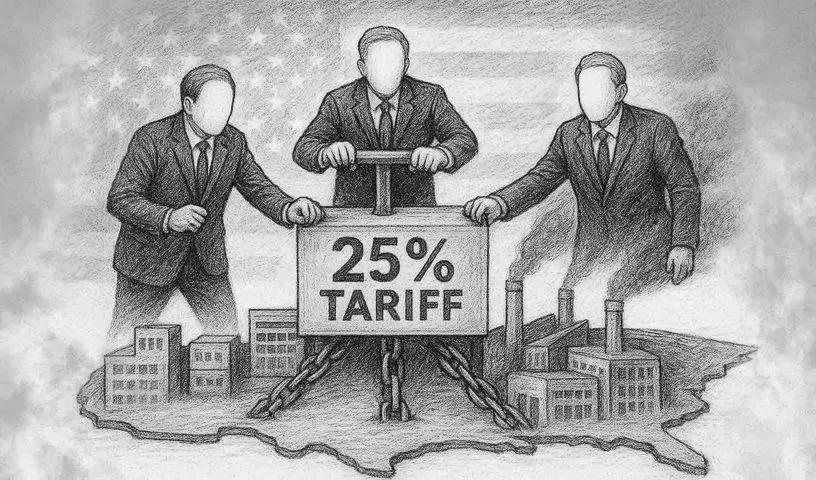
New US tax proposal could shake Indian IT
India’s information technology (IT) sector is facing uncertainty after the introduction of a new bill in the United States that seeks to impose a 25 per cent tax on companies outsourcing jobs abroad. The legislation, called the Halting International Relocation of Employment (HIRE) Act, was introduced by Republican Senator Bernie Moreno and is aimed at discouraging American corporations from shifting work outside the country.
The bill proposes two major measures: a 25 per cent surcharge on U.S. firms that outsource jobs and a ban on tax deductions for such outsourcing expenses. The revenue collected would be redirected into a Domestic Workforce Fund to support employment generation within the U.S. The measure, if passed, could raise the cost of outsourcing significantly and create ripple effects across India’s export-driven IT services industry.
India’s IT sector, valued at approximately USD 238 billion, derives nearly 60 per cent of its revenue from the U.S. market. Leading companies such as Tata Consultancy Services (TCS), Infosys, Wipro, and HCLTech, as well as numerous mid-sized firms and start-ups, could feel the impact if the bill becomes law. In addition, business process outsourcing (BPO) firms, freelancers, and global capability centres serving industries like finance, retail, healthcare, and technology would also be affected.
Industry experts point out that the U.S. is India’s largest IT market, and any additional taxation or restrictions on outsourcing could erode competitiveness, forcing Indian firms to rethink their cost structures and delivery models. While the proposed legislation reflects rising protectionist sentiment in Washington, it still has to clear several legislative hurdles. To become law, it must be passed by both the House of Representatives and the Senate, and subsequently receive approval from the U.S. President.
The bill has generated debate in the U.S. as well. While some argue it will strengthen domestic employment opportunities, others caution that it could hurt American companies that rely on outsourcing to remain competitive globally. Observers note that U.S. corporations have long benefited from India’s large pool of skilled IT professionals, cost efficiencies, and round-the-clock delivery models.
For India, the immediate concern lies in mitigating potential risks. Companies are expected to intensify efforts to diversify markets beyond the U.S., focusing more on Europe, Asia-Pacific, and emerging regions. Analysts also underline the importance of strengthening domestic demand and expanding service offerings in areas such as artificial intelligence, cybersecurity, and digital transformation to cushion any adverse impact.
Even if the bill does not progress in its current form, its introduction signals a shift in U.S. policy towards outsourcing. The possibility of stricter rules in the future cannot be ruled out, adding uncertainty for India’s IT export sector.
With the Indian IT industry employing millions directly and indirectly, and contributing significantly to foreign exchange earnings, the stakes remain high. As discussions unfold in the U.S. Congress, Indian IT companies will closely watch developments, while also preparing for potential long-term changes in global outsourcing dynamics.