
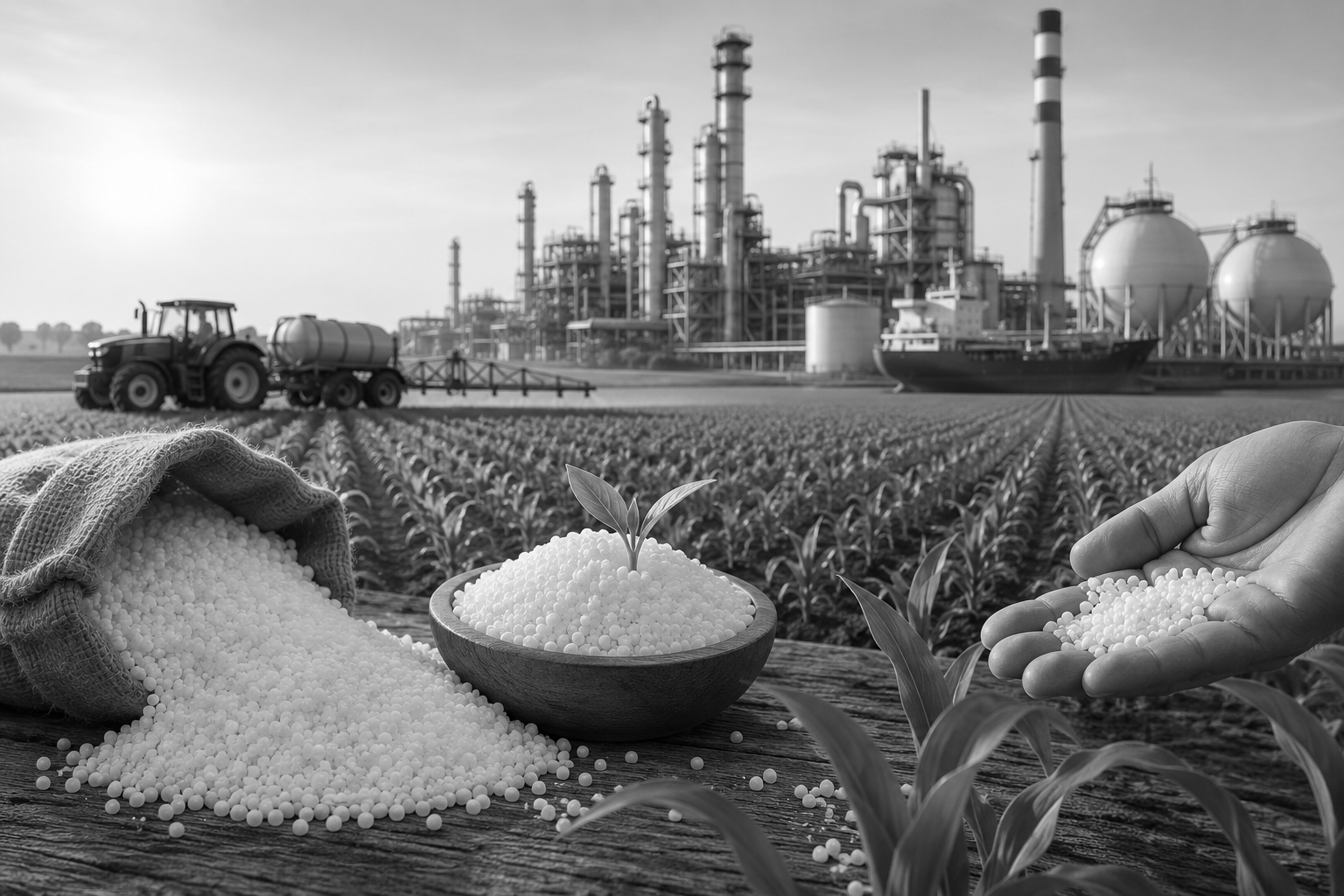
New Urea Policy Targets Imports, Investment and Food Security
India's fertilizer sector is entering a new phase with the Union Cabinet approving the National Investment Policy for Urea-2026 for Atmanirbhar Bharat (NIPU-2026) . Cleared by the Cabinet Committee on Economic Affairs (CCEA) under the chairmanship of Prime Minister Narendra Modi , the policy is designed to attract fresh investments in domestic urea manufacturing and strengthen India's long-term fertilizer security. While the announcement may appear to be another industrial policy, it has far-reaching implications for food security, fiscal sustainability, import dependence and the country's agricultural future.
The new framework replaces the New Investment Policy (NIP)-2012 , which expired in October 2019 . Although the earlier policy facilitated the establishment of six new urea plants including four joint ventures promoted by public sector undertakings and two private sector units India continues to rely heavily on imports to bridge the gap between domestic production and consumption.
Why India Still Needs More Urea Production
Today, India operates 33 urea manufacturing plants with a combined installed capacity of 269.42 lakh metric tonnes (LMT) . However, annual urea consumption is estimated at around 40 million tonnes , while domestic production stands at nearly 30 million tonnes , leaving a shortfall of about 10 million tonnes that has to be met through imports. This dependence exposes the country to international price volatility, geopolitical disruptions, shipping constraints and exchange-rate fluctuations.
The country's urea is produced primarily using natural gas , sourced from domestic fields in the Krishna-Godavari Basin, Mumbai Offshore, Assam, Rajasthan and Tripura . Since domestic gas production is insufficient to meet the industry's requirements, India also imports Liquefied Natural Gas (LNG) from countries such as Qatar, the United States, Australia and the UAE . Expanding efficient gas-based manufacturing is expected to improve fertilizer security while reducing long-term dependence on imported urea.
Against this backdrop, NIPU-2026 seeks to make investment in the urea sector more attractive by introducing structural reforms rather than direct financial assistance.
What Changes Under NIPU-2026?
The policy introduces several significant modifications over NIP-2012 . One of the biggest changes is the separation of fixed and variable costs , making project evaluation and subsidy calculations more transparent. It also introduces a Return on Equity (RoE) band of 12% to 16% , providing investors with predictable returns while preventing excessive profits.
Another major reform is the mitigation of foreign exchange risk by converting fixed costs into Indian Rupees after four years based on prevailing exchange rates. According to the government, these measures are expected to generate savings of over ₹250 crore for every new plant established under the new policy compared with projects approved under NIP-2012.
The Department of Fertilizers has already received several proposals for setting up new manufacturing facilities. Although the government has not officially announced locations or timelines, industry estimates suggest the policy could facilitate the establishment of eight to nine new gas-based urea plants over the coming years.
What the Policy Does Not Change
Unlike many flagship government schemes, NIPU-2026 is not a subsidy programme . It does not change the Maximum Retail Price (MRP) of urea, alter fertilizer subsidies or modify the existing state-wise allocation mechanism.
Farmers will continue to purchase urea at the government-notified subsidized price, while the existing Direct Benefit Transfer (DBT) system, monthly allocation process and distribution network through cooperatives and private retailers will remain unchanged. In essence, the policy focuses exclusively on encouraging investment in domestic manufacturing capacity rather than reforming fertilizer subsidies or farmer benefits.
Budget Trends Reflect a Changing Fertilizer Landscape
The timing of the policy is also significant in light of India's fertilizer subsidy bill. The subsidy burden surged dramatically after the Russia-Ukraine conflict , which disrupted global natural gas and fertilizer markets. The fertilizer subsidy increased from a Budget Estimate (BE) of ₹1.05 lakh crore in 2022-23 to a Revised Estimate (RE) of ₹2.25 lakh crore , making it one of the highest subsidy outlays in recent years. As global fertilizer and energy prices gradually eased, the allocation moderated to ₹1.75 lakh crore in 2023-24 and further to ₹1.64 lakh crore in 2024-25 . The government maintained a broadly similar level of support by allocating around ₹1.67 lakh crore in 2025-26 , while the Union Budget 2026-27 has earmarked ₹1.71 lakh crore for the Department of Fertilizers , including nearly ₹91,000 crore towards indigenous urea subsidy.
Despite approving NIPU-2026 , the government has not announced any separate budget allocation or capital grant for the policy. Likewise, there are no plans to establish new fertilizer research centres or chemical laboratories under the framework. Instead, the policy seeks to encourage investments from public sector enterprises, joint ventures and private companies by offering a transparent and financially viable investment mechanism rather than direct government funding.
If India Has Enough Urea, Why Do Shortages Continue?
One of the biggest questions surrounding India's fertilizer sector is why shortages continue despite seemingly comfortable national stocks.
Government data for 2024-25 shows that the country's estimated urea requirement stood at 364.01 LMT , while total availability reached 443.83 LMT . Actual sales to farmers through the DBT system amounted to 387.92 LMT , indicating that India maintained adequate supplies at the national level.
State-wise figures present a similar picture. Uttar Pradesh , the country's largest consumer, recorded 79.18 LMT of urea sales against an availability of 91.72 LMT . Madhya Pradesh utilized 38.09 LMT , Punjab consumed 32.56 LMT , while Maharashtra (26.41 LMT) , Rajasthan (26.40 LMT) , Bihar (25.60 LMT) , Telangana (20.08 LMT) and Andhra Pradesh (15.70 LMT) also recorded substantial consumption. In most major agricultural states, annual availability exceeded projected demand.
The Real Challenge Is Distribution, Not Production
Despite these seemingly comfortable figures, farmers in states such as Andhra Pradesh, Telangana and Punjab continue to witness periodic shortages and long queues outside fertilizer outlets during the Kharif and Rabi seasons.
The contradiction lies in the difference between annual availability and timely accessibility . Urea demand peaks within a narrow crop application window, particularly for paddy, cotton and maize. Delays in railway movement, transportation, district-level distribution, localized stock imbalances, panic buying and temporary hoarding can create shortages even when sufficient fertilizer is available nationally.
The Centre prepares monthly state-wise allocations based on projected demand, production and imports, while state governments are responsible for district-level distribution through cooperatives, Primary Agricultural Cooperative Societies (PACS), licensed dealers and retailers. Agriculture departments in Andhra Pradesh and Telangana have repeatedly appealed to farmers against unnecessary stockpiling, while the Centre has maintained that it ensures adequate allocations and that intra-state distribution remains the responsibility of the respective state governments.
The Road Ahead
Another long-term challenge is the imbalanced use of fertilizers . Because urea is heavily subsidized, it is considerably cheaper than phosphatic and potassic fertilizers, encouraging excessive application in many regions. This has contributed to nutrient imbalance, declining soil health and inefficient fertilizer use. Alongside expanding domestic production, the government continues to promote Neem-Coated Urea and Nano Urea to improve nutrient-use efficiency and reduce excessive consumption.
Ultimately, NIPU-2026 is not intended to solve temporary shortages at fertilizer retail outlets. Rather, it is a long-term industrial policy aimed at making India more self-reliant in urea production, reducing dependence on imports, creating a predictable investment environment for manufacturers and lowering future subsidy costs. If implemented effectively, the policy could strengthen India's fertilizer security, support agricultural productivity and reinforce the broader vision of Atmanirbhar Bharat , ensuring that one of the country's most critical agricultural inputs remains both affordable and sustainably available in the years ahead.