
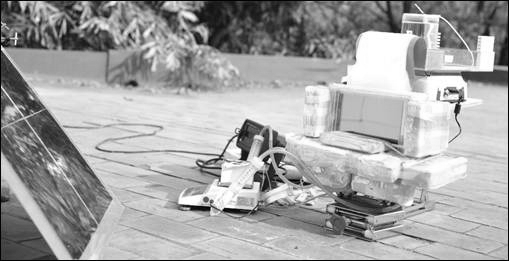
New siphon-powered device turns saltwater into drinking water efficiently
A research team from the Indian Institute of Science (IISc) has developed a siphon-based thermal desalination system capable of converting salty seawater into potable water more efficiently, reliably, and cost-effectively than existing methods. The breakthrough system addresses longstanding challenges of traditional solar stills, including salt buildup and limited scalability due to the low lifting height of wicking materials.
At the core of the system is a composite siphon, consisting of a fabric wick and a grooved metallic surface. The fabric draws saline water from a reservoir, while gravity ensures continuous flow, preventing salt crystallization by flushing it away before accumulation occurs. Water spreads as a thin film across the heated metal surface, evaporates, and then condenses onto a cooler surface located just two millimetres away, significantly enhancing efficiency.
By stacking multiple evaporator–condenser pairs, the system recycles heat repeatedly, enabling a production rate of over six litres of clean water per square metre per hour under sunlight, several times higher than conventional solar stills. The unit can also handle highly saline water, with salt concentrations up to 20 percent, marking a major advance in brine treatment.
The technology is low-cost, scalable, and sustainable, constructed from simple materials such as aluminium and fabric. It can operate using solar energy or waste heat, making it suitable for off-grid communities, disaster-affected areas, arid coastal regions, and remote islands. The system’s ease of maintenance and salt-resistant design make it practical for deployment in rural villages and water-stressed regions.
The research was led by Dr. Susmita Dash, Assistant Professor in the Department of Mechanical Engineering at IISc, in collaboration with her PhD student Nabajit Deka. Their work, published in the journal Desalination and supported by India’s Department of Science and Technology (DST), demonstrates the potential for siphon-powered desalination to provide sustainable freshwater solutions. The innovation draws inspiration from the need to overcome limitations of traditional solar stills by leveraging the principle of siphonage, where liquid flows under gravity, enabling continuous water movement and heat-efficient evaporation.
This development aligns with India’s national water goals, including the Jal Jeevan Mission, by providing access to safe drinking water in rural and remote areas using renewable energy. Globally, it contributes to Sustainable Development Goal 6, promoting access to clean water and sanitation while offering climate-resilient, low-cost desalination solutions suitable for regions facing freshwater scarcity.
The IISc siphon-powered desalination system presents a scalable, energy-efficient, and salt-resistant solution that could transform seawater into a dependable source of drinking water for millions in India and other water-stressed regions worldwide.