
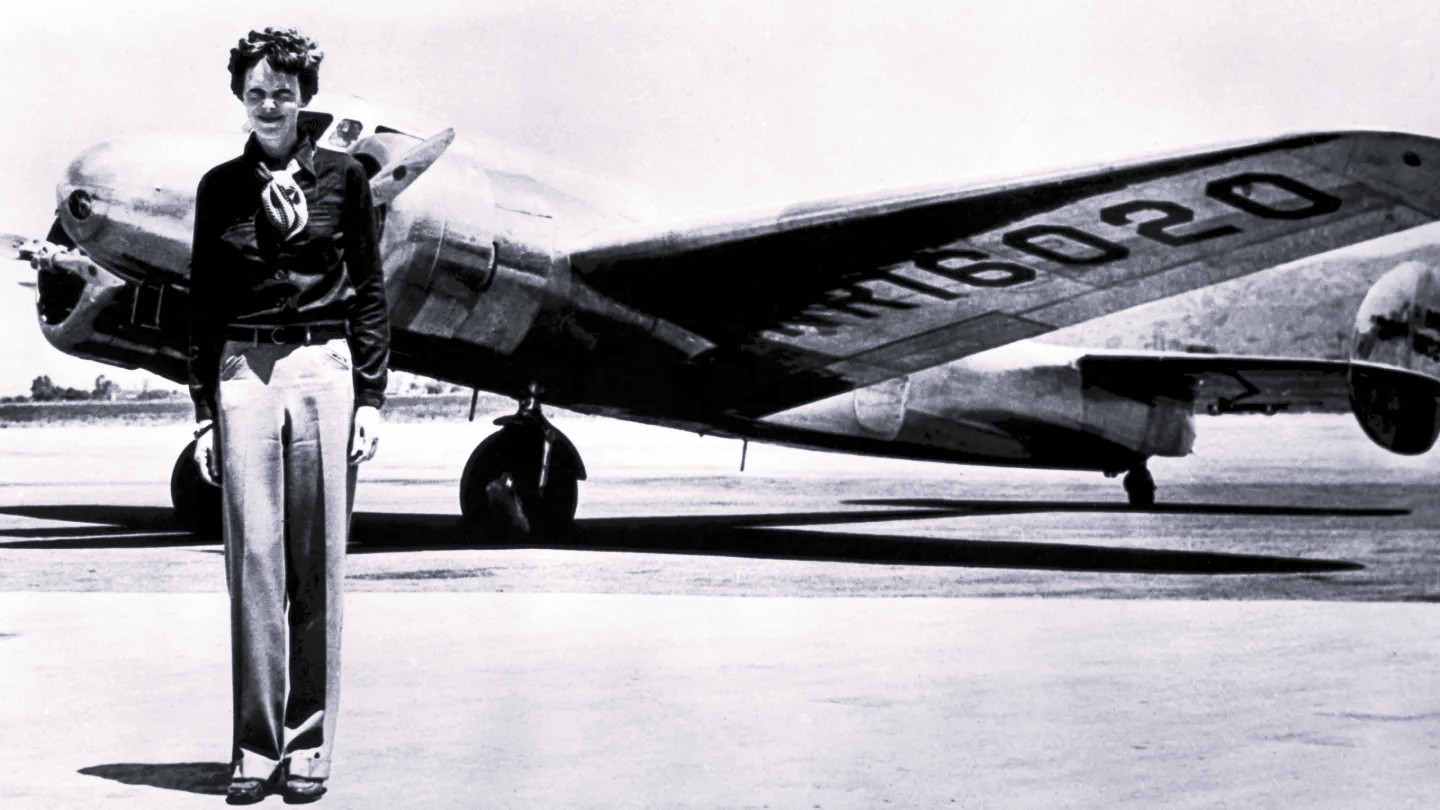
New expedition rekindles hope of solving Amelia Earhart’s 1937 Disappearance
Amelia Earhart’s disappearance is not just a historical event it is a legend that continues to intrigue and inspire nearly ninety years later. She was more than just a pioneering aviator she was a symbol of boldness, curiosity, and the spirit of adventure. As new expeditions and technological advances reignite hope of solving her mystery, Earhart’s story persists at the intriguing intersection of history, myth, and ongoing search.
Born on July 24, 1897, in Atchison, Kansas, Amelia Earhart’s childhood was filled with curiosity and adventure. Despite frequent family moves and financial hardships, she forged a reputation for independent thinking and determination. After serving as a nurse’s aide in wartime Toronto, her first airplane ride in 1920 changed her life forever, setting her on course for a trailblazing career in aviation. By 1922, she had set a women’s altitude record, and soon after, became only the sixteenth woman in the United States to earn a pilot’s license.
Her achievements quickly caught the world’s attention. In 1928, Earhart became the first female passenger to cross the Atlantic by plane, and in 1932, she made history as the first woman to fly solo nonstop across the Atlantic, a feat that brought her global recognition. She set multiple solo records across North America, and as an advocate for women in aviation, helped found The Ninety-Nines, a support network for female pilots. Her involvement as an advisor at Purdue University highlighted her dedication to advancing aeronautical science and empowering women.
It was in 1937, at the height of her career, that Earhart embarked on her final challenge, an attempt to circumnavigate the globe with her navigator Fred Noonan. On July 2, 1937, having nearly completed the journey, Earhart’s Lockheed Electra vanished en route to Howland Island. The disappearance sparked a massive search operation, but the official U.S. government report ultimately concluded that their plane likely ran out of fuel and crashed into the Pacific.
Yet, Earhart’s legacy did not end in the vastness of the ocean. Instead, her story became a touchstone for dreamers, explorers, and researchers. Every few years, headlines proclaim the possible discovery of her aircraft’s remains. Recently, a new wave of hope came as a joint Purdue University and Archaeological Legacy Institute (ALI) team identified a mysterious underwater feature the “Taraia Object” near Nikumaroro Island. Using satellite analysis and advanced underwater search technology, they planned a high-profile expedition to uncover whether this anomaly might indeed be Earhart’s lost Electra.
The excitement, however, was tempered by the realities of funding, technology, and international cooperation. The expedition’s launch has been postponed until April 2026, owing to the cyclone-prone climate and strict permit requirements from the Kiribati government. Still, the delay offers researchers time to refine their approach, integrating underwater drones, magnetometers, and sophisticated sonar mapping for a search that is as much about engineering as it is about history.
Debate continues around what truly happened in 1937. Ric Gillespie and TIGHAR have led repeated expeditions to Nikumaroro, convinced Earhart crash-landed and survived for a time as a castaway. Other organizations have explored regions near Howland Island or pursued outlandish theories, from espionage to clandestine returns to the United States. Time and again, apparent breakthroughs like promising sonar images or dubious artifacts fail to provide definitive proof. Each disappointment only seems to deepen the world’s fascination and commitment to the search.
The persistent search for Earhart’s aircraft is now as much about cultural memory as historical discovery. Sky-high budgets and public fundraising raise ethical questions about the motives and transparency of such explorations. Yet, the world’s obsession with solving a puzzle that bridges generations and technologies speaks to Earhart’s profound influence.
Amelia Earhart was more than her final flight. She was a record-breaking pilot, a best-selling author, and a feminist hero who vanished when her legend was at its brightest. The continuing mystery of her fate commands attention not only from aviation archaeologists but from anyone drawn to the edge of the unknown. Each new expedition brings a renewed sense of hope, a reminder that the pursuit of adventure, curiosity, and courage never truly ends.
Her story endures, not because of what the world may yet find, but because of how humanity chooses to keep her memory alive: as a daredevil among the clouds, an icon for those who challenge limits, and a symbol that the skies still hold secrets worth chasing.