
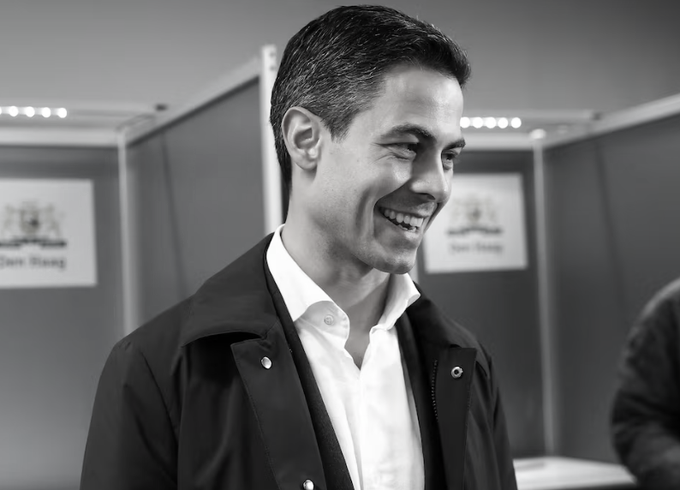
Netherlands poised to elect its first young and openly gay prime minister, Rob Jetten
Rob Jetten’s centrist D66 party made major gains in the Netherlands’ general election, finishing neck-and-neck with Geert Wilders’ far-right Freedom Party (PVV), whose support declined sharply compared to last year’s record performance. With over 90 per cent of the votes counted, both D66 and PVV secured 26 seats each in the 150-member lower house, signalling a sharp fall for Wilders and a clear voter shift toward moderation and stability. Exit polls had initially suggested a narrow D66 victory, later adjusted to a virtual tie, yet the mood across the Netherlands was one of relief and optimism as the populist wave that once dominated Dutch politics appeared to recede.
Jetten’s Rise Marks a New Generation of Dutch Leadership
Addressing jubilant supporters waving Dutch flags at party headquarters in The Hague, Jetten, 38, who could become the Netherlands’ youngest and first openly gay prime minister, declared victory with conviction and humility. “We’ve shown not only to the Netherlands but to the world that it is possible to defeat populist and extremist politics through hope, progress, and decency,” he said, adding, “This victory isn’t just about one party; it’s about restoring trust, protecting freedom, and proving that courage and compassion can win over fear.”
Wilders, meanwhile, admitted disappointment over the loss of seats but vowed to continue his political fight from the opposition, stating, “Of course, we would have liked to win more seats, but it’s not as if we were wiped off the map.” Jetten’s rise reflects a generational shift in Dutch politics. Born in 1987 in Uden, he joined D66 as a teenager and quickly rose through the ranks, becoming a member of parliament in 2017 and later serving as Minister for Climate and Energy. Known for his calm temperament, intellectual discipline, and strong commitment to liberal values, Jetten has earned a reputation as a bridge-builder capable of uniting diverse parties and communities. His campaign focused on forward-looking centrism-combining economic innovation, climate responsibility, social equality, and transparent governance. It was this message of practical optimism that resonated with Dutch voters weary of polarization and populism.
A Coalition Built on Cooperation, Not Confrontation
The far-right PVV’s decline is being widely attributed to voter fatigue with confrontation and to backlash over the collapse of the previous right-wing coalition, which fell apart earlier this year after Wilders withdrew his support during a dispute on immigration. The breakdown led to the resignation of Prime Minister Dick Schoof and his cabinet, sparking frustration among voters who blamed the far-right for political instability. Meanwhile, Jetten’s moderate tone and his call for cooperation on housing, healthcare, and climate issues stood in sharp contrast to Wilders’ anti-immigration rhetoric. Analysts described the result as a symbolic rejection of populism and a reaffirmation of centrist values.
Although D66’s 26 seats fall short of a majority, Jetten is now the most likely figure to form a new government. In the Netherlands’ 150-member Parliament, a governing coalition requires at least 76 seats. With the centre-right People’s Party for Freedom and Democracy (VVD) projected to win 22 seats, the Labour-Green alliance around 20, and smaller liberal allies such as Volt expected to secure a few, Jetten has the potential to assemble a coalition of roughly 76–80 seats. All major parties have ruled out any alliance with Wilders, making Jetten’s leadership crucial to the formation of a stable, pro-European government.
Managing such a broad coalition will not be easy, but the Netherlands has long relied on what it calls “polder politics” - a tradition of consensus and compromise rooted in the nation’s history of cooperation to manage shared floodplains. Coalition parties negotiate detailed agreements setting out shared goals and budgets, and ministers are bound by collective responsibility. Jetten’s reputation as a calm, pragmatic negotiator aligns perfectly with this cooperative model. As one Dutch political observer put it, “Running a coalition here is like steering a ship with five captains-but they all know the same storm will sink them if they don’t row together.”
A Historic Symbol of Inclusion and Change
European Union leaders have reacted with cautious optimism to Jetten’s success, viewing it as a stabilizing signal amid the resurgence of populism elsewhere in Europe. Brussels officials praised his pro-European stance and commitment to climate goals, calling it “a refreshing reaffirmation of European unity.” A D66-led government is expected to reinforce the Netherlands’ support for the EU Green Deal, digital governance, and shared migration frameworks, positioning the country as a leading voice for liberal democracy within the bloc.
Beyond politics, Jetten’s victory holds powerful symbolism. As an openly gay leader, his potential premiership would mark a historic moment not only for the Netherlands but for Europe as a whole. The country, which became the first in the world to legalize same-sex marriage in 2001, has long been at the forefront of LGBTQ+ equality. Jetten’s openness about his personal life has drawn admiration, and his relationship with his fiancé, former athlete Nicolás Keenan, has been warmly embraced by the public as a symbol of authenticity and progress. Their visibility reflects the Netherlands’ inclusive spirit, where diversity is seen as a strength rather than a division.
Globally, only a few nations have been led by openly gay heads of government, including Luxembourg’s Xavier Bettel, Ireland’s Leo Varadkar, Iceland’s Jóhanna Sigurðardóttir, and Serbia’s Ana Brnabić. If Jetten succeeds in forming a government, he will join this small but growing list of leaders breaking barriers and redefining representation in world politics.
For many Dutch citizens, Jetten’s rise represents both continuity and renewal, a return to rational, inclusive governance and a fresh step toward generational change. As coalition negotiations begin, his calm demeanour and centrist vision may prove vital in restoring trust in Dutch democracy and setting a new tone for Europe’s political future.