
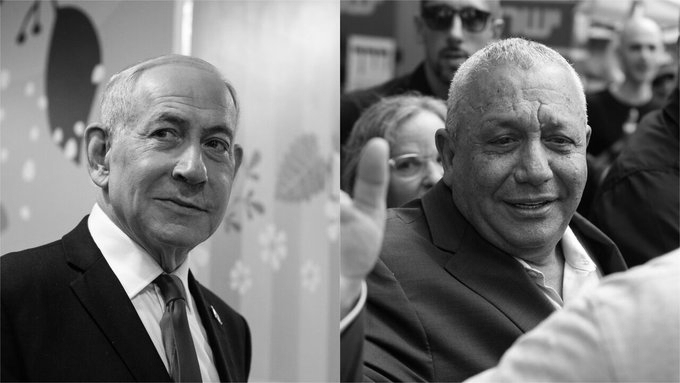
Netanyahu Open to Eisenkot Alliance as Israel Faces Political Deadlock: Report
Israeli Prime Minister Benjamin Netanyahu has not ruled out forming a coalition government with opposition leader Gadi Eisenkot, despite publicly denying plans for a unity government, Israeli media outlet i24 News reported on Monday. Sources close to Netanyahu's Likud party said the prime minister was keeping his options open, adding that they were “examining every option” amid growing uncertainty over government formation.
The possibility of an alliance comes after Israel's October 27 parliamentary elections, in which Netanyahu's bloc failed to secure a majority in the 120-member Knesset. His bloc won 53 seats, down from 68 in the outgoing parliament, while the opposition bloc led by Eisenkot secured 48 seats. Arab-led parties won the remaining 19 seats.
Together, the opposition and Arab-led parties have 67 seats, enough to form an alternative government, although it remains unclear whether they can agree on a common coalition. Netanyahu is reportedly concerned that Eisenkot could join forces with Arab-led parties and ultra-Orthodox factions to remove him from power. He has described such an alliance as “treason”, drawing criticism from opponents who accuse him of trying to block an alternative government.
The political deadlock has also triggered protests demanding Netanyahu's resignation and a Jewish-Arab coalition government. Thousands of Israelis gathered at Tel Aviv's Habima Square on October 31, urging opposition leaders to cooperate with Arab parties and prevent Netanyahu from returning to power. Demonstrators carried placards reading “There is a majority for change” and “Arabs and Jews will only win together”, before marching towards Rabin Square. Similar demonstrations were held in Jerusalem, Haifa and other locations.
Some protesters described the election as a last opportunity for political change and called Netanyahu a “great manipulator”. Demonstrations outside his residence earlier also demanded his resignation and an end to the Gaza war. However, Netanyahu supporters organised counter-protests, opposing any government that depends on Arab parties and demanding fresh elections. A separate group also gathered outside Eisenkot's home to oppose a possible alliance.
Meanwhile, Likud has questioned the election's conduct, citing suspected attempts to bribe voters, but has presented no evidence that the allegations affected the outcome. Three political activists were arrested before voting began on October 27 after police found them carrying envelopes of cash. Four more suspects were arrested two days later over suspected links to the Islamist Ra'am party, which denied involvement.
A judge on Sunday eased restrictions on the initial three suspects. One was released under conditions, another was placed under house arrest for eight days, while the third had his detention extended by two days. Allegations of possible foreign interference have also prompted an investigation by Israel's Shin Bet security service. However, election committee chief and Supreme Court Justice Noam Sohlberg said that even if the suspicions were substantiated, they would not undermine the integrity of the electoral process or the overall results.
Eisenkot accused Netanyahu of running an organised campaign to delegitimize the election outcome, including by alleging that Qatar supported opposition parties. Qatar has denied funding activities intended to influence the vote.
The results are expected to be officially certified this week. President Isaac Herzog will begin consultations with elected parties on Wednesday before deciding which candidate should be tasked with forming the next government. The candidate will have to secure a parliamentary majority through coalition negotiations. If the talks fail, Herzog can ask another candidate to try forming a government. Fresh elections remain possible if no coalition emerges.