
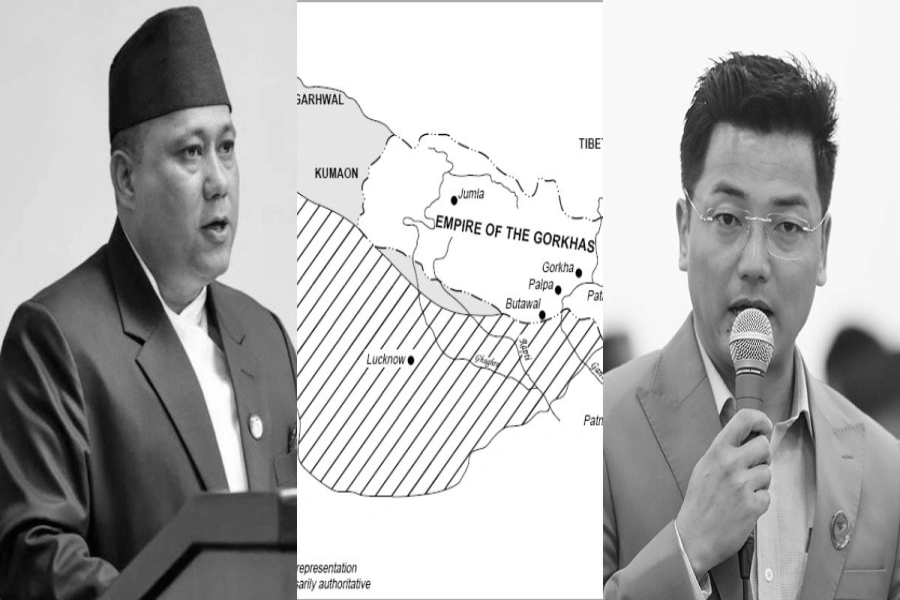
Nepal Govt Cannot Locate Original Sugauli Treaty Amid Fresh Lipulekh Row
Nepal’s government has been unable to locate the original 1816 Sugauli Treaty, a key document linked to the country’s boundary with British India, even as a fresh dispute with India over Lipulekh has intensified.
Foreign Minister Shisir Khanal told Nepal’s House of Representatives on Monday that the government was not even certain whether it possessed the original treaty signed between Nepal and the East India Company. He said records show that treaty related documents are held in Nepal’s National Archives, but officials have not confirmed whether they are the original documents.
The disclosure comes amid renewed tensions over Lipulekh, Limpiyadhura and Kalapani, which Nepal claims as its territory. India maintains that these areas belong to India.
The issue has gained fresh attention after India and China resumed border trade through Lipulekh Pass on August 1, despite repeated objections from Kathmandu. Nepal has argued that the route passes through territory it claims and that India and China should not make agreements concerning the area without Nepal’s consent.
India has rejected Nepal’s objections and said Lipulekh has been a long-standing route. New Delhi has also maintained that it remains open to constructive engagement with Nepal on outstanding boundary issues.
The Sugauli Treaty was signed between Nepal and the East India Company after the Anglo-Nepalese War. It helped define Nepal’s boundary with British India and remains central to Nepal’s position on the western border.
Khanal said Nepal does possess documents related to the 1816 Sugauli Treaty and the 1950 Nepal-India Treaty, but the government cannot confirm whether the copies are the original signed documents.
The question of the missing originals is not new. In 2016, when the Eminent Persons’ Group on Nepal-India relations began discussions on reviewing the 1950 treaty, Nepal tried to locate its original copy but failed. A parliamentary inquiry later searched archives, libraries, museums and government offices but could not find the original copies of either treaty.
In 2019, former Foreign Minister Pradeep Gyawali had also said Nepal possessed copies of both treaties but needed forensic verification to establish whether they were originals.
The latest disclosure comes as Kathmandu appears to be seeking greater diplomatic engagement with New Delhi. On Monday, Prime Minister Balendra Shah met Indian Ambassador Naveen Srivastava, ending a period in which he had avoided one-on-one meetings with foreign envoys. Shah also met Chinese Ambassador Zhang Maoming later the same day.