
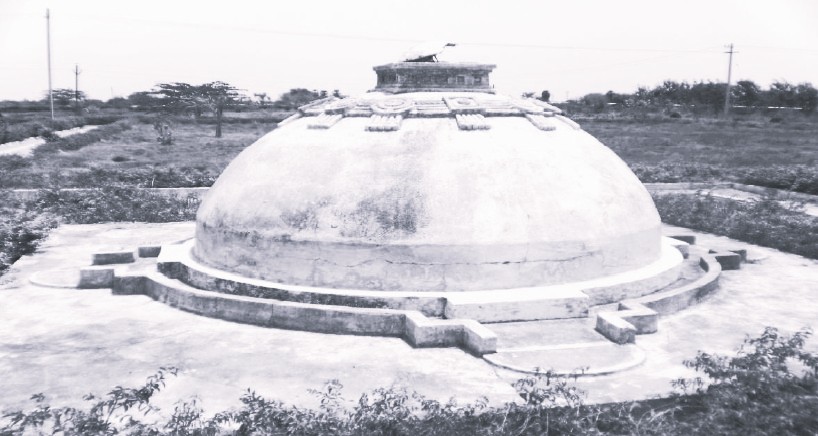
Nelakondapalli: A Testament to Buddhist Glory
Nelakondapalli, a town in the Khammam district of Telangana state, holds a prominent position on India's cultural and historical map. It is not just the headquarters of a Mandal but also a crucial archaeological center for Buddhism, which flourished since pre-Christian times, and later for Hinduism. This region served as a crossroads for ancient Indian trade routes, leaving an indelible mark on the history of the Deccan as a great spiritual and economic hub.
Geographical Location
Nelakondapalli is strategically located about 21 kilometers southwest of Khammam town, 58 km from Suryapet, and close to the Telangana-Andhra Pradesh border. It is connected to the national highway grid via National Highway NH365A (the Khammam- Kodad - Kusumanchi route).
It should not be confused with another historical town in the Deccan, 'Kondapalli' (which means a hill fort). The name Nelakondapalli itself signifies its uniqueness; 'Nela' means earth or ground. According to archaeological evidence, it was a major Deccan city situated on one of the most important ancient trade routes connecting North, East, and South India. This connectivity enabled its prosperity for centuries.
Ancient History and Archaeological Excavations
Archaeological evidence suggests that the Nelakondapalli region has been a significant human settlement since at least 100 BCE. Excavations carried out in phases between the 1970s and 1990s brought the region's glorious history to light. These excavations were initiated after local farmers discovered fragments of ancient sculptures and limestone slabs in their fields.
The Maha Stupa (Mahachaitya): Buddhist Grandeur
One of the largest Buddhist stupas discovered in the Deccan region was unearthed in the fields about 2 kilometers northeast of the village, adjacent to a large ancient man-made lake. Locally, these sites are known as 'Viratraj Gadde,' 'Erradibba,' and 'Bairagulagutta.'
This Mahachaitya features a 'Ring and Spoke' architectural style. It is a massive structure, approximately 54 feet high with an outer diameter of 138 feet. Along with the stupa, foundations of a brick-paved Vihara complex, extending over an area of approximately 200 meters and oriented east-west and north-south, were discovered. These foundations include structures for wells and water tanks. The excavated foundation is in two layers, suggesting that the upper layer was a repair or reconstruction over the older layer beneath. Historians estimate that the inscribed stupa found here belongs to the 3rd to 4th centuries CE. However, some evidence suggests the site existed before the 1st century CE and was active until at least the 4th to 5th centuries.
Archaeological Artifacts
Numerous rare artifacts were recovered during the excavations at the Buddhist site. These include a bronze statue of the Buddha, a small model stupa carved from limestone, terracotta figurines, plaques, and other religious objects.
Satavahana and Ikshvaku Influence
Evidence suggests that the Nelakondapalli region was a commercially significant town during the rule of the Satavahanas and the subsequent Ikshvaku dynasty.
Coins: Hundreds of Satavahana coins and rare Andhra Ikshvaku coins were found here. Ikshvaku coins are usually found in the Telangana region only in the southwestern parts of Nalgonda district. Their presence in Nelakondapalli indicates its central position in the ancient regional trade network and its exceptional economic prosperity.
Trade Route: According to the archaeologist Himanshu Prabha Ray, Nelakondapalli was situated on the historic 'Trans-Peninsular Trade Route.' This route connected the Krishna River valley to other prominent Deccan centers like Kondapur, Dhulikatta, Ter, and Paithan. Merchants and Buddhist monks frequently traveled along this route.
Hindu Culture and Inscriptions
In addition to Buddhism, Nelakondapalli was an important center for Hindu culture.
Chalukya and Kakatiya Eras: Numerous inscriptions dating from the 5th century CE to the 12th century CE have been discovered here. These inscriptions suggest that the site remained an active and historically important center during the Western Chalukya, Vengi Eastern Chalukya, and Kakatiya periods.
Literary References: The administrative and military importance of the town is confirmed by literary references in Telugu and Sanskrit texts, where it is mentioned as '(Nela)Kondapalli-300' or 'Kondapalli-300' Panugallu.
Temples and Donations: Kakatiya era inscriptions from the 12th century state that local Recharla rulers gifted donations and presents to the temples of deities here. An inscription from the time of the Vijayanagara Emperor Sri Krishnadevaraya from the 16th century was also found here, affirming the site's long-term historical significance.
19th Century Survey: A survey conducted in 1934 during the Hyderabad Nizam's rule reported the presence of temple ruins and a decapitated Nandi idol in Nelakondapalli, attesting to the existence of ancient Hindu temples here.
Spiritual Zenith: Birthplace of Bhakta Ramadasu
The history of Nelakondapalli is not limited to archaeological evidence and royal dynasties. It is also the birthplace of the great devotee-poet and composer of the 17th century, Kancharla Gopanna (Bhakta Ramadasu).
Bhadrachalam Temple:
Ramadasu played a crucial role in constructing the famous Sri Sita Ramachandra Swamy Temple at Bhadrachalam, dedicated to Sita and Rama of the Ramayana epic. Historical texts refer to Nelakondapalli as 'Bhugiri.' Although highly revered by Hindus of his time, he faced punishment from the Muslim authorities (Golconda Sultanate). Accused of misappropriating government revenue for building the main temple, Ramadasu was arrested under the orders of Sultan Abul Hasan Qutb Shah (Tana Shah). Ramadasu spent many years in the Golconda Sultanate jail. According to local legends, Lord Rama himself appeared in a dream, and Gopanna was released after the disputed amount was paid to the Sultan. To commemorate the great service rendered by Gopanna to the Bhadrachalam and the regional Hindu community, 'Bhakta Ramadasa Utsavams' are celebrated annually with great splendor in Nelakondapalli and Bhadrachalam.
Preservation of Artifacts and Tourism
The most important and largest artifacts, including Buddhist and Hindu idols, discovered from Nelakondapalli have been moved to safe locations like the Vijayawada Museum. Some inscribed pillars and broken fragments are being preserved in local modern Hindu temples and a small village library.
Since the early 1990s, regional tourism departments have promoted Nelakondapalli as a historical tourist center showcasing Buddhist and Hindu artifacts. To preserve the historical importance of the site and pass it on to future generations, the excavation sites, especially the foundations of the Maha Stupa, are supervised by the Archaeological Survey of India (ASI). The local belief that sites like 'Virat Raja Dibba' and the nearby 'Kichaka Gundam' are associated with events from the Mahabharata highlights the mythological connection of the region.
Nelakondapalli is, undoubtedly, a jewel in the history of Telangana. It served as a center for ancient Buddhism, a thriving commercial city during the Satavahana and Ikshvaku periods, and a spiritual powerhouse under Hindu dynasties. As the birthplace of a great personality like Kancharla Gopanna, who caused the construction of the Bhadrachalam Temple, this sacred land holds history, devotion, and culture within its soil. The greatness of Nelakondapalli lies not only in its archaeological treasures but also in the religious harmony and spiritual life it has maintained for generations.
Nelakondapalli as a Buddhist Tourist Center
Nelakondapalli is a center of paramount importance for Buddhist tourists and history enthusiasts. The massive Mahachaitya (Stupa) discovered here, along with the surrounding Vihara complex foundations and Buddhist artifacts, provide undeniable evidence of the spread of Buddhism in the ancient Deccan region. This archaeological site, active since pre-Christian times, with treasures like Ikshvaku coins and bronze statues of Buddha, indicates a significant Buddhist monastery on the ancient trade route. The Telangana government is preserving this site as a historical heritage and promoting it as a serene center for those interested in Buddhist studies and meditation. However, as mainly archaeological remains exist here, tourists visit the site as a historical pilgrimage, and full-scale development like Ajanta-Ellora has not yet taken place.
Transportation and Accommodation Facilities
Although Nelakondapalli is a Mandal headquarters, advanced accommodation facilities required for Buddhist tourism are limited within the village itself. Tourists usually prefer to stay in the nearby major city of Khammam (approx. 21 km), where mid-range to high-end hotels and guest houses are available. Regarding transportation, Nelakondapalli is connected to National Highway NH365A. Local RTC buses and private taxi services are easily available from Khammam to Nelakondapalli. The nearest railway station is Khammam Railway Station (KMT), which is connected to many major cities. The nearest airports are Vijayawada International Airport (approx. 100 km) and Hyderabad International Airport (approx. 250 km). From there, one can travel to Nelakondapalli by road.