
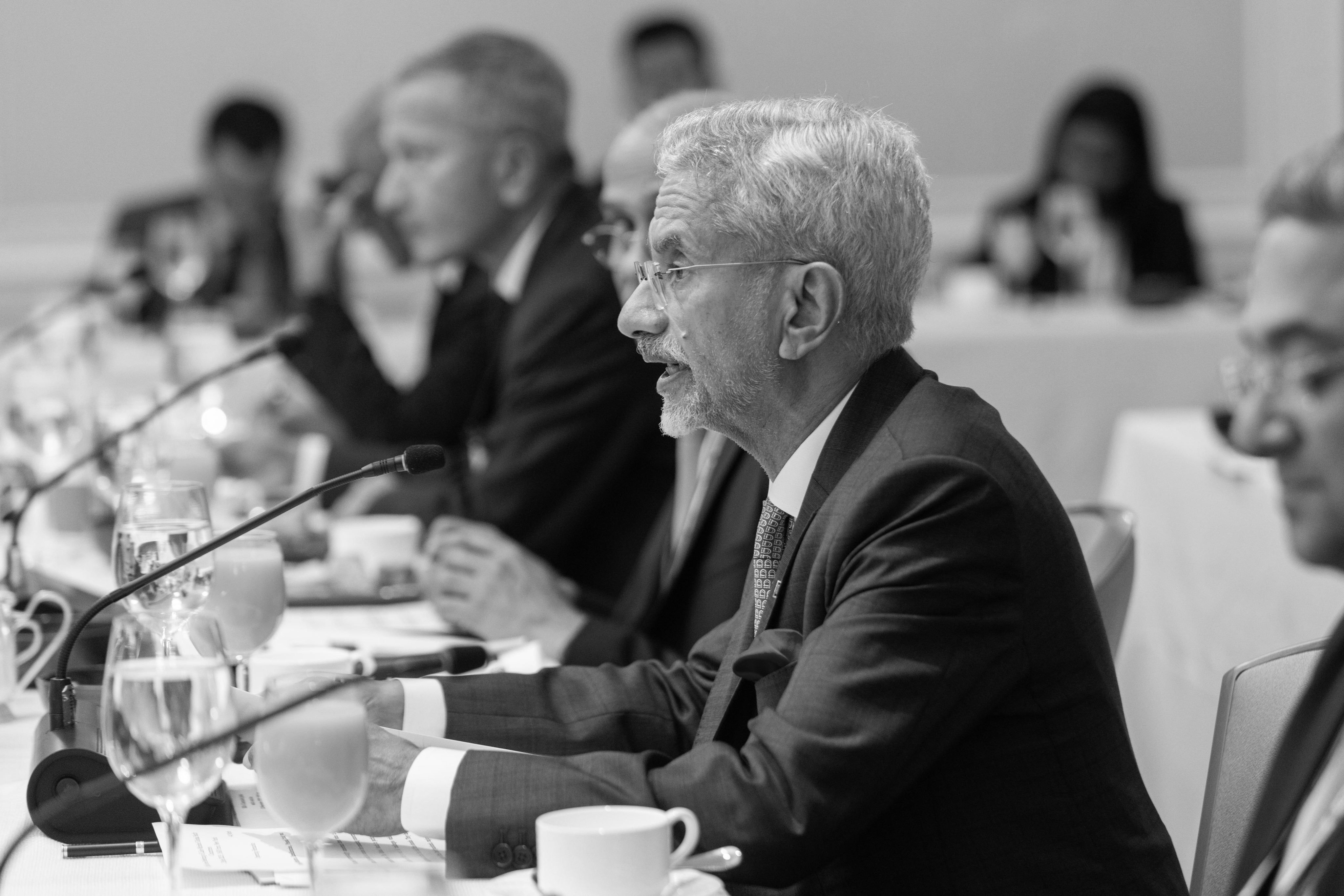
Need for distributed, Efficient global workforce: EAM S Jaishankar
External Affairs Minister S. Jaishankar emphasized that today’s changing world requires a global workforce, noting that many countries cannot meet workforce demands solely through national demographics.
His remarks came amid ongoing trade and tariff challenges, as well as President Donald Trump’s hardline stance on immigration, including a new USD 100,000 fee on H-1B visas, which predominantly affects Indian professionals, the largest group of beneficiaries of these temporary work visas.
Addressing the event “At the Heart of Development: Aid, Trade, and Technology” hosted by the Observer Research Foundation (ORF) on the margins of the UN General Assembly session on Wednesday, Jaishankar called for the creation of a more contemporary, efficient, and acceptable model of a global workforce, which could then operate in a distributed, worldwide workplace.
“Where that global workforce is housed may be a matter of political debate, but there’s no escaping the reality that, if you look at demand and demographics, many countries cannot meet workforce needs on their own,” he said. “You cannot run away from this reality. How do we create a more acceptable, contemporary, efficient model of a global workforce that can operate in a distributed global workplace? This is a critical question the international economy must address today.”
He added that, as part of this re-engineered global framework, countries will likely form new trade arrangements, sometimes out of necessity. “We will see nations making decisions they may not have considered in other circumstances, driven by the desire or even compulsion to seek new partners and regions,” he said.
Despite uncertainties, Jaishankar noted that trade continues to find a way. “It is easier to trade today, both physically and digitally, thanks to better roads, shipping, and smoother trade interfaces than ever before,” he said. He added that obstacles will often be mitigated by advancements in technology and connectivity.
Commenting on the turbulent global environment, Jaishankar stressed the importance of large nations building self-reliance. “This is very much a focus in India,” he said, highlighting the need to build national capacities to achieve multipolarity. “National experiences, once developed, can often be applied to other societies. India’s Digital Public Infrastructure (DPI) is a case in point many countries find it more relevant and transposable than European or American digital models.”
He observed that over the past year, the world has moved toward greater unpredictability and volatility. “By definition, unpredictability means you cannot know what lies ahead it is not a simple extrapolation from the past. Clearly, it is disruptive.”
Referring indirectly to the Trump administration, he added, “People expected different outcomes in different terms, but times change. A few months, or even weeks, can make a significant difference. Experiencing such rapid policy changes, often in the public eye, is unprecedented.”
On supply chains, Jaishankar said that in recent years, countries focused on de-risking production, creating more resilient and redundant supply chains. “Today, we must also protect against uncertainties in market access. Over-dependence on markets is just as risky as over-dependence on supplies or connectivity. Almost the entire economic chain has become riskier and more complex.”
He concluded, “The central challenge in diplomacy now is how to de-risk, hedge, build resilience, and safeguard against unforeseen contingencies by definition of unpredictable events through effective policy and planning. This is a major challenge for the entire world.”