
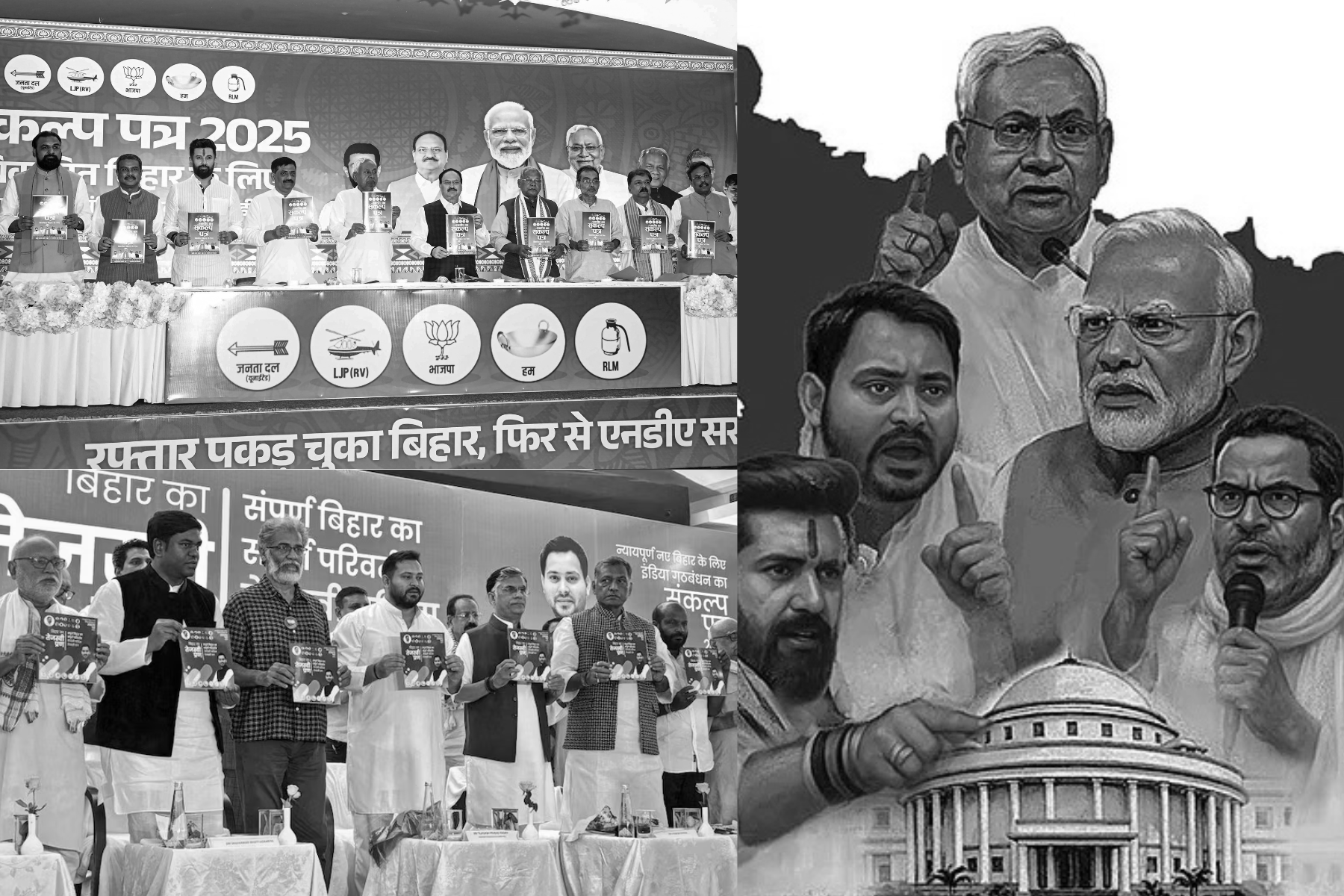
NDA’s ‘Viksit Bihar’ Manifesto Sets Stage for Ideological Contest in State Elections
The National Democratic Alliance (NDA) on Friday released its election manifesto for the 2025 Bihar Assembly polls, promising large-scale job creation, free education, women’s empowerment and major infrastructure expansion across the state. The 69-page document, unveiled in Patna by Chief Minister Nitish Kumar, BJP president JP Nadda and Deputy Chief Minister Samrat Choudhary, is titled “Viksit Bihar, Viksit Bharat.”
Key Highlights of the NDA Manifesto
The NDA manifesto pledges one crore jobs and employment opportunities, free quality education from KG to PG, and metro rail projects in four cities. It also promises seven international airports, seven expressways, 10 industrial parks, and 50 lakh new pucca houses.
Social welfare measures include ₹2,000 per month for SC/ST students in higher education, ₹10 lakh assistance for EBC professionals, free healthcare up to ₹5 lakh, and increased PM-Kisan support from ₹6,000 to ₹9,000 annually. The NDA also announced the creation of “one crore Lakhpati Didis,” mega skill centres, and new medical colleges in every district.
Mahagathbandhan’s ‘Bihar Ka Tejashwi Pran’
Earlier, the Mahagathbandhan (INDIA bloc), led by the Rashtriya Janata Dal (RJD) and the Congress, released its manifesto titled “Bihar Ka Tejashwi Pran.” The alliance promised to enact a law within 20 days of forming a government to guarantee a government job for one member of every family in the state.
Other highlights include ₹2,500 monthly financial assistance for women under the Mai-Behin Maan Yojana, 200 units of free electricity per household, restoration of the old pension scheme, improved healthcare and education infrastructure, and employment opportunities for youth through new industrial zones and startups.
Jan Suraaj’s Five-Point Vision
The Jan Suraaj Party (JSP), founded by political strategist Prashant Kishor, has not yet released a formal written manifesto. However, earlier this year, Kishor outlined a five-point vision aimed at transforming Bihar if his party comes to power.
His agenda emphasises education reform, with a focus on strengthening government schools to deliver quality education on par with private institutions. It also prioritises employment generation, promising livelihood support or jobs for every family, and healthcare access, with plans to establish clinics in every panchayat and super-speciality hospitals in each district.
Additionally, Kishor’s vision includes women’s empowerment and self-reliance through expanded access to credit and leadership opportunities, along with agricultural reform and rural development to link rural labour with agricultural productivity and raise incomes across the state.
Competing Blueprints for Bihar’s Future
NDA: Expansion with Continuity
The NDA’s manifesto reflects a blend of continuity and expansion a development-heavy agenda focusing on infrastructure, jobs, and welfare, backed by public consultations. It appeals to voters seeking stability and incremental growth while promising tangible benefits through large-scale projects and skill-driven employment.
Mahagathbandhan: Welfare and Job Guarantees
The Mahagathbandhan’s plan is more populist and welfare-centric, pledging direct financial support and job guarantees to address widespread poverty and unemployment. Its immediate relief promises target economically vulnerable families, though experts have questioned how such commitments would be financed and sustained.
Jan Suraaj: Structural Transformation
In contrast, the Jan Suraaj Party envisions structural change rather than short-term relief. Prashant Kishor’s five-point plan focuses on improving governance, education quality, and rural healthcare long-term investments aimed at breaking Bihar’s cycle of underdevelopment and dependence on migration.
A Three-Way Contest of Ideas
Together, the three roadmaps capture distinct priorities NDA’s pragmatic expansion, Mahagathbandhan’s welfare focus, and Jan Suraaj’s governance reform, reflecting Bihar’s evolving political debate between growth, welfare, and systemic change.
As Bihar heads into a high-stakes election, the three competing visions set the tone for a debate on development, welfare, and accountability. Voters will now decide which roadmap continuity, social security, or structural change best defines the state’s future.