
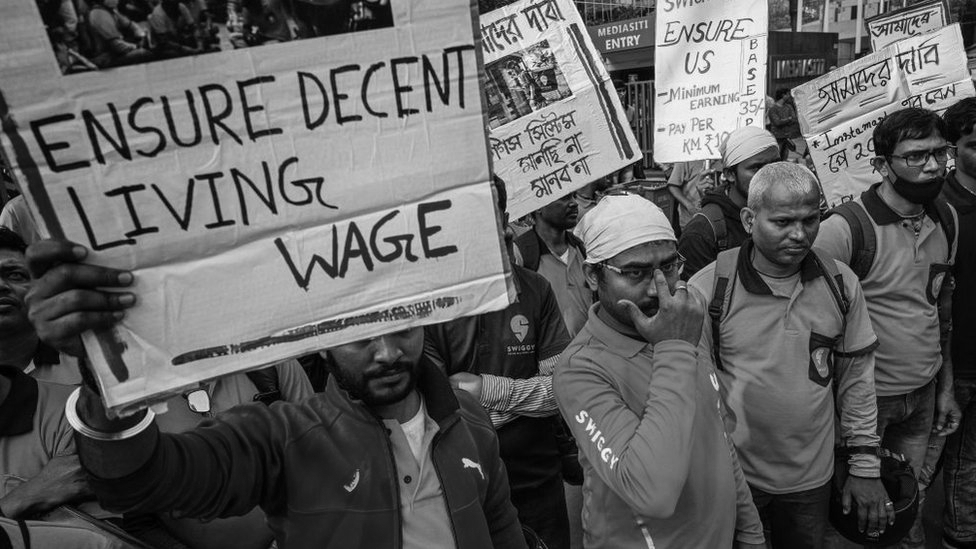
Nationwide strike by Gig workers highlights gaps between policy and reality
Gig and platform-based delivery workers across India staged a nationwide strike on Wednesday , marking their second nationwide protest this month. Workers are demanding a raise in pay to at least Rs 20 per km , citing long hours, safety risks, and the challenges they face on the roads. The first strike, held on December 25 , disrupted deliveries in several areas by up to 60 percent , drawing attention to the difficult working conditions of these essential workers.
Often referred to as the silent warriors of India’s urban workforce , gig workers ensure that food, groceries, and essential supplies reach homes at any hour of the day or night , braving traffic, harsh weather, and other hazards. Despite their critical role in keeping cities running, many continue to struggle with low pay, long shifts, and limited social security .
Workers said their income has sharply declined despite long hours on the road, pushing many into financial distress. They highlighted unfair practices, including penalties for order cancellations beyond their control and arbitrary blocking of accounts by team leaders. “We work 14–16 hours a day, but we barely earn Rs 700–800. If an order is cancelled for any reason, the penalty falls on us. We are forced to continue working late into the night,” a delivery worker in Delhi told ANI. Another added, “Even after accidents, like the one in Barakhamba, riders are not getting insurance support. We had to collect Rs 1,000–2,000 each to help our colleague.”
Workers also criticised algorithm-driven management , pointing to opaque incentive structures and unfair penalties, and raised concerns over the lack of social security, health coverage, and grievance redressal mechanisms .
Aam Aadmi Party Rajya Sabha MP Raghav Chadha called for banning 10-minute delivery apps , stating that gig workers are the backbone of billion-dollar platforms like Swiggy, Zomato, Blinkit, Ola, and Uber but remain under immense pressure with minimal rights. “Under 10-minute delivery guarantees, riders drive recklessly, face anxiety, risk losing incentives, and are exposed to customer abuse all without regular worker protections,” Chadha said. He also proposed setting limits on daily working hours for gig workers.
The Union government has formally recognised gig and platform workers under national labour law through the Code on Social Security, 2020 , effective November 2025. Key provisions include legal recognition, mandatory contributions by platforms to a Social Security Fund for accident and health insurance, pension and maternity benefits, and portable benefits via the e-Shram portal . However, gaps remain as the central policies do not mandate minimum pay, daily working hours, or full enforcement of grievance redressal . Workers’ key demands, predictable earnings, capped hours, and reliable insurance claims are largely unmet.
Some states have announced or enacted additional measures. Telangana has a Cabinet-approved Gig and Platform Workers Welfare Bill 2025 , creating a Social Security and Welfare Board, welfare fund, and accident insurance of ₹5 lakh, but full implementation is pending. Rajasthan passed a law in 2023 for welfare boards and insurance, but operational rollout remains incomplete. Karnataka has an ordinance with insurance coverage around ₹4 lakh already active, though worker registration is low. Jharkhand passed a welfare law in 2025, while Delhi and Maharashtra are in the policy drafting and planning stages.
Despite policy announcements, on-ground gaps persist , including delayed fund disbursement, poor awareness and registration, low insurance uptake, no guaranteed earnings, long work hours without protection, opaque algorithmic management, and weak grievance mechanisms. Gig workers continue to demand fair pay, limits on working hours, accident and health insurance with guaranteed claims, social security benefits , and transparent algorithmic management with effective grievance redressal.
Today’s strike is not just about pay, but about respect and recognition for a workforce that powers the daily lives of millions . As cities await deliveries, it is a reminder that behind every order is a dedicated rider working tirelessly, often unseen and underappreciated , whose demands for fair compensation are both reasonable and long overdue.