
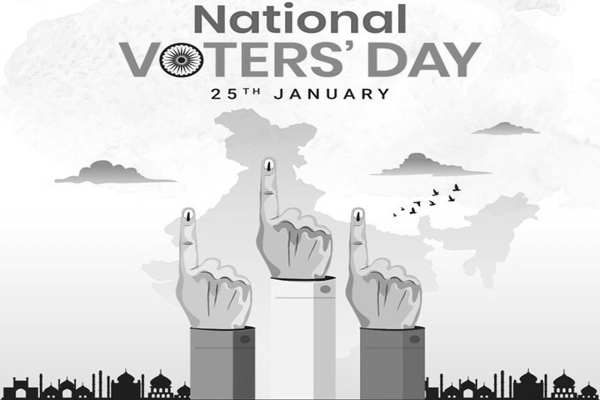
National Voters' Day: The Lifeblood of Democracy
India is the world's largest democracy, and the foundation of this democratic structure is the Right to Vote. The 'Universal Adult Suffrage' granted by our Constitution is a magnificent boon that empowers citizens to choose their own rulers. The Election Commission of India (ECI) was established on January 25, 1950. Commemorating this historic occasion, the government has been celebrating January 25th as 'National Voters' Day' (NVD) since 2011 to raise awareness among voters and enhance their participation in the electoral process. This is not merely a celebration but a sacred occasion to reaffirm democratic values.
The idea of National Voters' Day was proposed by the Election Commission of India in 2011 to mark its 60th anniversary. This proposal was approved by the Union Cabinet led by then-Prime Minister Dr. Manmohan Singh. The inaugural celebrations were officially launched on January 25, 2011, by the then-President of India, Pratibha Patil. The primary objective of celebrating this day on the anniversary of the ECI's founding is to encourage the registration of new voters and instill a sense of responsibility among them.
Regarding the Right to Vote, India did not simply copy it from any single country. While the Parliamentary system was adopted from Britain and the spirit of equality from nations like the USA, Dr. B.R. Ambedkar introduced 'Universal Adult Suffrage' through Article 326 of the Constitution, tailoring it to Indian conditions. It is noteworthy that while women in many Western countries had to struggle for decades for this right, India granted equal voting rights to everyone regardless of gender from the very first day of independence.
The 61st Amendment: A Historical Change and Its Impact
The 61st Constitutional Amendment is considered one of the most significant changes in Indian electoral history. When the Indian Constitution originally came into effect, the minimum voting age was 21 years. However, recognizing that the youth play a vital role in determining the nation's future, the government led by then-Prime Minister Rajiv Gandhi decided to lower the age to 18. To facilitate this, the 61st Constitutional Amendment Act was introduced in 1988 and officially came into force on March 28, 1989 . This amendment modified Article 326, allowing millions of young people to participate in the democratic process for the first time.
The primary goal of lowering the voting age was to foster political consciousness among the youth and ensure that national governance aligns with their aspirations. Following the principle that "today’s youth are tomorrow’s citizens," granting them the right to vote at 18 has significantly increased their participation in democracy. This historic decision has transformed India into the country with the largest number of young voters in the world, paving the way for digital campaigns, political discourse on social media, and active youth turnout.
The Journey: From Ballot Papers to EVMs
The electoral process in India has undergone a massive evolution from physical ballot papers to the sophisticated Electronic Voting Machines (EVMs) we see today. Initially, voters would stamp a paper with the symbol of their preferred candidate and drop it into a ballot box. This often led to delays in counting and issues like booth capturing or rigging. To overcome these challenges and increase transparency, the ECI introduced EVMs.
This was further strengthened by the introduction of Voter ID (EPIC) cards for foolproof identification. Currently, the VVPAT (Voter Verifiable Paper Audit Trail) system has been added, allowing voters to verify that their vote was cast correctly, thereby increasing public trust in democracy. The use of EVMs began experimentally in 1982 during the Paravur Assembly by-election in Kerala. It was later expanded to parts of Madhya Pradesh, Rajasthan, and Delhi in 1988, and finally, since the 2004 General Elections , EVMs have been used across all constituencies nationwide. The ECI has repeatedly clarified that these machines are highly secure and cannot be hacked.
Themes and the Digital Revolution
Every year, these celebrations are held under a specific theme. For instance, the 2021 theme was "Making Our Voters Empowered, Vigilant, Safe, and Informed." In recent times, the Commission has heavily integrated technology. Initiatives like 'Radio Hello Voters' (an online digital radio service), the 'Voter Helpline App' for easy registration, and digital voter card (e-EPIC) downloads have modernized the experience. Even during crises like COVID-19, the ECI successfully conducted elections using safe methods, ensuring that the democratic process remained uninterrupted.
The 2026 theme is: "Nothing Like Voting, I Vote for Sure." This theme aims to instill a sense of pride and duty in voters. Alongside the slogan "My India - My Vote," this year’s celebrations emphasize that citizens are the pillars of democracy.
Voter Registration and 'ECINet'
To register as a new voter, a person must be an Indian citizen and 18 years of age (though 17-year-olds can now apply in advance).
Online:
Visit voters.eci.gov.in or use the Voter Helpline App to fill out Form-6 .
Forms:
Form-6 is for new registration, Form-6B for Aadhaar linking, and Form-8 for corrections.
ECINet:
In January 2026, the ECI launched 'ECINet', a unified digital platform that integrates over 40 different apps and websites (like cVIGIL and Saksham) into one portal. This saves time and increases transparency. It even features 'Book-a-call with BLO' to resolve queries directly with local officials.
SIR (Special Intensive Revision):
Under the 2026 "My India - My Vote" campaign, the government initiated the SIR program to bring electoral services to every doorstep, empowering migrant workers and rural populations.
While people in many countries struggled for decades for the right to vote, Indians received it without discrimination immediately upon independence. Utilizing this great opportunity is the fundamental duty of every citizen. National Voters’ Day reminds us of the power given to us by our founding fathers. Only when the sentiment "My Vote, My Responsibility" is felt by everyone will India become a more powerful democracy. To provide a better future for the next generation, every citizen seeking change in society must wield their vote as a powerful tool.