
National Security at the Core of the Union Budget
Union Finance Minister Nirmala Sitharaman on Sunday presented the Union Budget for 2026–27 , with a total outlay of ₹53.47 lakh crore , placing a strong emphasis on national security, defence and infrastructure . The budget, however, drew criticism from opposition parties for offering limited relief to the middle class , even as the NDA government described it as a “strong and forward-looking” budget.
While some schemes were announced for the poor, critics argued that a large share of allocations was directed towards defence, infrastructure and capital-intensive sectors , leaving middle-income households disappointed. The government did provide partial relief by announcing reductions in the prices of certain medicines, including cancer drugs. Corporate sectors largely welcomed the budget, while opposition parties accused the government of ignoring everyday concerns such as rising costs of living.
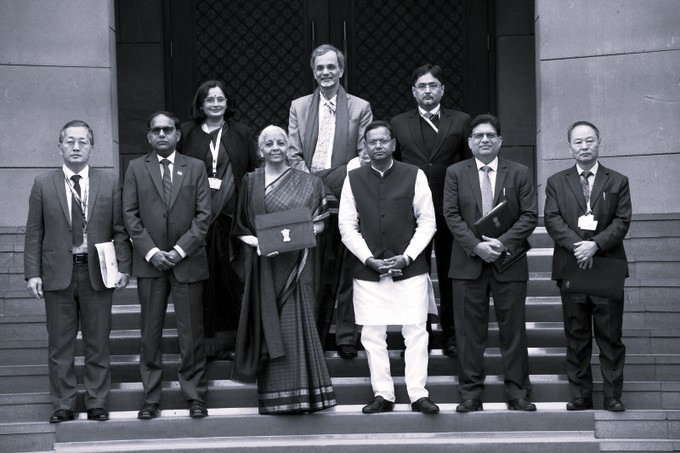
Before presenting her ninth consecutive Union Budget , Sitharaman paid a courtesy visit to President Droupadi Murmu at Rashtrapati Bhavan, in keeping with tradition. The President extended her best wishes to the Finance Minister and her team. Sitharaman was accompanied by Minister of State for Finance Pankaj Chaudhary and six senior Finance Ministry officials. As part of the customary ritual, the President offered ‘dahi-chini’ (curd and sugar) to the Finance Minister as a good omen.
Later, Sitharaman posed for photographs with her budget team outside her office at Kartavya Bhavan , wearing a magenta-and-blue Kanchipuram silk saree , and carrying a tablet enclosed in a red cover bearing the national emblem . The Union Cabinet, chaired by Prime Minister Narendra Modi , subsequently approved the Union Budget 2026–27. Continuing a tradition she began in 2019, Sitharaman once again presented the budget in the ‘bahi-khata’ style , having replaced the earlier briefcase format.
As part of efforts to accelerate development in eastern India, the Centre proposed the East Coast Industrial Corridor , with Durgapur in West Bengal to be developed as a key node. Under the ‘Purvodaya’ scheme, five tourism destinations across five states will be developed, while Buddhist tourism will be promoted through the creation of Buddhist circuits in six northeastern states. Sitharaman also announced the deployment of 4,000 electric buses. The Purvodaya initiative, announced in September 2024 under the Viksit Bharat 2047 vision, focuses on the integrated development of Bihar, Jharkhand, West Bengal, Odisha and Andhra Pradesh .
The Finance Minister announced an investment of ₹10,000 crore over five years to develop India as a global biopharmaceutical manufacturing hub , including the establishment of 1,000 clinical trial centres and strengthening of the Central Drugs Standard Control Organisation (CDSCO) . She also announced a complete basic customs duty exemption on 17 cancer drugs , and added seven more rare diseases to the list eligible for duty-free personal imports for treatment. India currently supplies about 20 per cent of the world’s generic medicines and exports pharmaceuticals to 191 countries .
Providing relief to families sending money abroad for essential needs, the government proposed reducing Tax Collected at Source (TCS) under the Liberalised Remittance Scheme (LRS) from 5 per cent to 2 per cent for overseas remittances made for education and medical purposes. TCS on foreign tour packages was also reduced to 2 per cent, irrespective of the amount, while the higher rate will continue for other categories.
In the healthcare sector, the Centre announced plans to induct one lakh allied health professionals over the next five years across 10 disciplines, along with training 1.5 lakh caregivers in the coming year. To promote medical tourism, the government proposed setting up five regional medical hubs in partnership with the private sector, alongside the establishment of three new All India Institutes of Ayurveda and the upgradation of the WHO Global Centre for Traditional Medicine in Jamnagar.
The defence budget for 2026–27 was increased to ₹7,84,678 crore , up from ₹6,81,210 crore in the previous year. This includes ₹2,19,306 crore for capital expenditure and ₹5,53,668 crore for revenue expenditure , with ₹1,71,338 crore allocated for pensions. Customs duty exemptions were announced for select aircraft parts and defence-related manufacturing inputs.
The government also unveiled a ₹10,000 crore container manufacturing scheme over five years to position India as a global hub, alongside proposals for a new East–West Dedicated Freight Corridor from Dankuni in West Bengal to Surat in Gujarat. Over the next five years, 20 new national waterways will be made operational, beginning with National Waterway–5 in Odisha, and ship-repair facilities will be developed in Varanasi and Patna. A Coastal Cargo Promotion Scheme aims to increase the share of waterway transport to 12 per cent by 2047.
In governance-related allocations, the budget earmarked ₹30 crore for the Lokpal and ₹54.56 crore for the Central Vigilance Commission (CVC) for 2026–27.
Rural and agricultural sectors also received attention, with announcements covering 20,000 veterinary professionals , development of 500 reservoirs and Amrit Sarovars for fisheries , and special programmes for coconut farmers, cashew and cocoa cultivation, sandalwood plantations , and high-value crops in hill regions.
The education sector received an allocation of over ₹1.39 lakh crore , including ₹55,727 crore for higher education . Key initiatives include five university townships near industrial corridors, girls’ hostels in every district, content creator labs in schools and colleges, and the setting up of a high-powered committee on education-to-employment pathways . Union Education Minister Dharmendra Pradhan said the budget provides a clear direction for education and employment under the Viksit Bharat vision.