
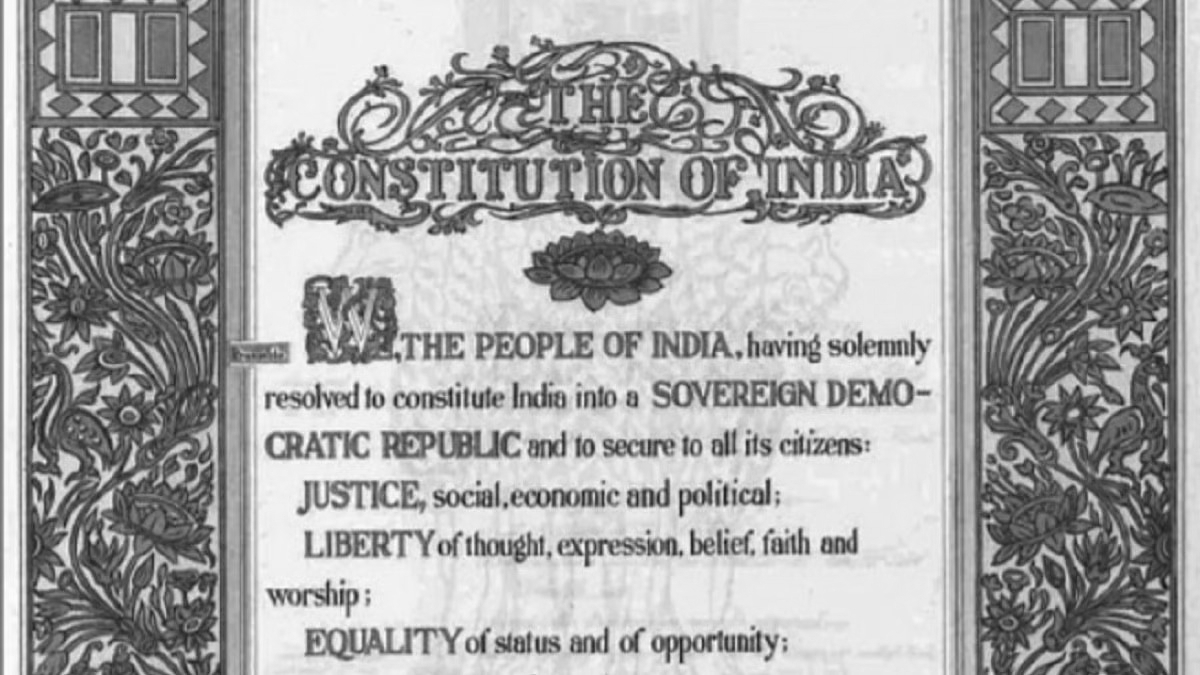
Nation Marks Constitution Day: Many Challenges Overcome, Many Remain
India commemorated Constitution Day on Wednesday with ceremonies across the country, led by the President, Prime Minister, Chief Justice of India, and top constitutional bodies even as political leaders and civil society used the occasion to reflect on both the strengths of the Constitution and the mounting challenges it continues to face.
At the Supreme Court, Chief Justice of India Surya Kant hosted chief justices and senior judges from Bhutan, Kenya, Mauritius, Sri Lanka, Nepal and Malaysia, who observed live proceedings and joined discussions on judicial cooperation. CJI Kant said the presence of global judicial leaders reflected the moral and institutional strength of India’s constitutional democracy. Solicitor General Tushar Mehta called the Supreme Court “one of the greatest courts in the world,” while senior advocate Kapil Sibal welcomed the guests on behalf of the Bar.
President Droupadi Murmu, addressing Parliament, praised India’s Constitution as a “living document” that continues to guide the nation’s social reforms, economic transition and democratic aspirations. She highlighted recent reforms such as GST, the Nari Shakti Bandhan Act, and the ban on triple talaq as examples of constitutional values in action. Prime Minister Narendra Modi paid tribute to the framers of the Constitution, describing duties as the “foundation of a strong democracy,” and urged citizens to uphold human dignity, liberty and equality as envisioned by the Constitution.
However, opposition leaders used the day to highlight concerns over the health of India’s democratic institutions.
Congress President Mallikarjun Kharge said the Constitution was under “constant assault,” alleging attempts to undermine equality, federalism and the independence of key institutions. West Bengal Chief Minister Mamata Banerjee warned that exercises like the Special Intensive Revision of electoral rolls were creating “fear in the name of citizenship,” and said citizens must protect the Constitution from “those who seek to bulldoze federalism and secularism.” Tamil Nadu Chief Minister M.K. Stalin, in a strongly worded message, declared: “India belongs to all its people, not to one culture or one ideology… We will do everything required to uphold true federalism as enshrined in our Constitution and protect the rights of every State.” He said the real tribute to the Constitution was to “defend the Republic from those who fear its promise of justice, liberty, equality, and fraternity.”
As leaders across the political spectrum paid homage to B.R. Ambedkar and the Constituent Assembly, observers noted that India’s constitutional journey has been marked by both remarkable resilience and ongoing strain.
One of the most significant victories of constitutionalism has been the end of political misuse of Article 356. For decades, President’s Rule was frequently invoked to dismiss state governments for partisan reasons. The Supreme Court’s landmark S.R. The Bommai judgment in 1994 largely ended this practice by subjecting Article 356 to judicial review and requiring floor tests to establish legislative majority. Since then, misuse of the provision has dramatically declined, strengthening India’s federal structure.
Judicial independence particularly at the higher levels has also been one of the Constitution’s enduring successes. Despite periodic tensions between the executive and judiciary, the Supreme Court has repeatedly asserted its autonomy, from striking down arbitrary amendments to upholding fundamental rights, privacy, and the basic structure doctrine. The judiciary remains one of India’s strongest constitutional pillars, even as lower courts face delays and systemic challenges.
But several concerns persist. The perceived erosion of the Election Commission’s independence has drawn criticism from civil society and opposition parties, with allegations that the Commission has not acted impartially during key electoral moments. Investigative agencies such as the Enforcement Directorate and the Central Bureau of Investigation are widely seen as lacking independence, frequently accused of targeting political opponents of the ruling party. Economists and former officials have also pointed to pressures on the Reserve Bank of India to align with government policy, raising questions about the autonomy of institutions originally designed to function at arm’s length from politics.
India’s Constitution has overcome other formidable tests: the trauma of Partition, the linguistic reorganisation of states, secessionist movements, political instability, and even the Emergency after which judicial review and basic structure protections emerged stronger. Yet, as leaders across India noted today, new challenges continue to confront the Republic: centralisation of power, increasing polarisation, misuse of laws affecting civil liberties, and tensions in federal relations.
Across schools, courts, state assemblies and Parliament, readings of the Preamble and commemorations of Ambedkar marked Constitution Day. But the larger message reiterated by leaders from the Treasury and Opposition alike was that India’s Constitution is strongest not merely because it was written well, but because it is defended continuously.
As the nation celebrated the document that binds more than a billion citizens together, the day served as a reminder of both how much India has safeguarded and how much remains to be protected.