
NASA Orbiter Spots Huge Lunar Crater Created by Powerful 2024 Impact
Scientists have discovered a massive crater on the moon that formed after a powerful impact two years ago, marking the largest known lunar impact crater created in recent times.
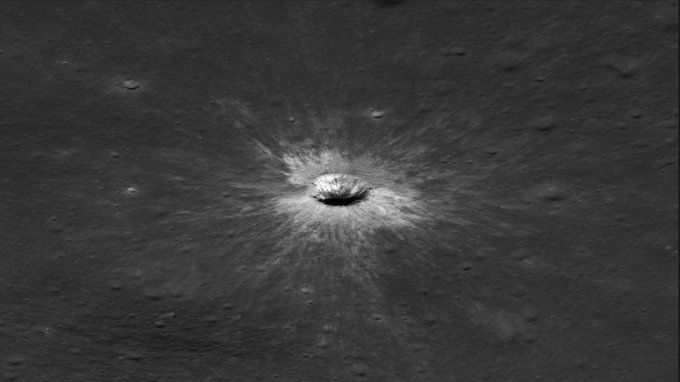
The steep-sided crater, measuring about 728 feet (222 metres) across and up to 141 feet (43 metres) deep, was formed when a fragment of an asteroid or comet struck the moon in May 2024. Researchers said an impact of this scale is expected only about once every 132 years, making the event a rare opportunity for scientists to study how the lunar surface changes.
The crater was spotted on the moon's near side by NASA's Lunar Reconnaissance Orbiter (LRO) shortly after the impact. However, the event was not detected in real time by telescopes on Earth or in space. LRO's wide-angle images were identified only in August 2025 during a review of its large volume of data. More detailed images collected later helped confirm the discovery early this year.
The crater has been named after Thomas McGetchin, a former director of Houston's Lunar and Planetary Institute. It is around three times larger than the previous record-holder discovered by LRO about a decade ago.
According to researchers, the impact excavated and scattered lunar material across an area extending more than 100 kilometres. Scientists also found evidence that dust and rocky soil were ejected at a higher angle than expected.
A separate study identified a 7-kilometre-wide cold spot around the crater, suggesting that the impact loosened and disturbed the moon's uppermost soil, or regolith.
Researchers said LRO observations indicate that the moon's top two centimetres of soil are overturned by impact ejecta roughly every 80,000 years, faster than previously estimated.
The findings could also help NASA prepare for future lunar missions. Scientists plan to assess the risk of ejecta from impacts reaching a planned lunar base, potentially helping engineers design structures capable of withstanding such events.