
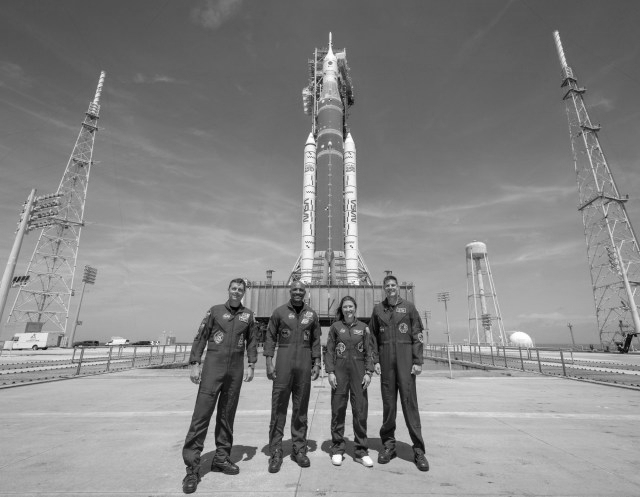
NASA begins final countdown for Artemis II, humanity’s first crewed moon mission in 53 years
NASA has begun the final countdown for humanity’s first crewed mission to the moon in more than five decades. The towering 32‑story Space Launch System (SLS) rocket is scheduled to lift off Wednesday evening at 7:45 PM EST from the Kennedy Space Center in Florida. Four astronauts aboard the Orion spacecraft will embark on a nearly 10-day journey around the moon and back . After a day orbiting Earth, Orion will set a course for the moon on a “free-return” trajectory, performing a close flyby before heading back to Earth. The mission will conclude with a splashdown in the Pacific Ocean near San Diego approximately 10 days after launch.
This will be the first time humans have traveled beyond low Earth orbit since the last Apollo mission in 1972 , and it serves as a crucial test for NASA’s broader Artemis program , which aims to land astronauts on the lunar south pole, explore new regions of the moon, and eventually prepare for human missions to Mars. Unlike future Artemis landings, Artemis II will not touch the lunar surface ; its main goal is to test spacecraft systems, life-support functions, and crew performance in deep space, while conducting scientific experiments along the way.
The mission follows several delays. A hydrogen fuel leak initially grounded Artemis II in February, and later a helium pressurization line became clogged, forcing repairs in the Vehicle Assembly Building. The rocket returned to the launch pad 1½ weeks ago , and the crew arrived at the site last Friday. NASA reports the vehicle is performing well, and forecasts predict favorable weather for the launch window.
Artemis II’s crew represents a historic moment in space exploration . Commander Reid Wiseman , a veteran U.S. Navy aviator and former International Space Station astronaut, will lead the mission. Pilot Victor Glover , a former test pilot and the first Black astronaut to fly around the moon, will operate Orion’s controls and guide navigation during the lunar flyby. Mission Specialist Christina Koch , who previously spent 328 days in space, will monitor life-support and spacecraft systems and oversee experiments. Canadian Space Agency astronaut Jeremy Hansen , the first non-U.S. citizen on a lunar mission, will contribute expertise in spacecraft systems and data collection.
During the mission, the crew will perform several key tasks. They will test the Orion spacecraft’s propulsion, navigation, and life-support systems , monitor radiation exposure, and conduct experiments on human physiological responses to deep-space travel. Orion is equipped with cameras and sensors to capture detailed images of the lunar surface, including regions near the far side and the south pole. Additionally, the spacecraft carries more than 5.6 million names submitted by the public through NASA’s “ Send Your Name to the Moon ” campaign, symbolically linking millions of people to this historic flight.
NASA has emphasized transparency and safety. Live video feeds, telemetry, and tracking by multiple independent observers will document the mission in real time, ensuring credibility and leaving no room for controversy , a response to lingering conspiracy theories about the Apollo missions.
The mission launches Wednesday at 7:45 PM EST, with a day in Earth orbit before Orion speeds toward the moon. The crew will reach their closest approach about three days after liftoff, loop around the lunar far side, and begin the return to Earth, with a Pacific splashdown expected roughly 10 days after launch. While no lunar samples will be returned, the data collected will be crucial for planning Artemis III , NASA’s first crewed moon landing with surface exploration and sample collection. The mission also unfolds amid a renewed lunar race, with China targeting crewed and robotic missions to the south pole, as NASA works to maintain U.S. leadership and prepare for future Mars expeditions.