
NAMASTE Day: Can India Finally End the Deadly Cost of Sanitation Work?
As India marks the 3rd NAMASTE Day on July 14 , the occasion is far more than an annual government observance. It serves as a reminder of a decades-long struggle to ensure that the country's sanitation workers who have quietly sustained public health and urban cleanliness can work with dignity, safety and social security . While the government celebrates three years of the National Action for Mechanized Sanitation Ecosystem (NAMASTE) Scheme, the day also invites an uncomfortable question: Has India truly moved from symbolic recognition to structural change?
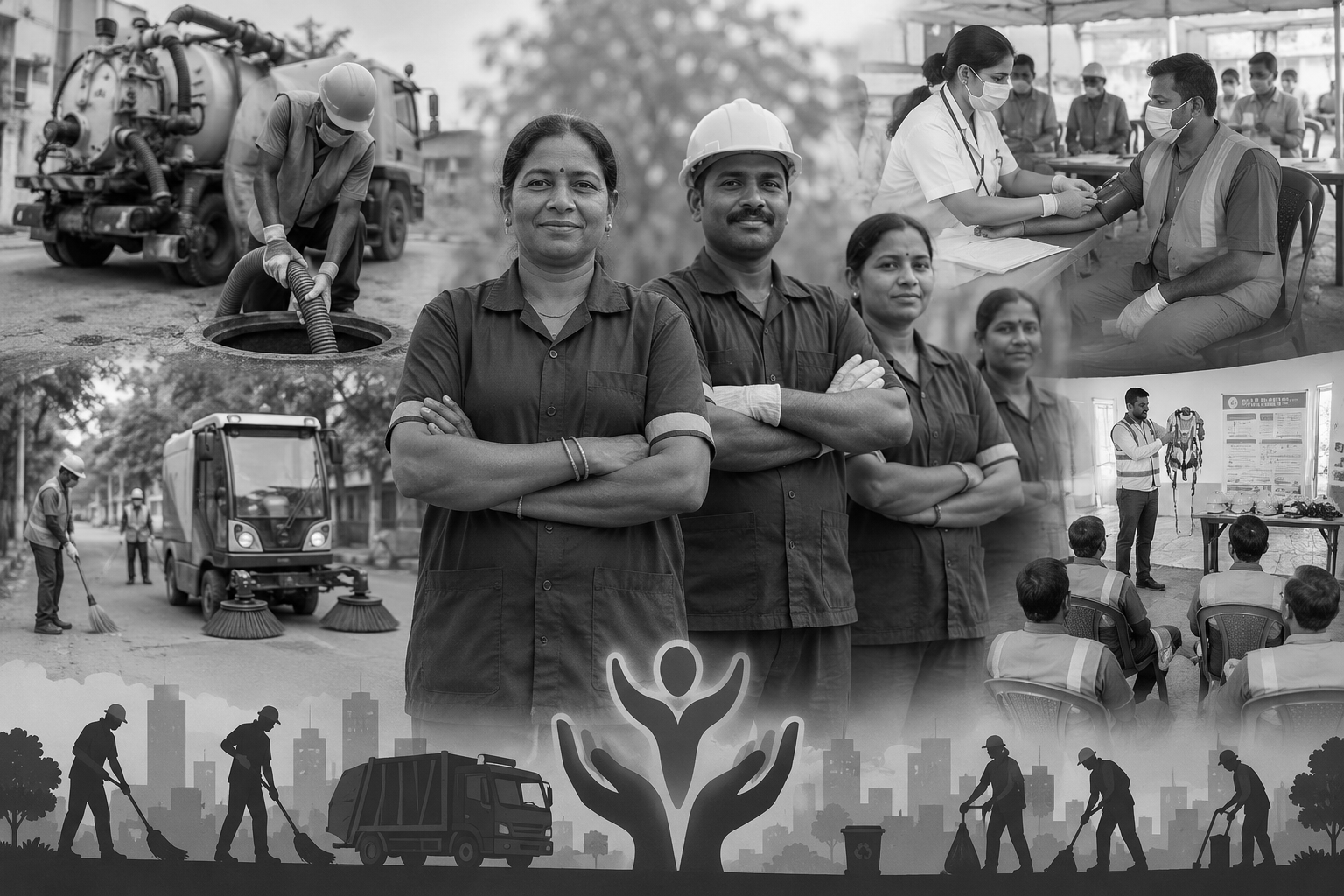
The Union Ministry of Social Justice and Empowerment will commemorate the day with the main event at Rabindra Sadan, Kolkata , alongside the DIVYA KALA MELA , while Urban Local Bodies (ULBs) across the country will organize parallel programmes. Union Minister Dr. Virendra Kumar and Minister of State Ramdas Athawale are expected to attend, with activities including occupational safety training, health camps, demonstrations of mechanized sanitation equipment, facilitation of government welfare schemes and recognition of sanitation workers for their contribution.
The observance marks three years since the launch of the NAMASTE Scheme in 2023 , which seeks to eliminate hazardous sanitation practices through mechanization while ensuring the welfare of sanitation workers. The scheme aims to achieve zero fatalities in sanitation work , eliminate direct human contact with human waste, strengthen Emergency Response Sanitation Units (ERSUs) , provide skill development, entrepreneurship support and social security, and ensure that hazardous cleaning is replaced by technology.
A profession far beyond manual scavenging
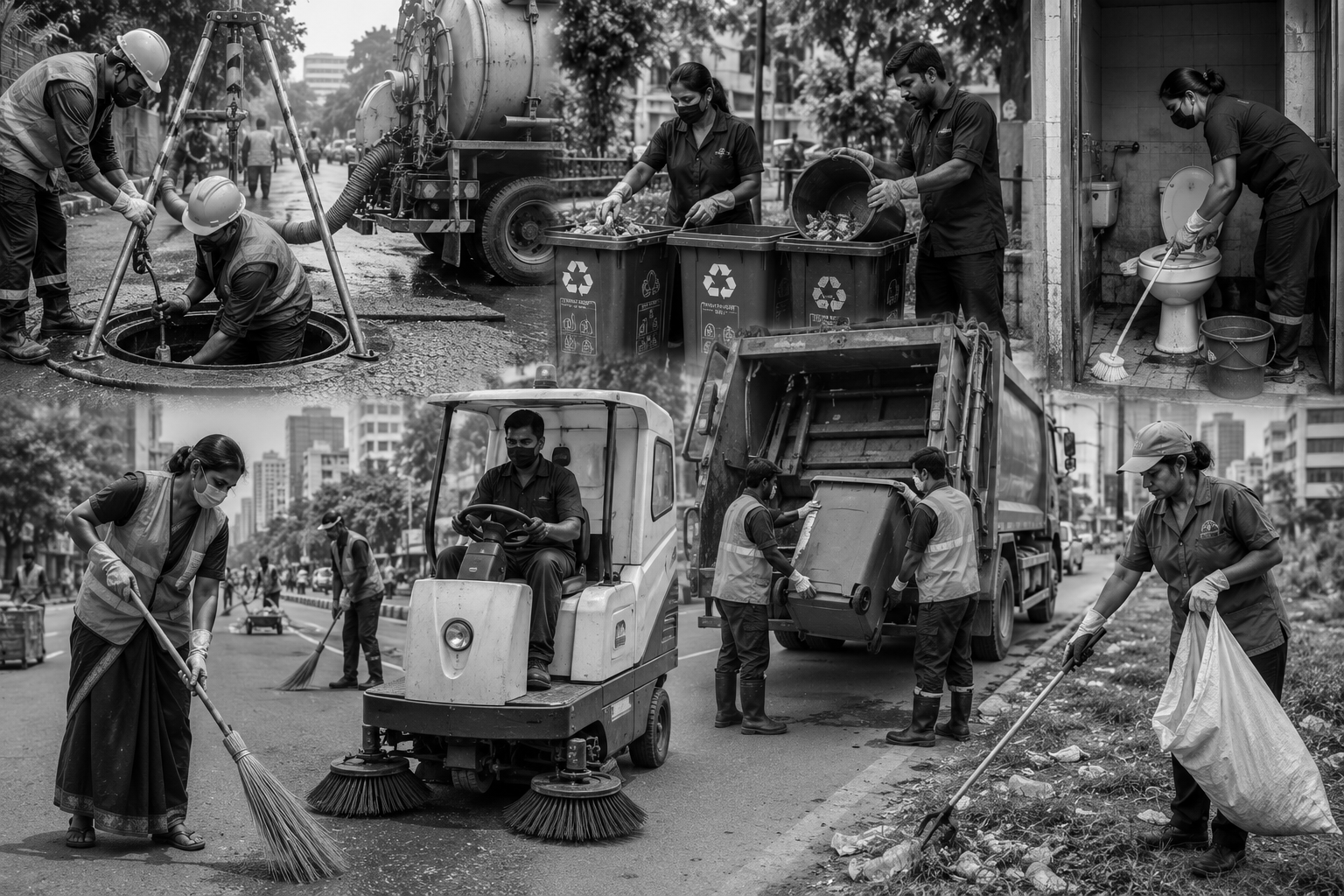
Sanitation workers in India represent a much larger workforce than manual scavengers alone. They include sewer workers, septic tank cleaners, municipal sweepers, waste pickers, drain cleaners, solid waste collectors, landfill workers, biomedical waste handlers and public toilet cleaners . Together, they form one of the country's most essential yet least visible workforces.
Despite performing an indispensable public service, many continue to face unsafe working conditions, informal employment, inadequate protective equipment, irregular wages, health risks and deep-rooted social stigma . For workers employed through contractors, the absence of written contracts, social security benefits, insurance and timely compensation remains a persistent concern.
The continuing tragedy of sewer deaths
Although manual scavenging is prohibited under the Prohibition of Employment as Manual Scavengers and their Rehabilitation Act, 2013 , hazardous sewer and septic tank cleaning continues to claim lives.
According to official government data, 859 sanitation workers lost their lives while cleaning sewers and septic tanks between 2014 and 2025 . Independent organisations, including the Safai Karamchari Andolan (SKA) , contend that the actual toll is significantly higher because many deaths go unreported or are not officially classified as hazardous sanitation work.
The National Commission for Safai Karamcharis (NCSK) , which maintains the government's cumulative database, records 28 sewer and septic tank deaths in Andhra Pradesh and 26 in Telangana up to October 2025 . Nationally, Uttar Pradesh recorded the highest number of deaths during the 2014–2025 period, while cumulative records since 1993 show Tamil Nadu, Gujarat, Uttar Pradesh, Delhi and Haryana among the worst-affected states.
A movement that transformed the national conversation
Much of India's policy response has been shaped by sustained activism led by the Safai Karamchari Andolan , founded in 1993 by Bezwada Wilson , one of India's foremost human rights defenders on sanitation workers' rights and recipient of the 2016 Ramon Magsaysay Award .
Born into a family engaged in manual scavenging in Kolar Gold Fields , Wilson rejected the caste-based occupation imposed on his community and dedicated his life to ending the practice. Under his leadership, SKA documented manual scavengers across the country, verified sewer deaths, supported affected families and pressed governments to enforce anti-manual scavenging laws.
The movement's most significant intervention came through the landmark Safai Karamchari Andolan vs Union of India case. In its 2014 judgment , the Supreme Court directed governments to eradicate manual scavenging, rehabilitate identified workers, mechanize hazardous sanitation work and pay ₹10 lakh compensation to the family of every sanitation worker who dies while cleaning a sewer or septic tank. The judgment also recognised manual scavenging as a violation of the constitutional guarantees of equality, dignity and the abolition of untouchability.
Policy shifts over the past decade
The years following the Supreme Court judgment witnessed important policy changes. The launch of the NAMASTE Scheme in 2023 marked a transition from merely rehabilitating workers to preventing hazardous sanitation work altogether.
Implemented jointly by the Department of Social Justice and Empowerment and the Ministry of Housing and Urban Affairs , with support from the National Safai Karamcharis Finance and Development Corporation (NSKFDC) , the scheme provides worker profiling, safety training, mechanized cleaning equipment, entrepreneurship support, health insurance and protective equipment. In 2024 , its scope was expanded to include waste pickers .
Official data indicates that around 89,248 sewer and septic tank workers have been identified and profiled, approximately 87,000 Personal Protective Equipment (PPE) kits have been distributed and more than 75,000 workers have been linked to health insurance.
The scheme was allocated ₹97.41 crore in 2023–24 , followed by ₹130 crore each in 2024–25 and 2025–26 . Much of the expenditure has been directed towards worker profiling, procurement of mechanized equipment, safety devices, Emergency Response Sanitation Units, training, entrepreneurship support and public awareness campaigns.
Safety standards exist but implementation remains uneven
Government guidelines require that workers entering confined spaces should be equipped with helmets, respirators, gloves, safety shoes, harnesses, gas detectors, oxygen monitors, rescue tripods and emergency response systems . The principle under NAMASTE is that human entry into sewers should be an exception rather than the norm .
However, investigations into recent sewer deaths frequently reveal workers entering toxic manholes without breathing apparatus, gas detectors, harnesses or rescue equipment . Activists argue that many municipalities continue to rely on manual methods despite the availability of mechanized alternatives.
The problem is particularly acute in smaller towns, where limited resources, inadequate maintenance of machines and dependence on contract labour often result in continued manual intervention.
Compensation and rehabilitation
Families of sanitation workers who die while cleaning sewers or septic tanks are entitled to ₹10 lakh compensation , as directed by the Supreme Court. Beyond this, the law provides rehabilitation measures including one-time cash assistance, scholarships for children, housing support, skill development, concessional loans and alternative livelihood opportunities .
Yet, activists say that delays in compensation, incomplete rehabilitation and lack of sustainable employment opportunities continue to force many families back into sanitation work.
The role of institutions
Several institutions now oversee sanitation workers' welfare.
The National Commission for Safai Karamcharis (NCSK) investigates complaints, monitors compensation and rehabilitation, and advises governments on policy implementation.
The National Human Rights Commission (NHRC) has repeatedly called for complete mechanization, stronger enforcement of safety norms and protection of sanitation workers' rights.
The Central Monitoring Committee periodically reviews implementation of the 2013 Act and the NAMASTE Scheme , while Parliamentary Standing Committees have consistently recommended increased mechanization, better funding and stronger labour protections.
Cinema and public consciousness
Public awareness has also expanded through cinema and documentary filmmaking.
The acclaimed Marathi film 'Court' (2014), directed by Chaitanya Tamhane , used the death of a sanitation worker in a sewer to expose systemic failures within the justice system and labour conditions. The Tamil film 'Witness' (2022) directly examined sewer deaths, contractor negligence and the struggle for justice, while the documentary 'Kakkoos' highlighted the lived experiences of manual scavengers and caste-based discrimination.
These works have helped move the issue from policy circles into mainstream public discourse, generating empathy and national attention for workers whose lives often remained invisible.
Despite stronger laws, higher budget allocations and the rollout of the NAMASTE Scheme , significant challenges continue to hinder the welfare of sanitation workers. Human entry into sewers still occurs despite official prohibitions, contract workers often lack adequate social security and protective equipment, rehabilitation remains incomplete, and many smaller municipalities lag in adopting mechanized sanitation. Experts stress the need for stricter enforcement of safety norms, greater accountability for contractors, transparent reporting of sewer deaths, universal access to quality PPE, regular health screenings, mental health support and comprehensive social security. As India marks the 3rd NAMASTE Day , the occasion presents an opportunity to move beyond symbolic recognition by making it an annual platform for accountability, safety audits, technology adoption and worker welfare. While the country has made notable progress in mechanization, compensation and worker profiling, the true success of the initiative will depend on ensuring that every sanitation worker can perform their duties with dignity, safety and equal protection, without risking their life in the line of duty.