
Najeeb Ahmad’s Disappearance: 10 Years of Unanswered Questions and Legal Battles
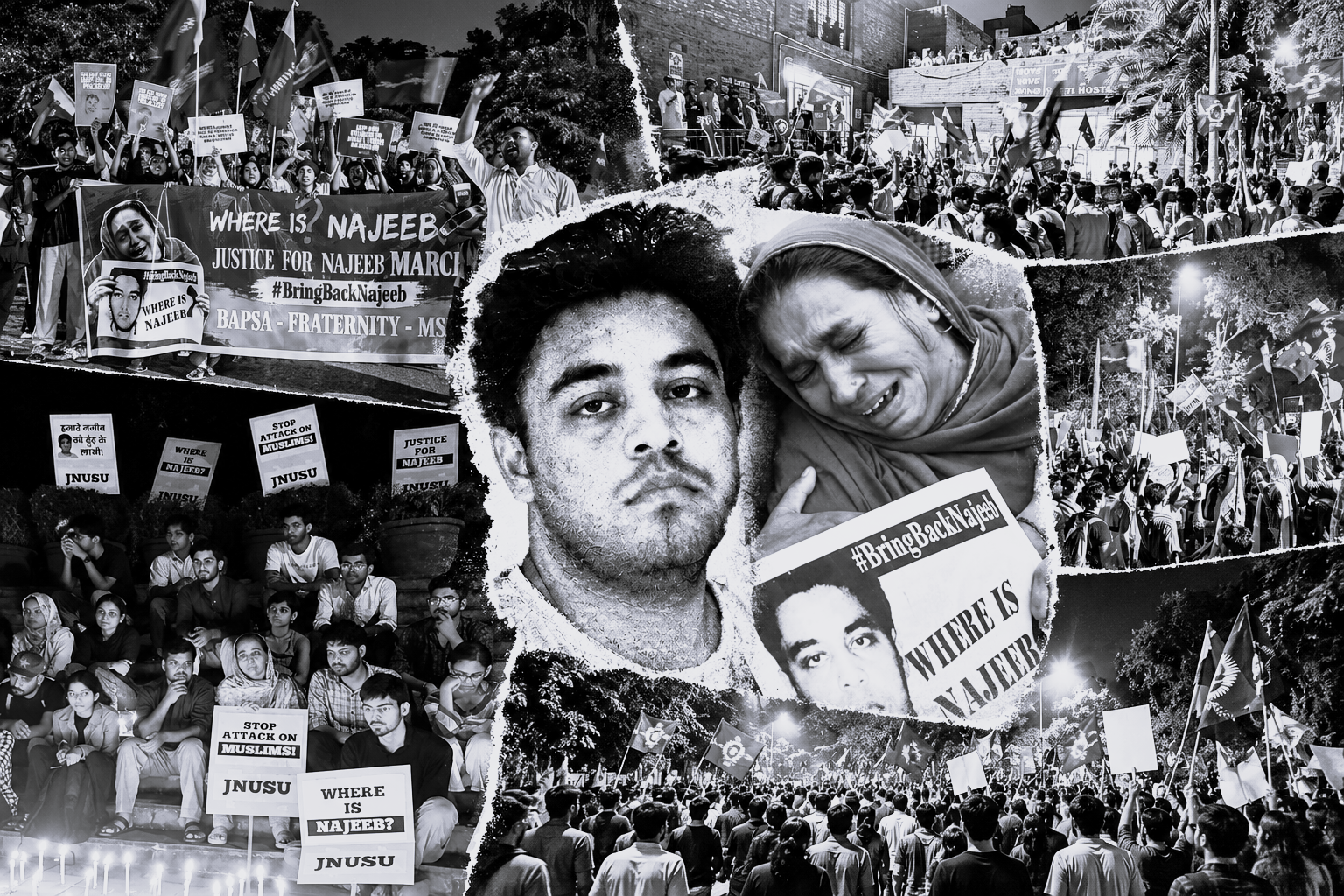
The Jawaharlal Nehru University Students’ Union (JNUSU) has marked ten years since student Najeeb Ahmad disappeared from the campus, demanding answers from the Delhi Police and justice for his family. A decade after the 27-year-old MSc Biotechnology student went missing on October 15, 2016, his whereabouts remain unknown despite extensive searches, a prolonged CBI investigation and years of court proceedings. Recent judicial directions for further forensic examination have renewed questions about the case.
At a gathering at the campus hunger strike site, JNUSU joint secretary Danish Ali accused the university administration and investigating agencies of failing to establish accountability. She alleged that an auto-rickshaw driver was made to claim Ahmad had left the campus in his vehicle and criticised the CBI for failing to trace him. Ali also questioned the role of former vice-chancellor Mamidala Jagadesh Kumar and alleged that Ahmad’s disappearance created fear among Muslim students.
Ahmad disappeared after an altercation involving students affiliated with the Akhil Bharatiya Vidyarthi Parishad (ABVP) at the Mahi-Mandavi hostel on October 14, 2016. Witness statements supported allegations of physical assault and verbal threats, but investigators could not establish a direct link between the confrontation and his disappearance. His mother, Fatima Nafees, approached the Delhi High Court in November 2016 seeking his whereabouts.
The Delhi Police conducted extensive searches, including a two-day operation involving approximately 560 personnel across JNU’s 1,019-acre campus. The investigation was transferred to the Central Bureau of Investigation (CBI) on May 16, 2017. The agency questioned 26 people, examined electronic evidence and pursued leads across multiple cities but failed to locate Ahmad.
In 2018, the CBI filed a closure report. A Delhi court accepted it on June 30, 2025, finding insufficient evidence connecting the hostel altercation to the disappearance. In December 2025, the Delhi High Court directed further forensic examination of mobile phones belonging to three witnesses, subject to the availability of suitable tools. A January 2026 court order facilitated retrieval of the original forensic report for re-examination.
Student organisations, including BAPSA, Fraternity Movement and MSF, organised a “Justice for Najeeb” march on October 14, demanding accountability and renewed efforts to establish his whereabouts. The case remains unresolved, with further forensic findings potentially offering new leads.