
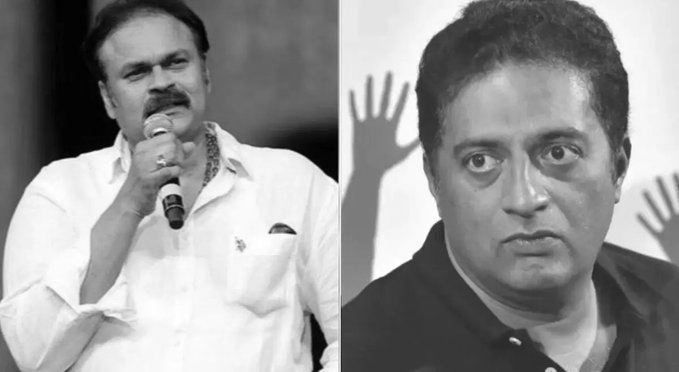
Nagababu condemns Prakash Raj remarks on lord Rama
The controversy surrounding actor Prakash Raj’s remarks on Lord Rama has intensified further after actor-politician Nagababu issued a strong condemnation on X , while the issue has already triggered a legal complaint and widespread backlash .
The row began after Prakash Raj’s interpretation of the Ramayana during a public literary discussion went viral online. His comments reportedly included a symbolic retelling of the epic, where he referred to Lord Rama and Lakshmana entering Ravana’s territory and taking fruits. The statements were widely criticised for allegedly distorting a sacred narrative and hurting religious sentiments.
In the viral discussion, Prakash Raj is also quoted as saying that people should not treat epics as untouchable texts but as narratives open to interpretation and questioning , adding that “stories evolve with society and should be seen through a modern lens.” These remarks triggered strong reactions across social media.
Amid the growing backlash, a criminal complaint was filed against him , with allegations that his comments were offensive and inflammatory. The controversy quickly moved beyond online debate into a formal legal and political issue.
Reacting strongly, Nagababu wrote on X, “Sri Rama is not just a deity for Hindus; He is the very embodiment of dharma, the eternal light of truth and justice. Insulting or demeaning Him is not an act of courage…” He further added that those who mock Rama only harm themselves and stated that dharma is indestructible , calling Sri Rama the embodiment of truth and justice .
His post has gone viral, intensifying the debate and drawing both support and criticism from different sections of social media users.
Interestingly, both Nagababu and Prakash Raj have at different points been associated with atheist or non-religious viewpoints , but have occasionally engaged in discussions involving faith, mythology, and culture, adding complexity to their public positions.
The controversy has now become a wider cultural flashpoint, dividing opinion between those defending artistic freedom and interpretation and those demanding respect for religious sentiments and tradition .