
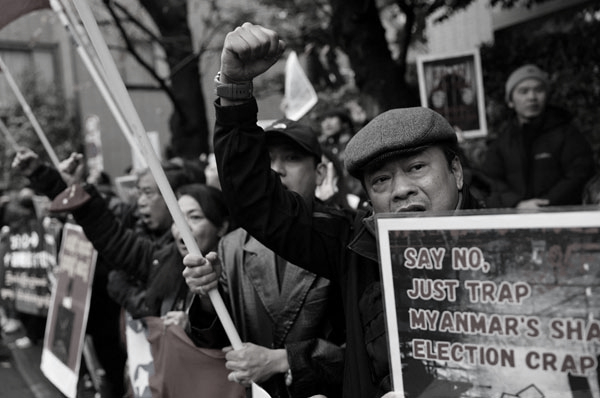
Myanmar’s junta set to begin first phase of election tomorrow
Myanmar is holding the first phase of a general election on Sunday, its first nationwide vote in five years, amid ongoing civil war, humanitarian crisis, and widespread skepticism about its credibility. Voting will take place in 102 townships in the first phase, with further rounds on January 11 and January 25 . Many areas, particularly those controlled by ethnic armed groups, will not participate, leaving large parts of the country excluded . The military has framed the polls as a return to multi-party democracy and a way to end emergency rule imposed after the 2021 coup that ousted Aung San Suu Kyi’s government, alleging without evidence that the 2020 election was fraudulent. Independent observers found no major irregularities in that vote, which Suu Kyi’s National League for Democracy won in a landslide.
Critics argue the election lacks basic legitimacy. Major pro-democracy parties, including the National League for Democracy, have been barred or dissolved under strict new rules requiring all parties to re-register, shrinking meaningful competition. The junta’s Election Protection Law criminalizes criticism of the polls and other political activity, and hundreds of activists, artists, and journalists have been charged, facing penalties ranging up to long prison terms or even death. With opposition parties absent, the military-backed Union Solidarity and Development Party is expected to dominate, likely consolidating power for Senior General Min Aung Hlaing. Constitutional provisions guaranteeing military seats further skew outcomes in the junta’s favor.
The election unfolds amid severe violence and a humanitarian crisis. Tens of thousands of political opponents have been detained, thousands of civilians killed, and more than 3.6 million people displaced by ongoing fighting. Both military authorities and armed opposition groups have threatened communities regarding participation. Local officials and militias have pressured residents to vote, while opposition coalitions have urged symbolic boycotts and stay-at-home campaigns. Analysts warn that the polls may reinforce military control rather than restore civilian rule, potentially fueling further conflict as resistance forces and disenfranchised citizens contest the results.
Myanmar’s instability has deep historical roots. After gaining independence from Britain in 1948, the country struggled to unify its ethnically diverse population of more than 135 groups. Promises of autonomy to communities like the Karens in the south and southeast, the Shans in the east, and the Kachins in the north were often broken, leading to decades-long civil wars. The Karen rebellion, which began in 1948, became one of the world’s longest-running internal conflicts, and successive military operations have repeatedly reignited fighting. Geographic isolation of hill and river valley regions fostered distinct ethnic identities, while colonial policies that categorized populations by ethnicity deepened divisions. Weapons flows during World War II and subsequent military coups entrenched armed ethnic groups and militias, further complicating national unity.
Analysts note that Myanmar has historically existed as a loose federation rather than a unified state. Central Burman dominance over the army and politics often marginalized minority communities, fueling resentment and rebellion. Ethnic armed groups generally prioritize defending their own territories rather than seeking national power, a dynamic that persists today. Observers say the current election, held amid ongoing conflict and exclusion, reflects this long-standing pattern: a veneer of democracy overlaying deep ethnic, political, and military fractures, with uncertain prospects for peace or national cohesion.
International reaction has been sharply critical. Western governments and the United Nations have condemned the elections as deeply flawed and unlikely to bring legitimacy or peace, maintaining sanctions on the junta. By contrast, neighboring countries such as China, India, and Thailand have engaged cautiously, citing regional stability, while some ASEAN members express frustration that the vote fails to meet agreed standards for inclusivity and credible dialogue. China’s influence and support for the military could benefit Beijing strategically, giving it economic and political leverage over Myanmar.
However, for India , Myanmar’s stability is critical. As India’s immediate neighbor and a gateway to its northeast, a stable and friendly Myanmar is essential for border security, trade, and regional connectivity. While China may gain influence through the military, India must continue engagement with Myanmar to ensure peaceful and cooperative relations. Strategic diplomacy, development cooperation, and maintaining dialogue with both the government and local stakeholders are crucial for India to promote stability, peace, and good neighborly ties.