
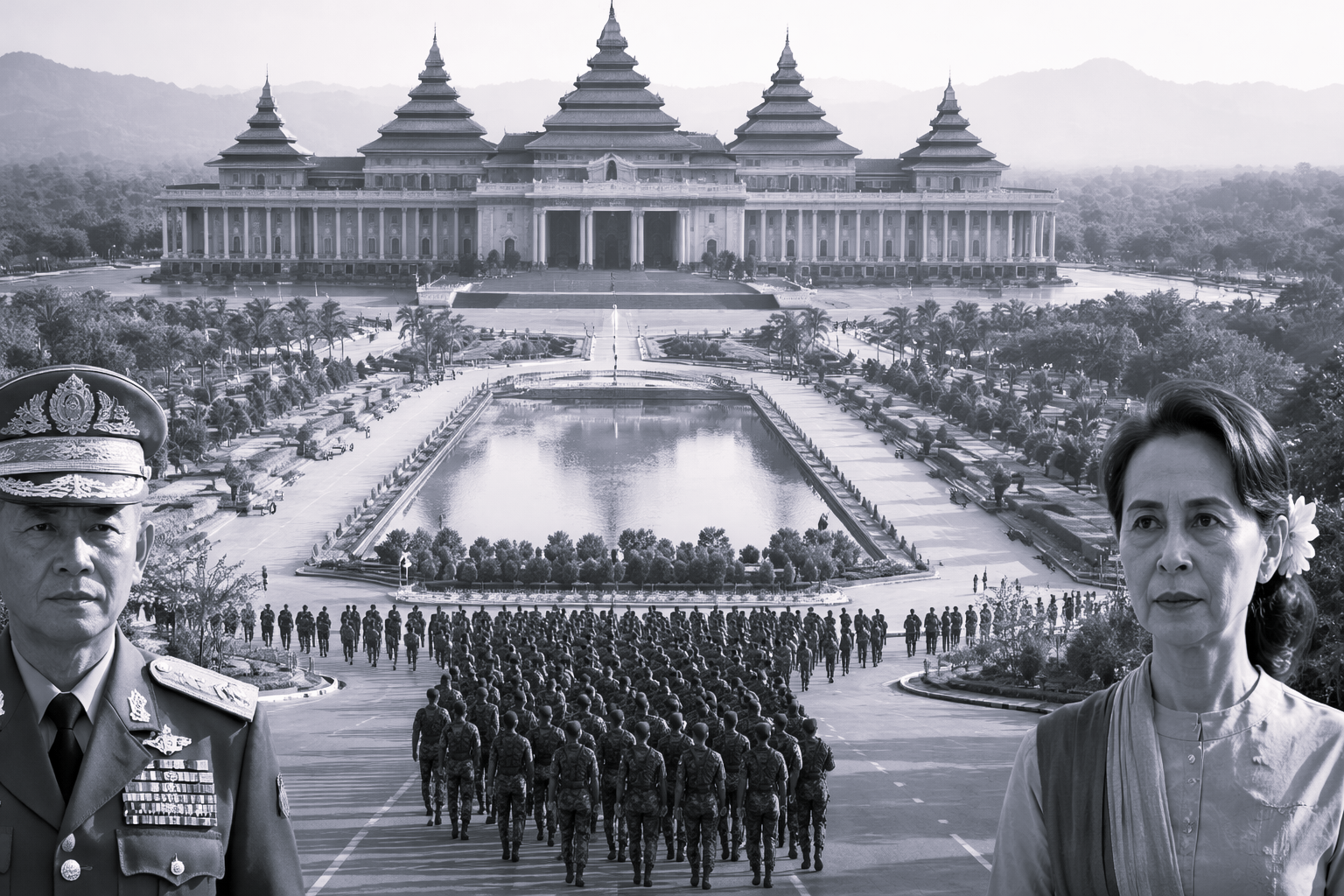
Myanmar Parliament to Meet After Controversial Polls, Military Grip Set to Continue
Myanmar’s newly elected parliament is scheduled to convene on March 16 , marking its first session in over five years following the 2021 military coup that overthrew the elected government of Aung San Suu Kyi and plunged the country into widespread unrest and civil conflict. The upcoming session comes after phased elections held in December and January , which were widely criticized both domestically and internationally for failing to meet democratic standards. The elections delivered a sweeping victory to the military-backed Union Solidarity and Development Party (USDP) , which, along with the 166 seats automatically reserved for the armed forces under the constitution , gives the military and its allies control of over 86 percent of the legislature . This overwhelming majority ensures the continued dominance of the military in Myanmar’s political system.
The vote was boycotted by the National League for Democracy (NLD) , the party formerly led by detained leader Aung San Suu Kyi , which refused to participate under the strict rules imposed by the military junta. Suu Kyi, now 80, is serving a 27-year prison sentence on charges widely regarded as politically motivated , further fueling international condemnation. State media reported that the lower house will convene on March 16 , followed by the upper chamber two days later in the capital, Naypyitaw . The new parliament’s immediate tasks will include electing speakers for both houses and selecting a president and two vice presidents . Senior General Min Aung Hlaing , the head of the military junta, is widely expected to assume the presidency, though constitutional provisions technically bar a president from simultaneously serving as commander-in-chief of the armed forces , leaving ambiguity over the consolidation of military power.
While the military government portrays the parliamentary session as a step toward constitutional governance , observers argue that the process effectively institutionalizes army rule through electoral means . Myanmar has remained engulfed in violence and unrest since the coup, with nationwide protests, armed resistance movements, and a gradually escalating civil conflict . Several conflict-affected regions were unable to hold voting, undermining the credibility of the elections and raising questions about the legitimacy of the new legislature. Analysts note that despite the appearance of institutional politics, the country’s deeper crisis remains unresolved, with the exclusion of opposition forces and continued concentration of power in military hands.
For India , these developments carry significant strategic implications . Myanmar shares a long and sensitive border with India’s northeast, making the stability of the country critical to New Delhi’s security and regional connectivity ambitions . Myanmar is a key partner for India in ensuring border stability and controlling insurgent movements along its northeastern frontier. It is also central to several major infrastructure initiatives, including the Kaladan multimodal transit corridor and the India-Myanmar-Thailand highway , which aim to improve trade and strategic access to Southeast Asia. Continued military dominance in Myanmar therefore forces India to balance its support for democratic principles with the practical need to engage the junta , safeguarding border security, regional connectivity, and broader strategic influence — particularly amid concerns about China’s expanding role in Myanmar (India must carefully manage its relationship with Myanmar’s military government to protect border security, regional connectivity projects, and counter China’s influence).
The convening of parliament may restore the appearance of institutional governance , but the reality suggests limited prospects for genuine civilian rule or national reconciliation. With opposition parties excluded, ongoing armed conflicts, and concentrated military power, the legislature is unlikely to deliver meaningful political change in the near future . Analysts warn that the parliamentary session could primarily serve as a mechanism for legitimizing the military’s authority , rather than providing a platform for democratic governance.
In summary, while Myanmar takes the procedural step of assembling its parliament, the elections and the new legislature highlight the continuing dominance of the military , the imprisonment of opposition leaders, and the country’s unresolved political and civil crises. For India and the wider region, Myanmar’s stability remains vital for strategic and economic reasons , requiring careful diplomatic engagement amid the complex realities of military rule and regional geopolitical competition