
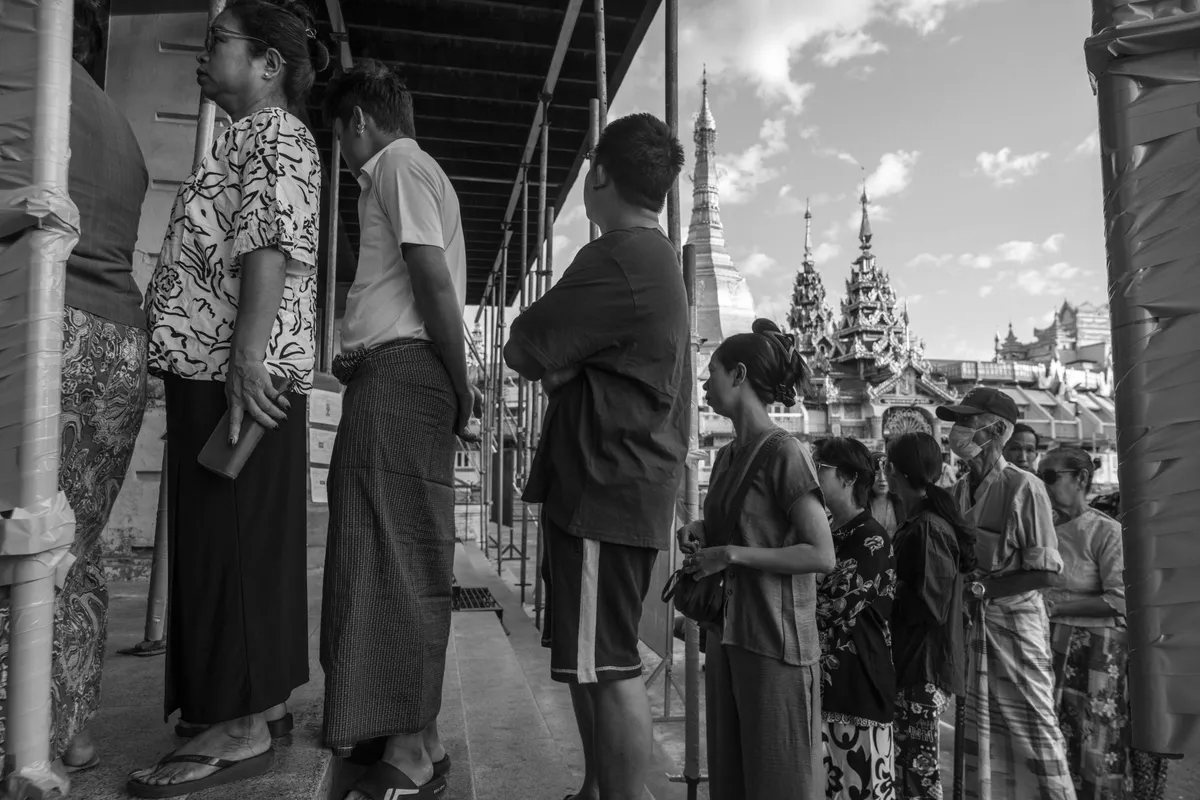
Myanmar holds general election under military supervision after five years of civil war
Voters in Myanmar went to the polls on Sunday for the first phase of the country’s first general election in five years, conducted under military supervision amid an ongoing civil war. The poll comes nearly five years after the army seized power, ousting the elected government of Aung San Suu Kyi in February 2021.
Voting took place at high schools, government buildings, and religious institutions in Yangon, the capital Naypyitaw, and other townships. Security was tightly enforced, with armed guards outside polling stations and military vehicles patrolling major roads. Electronic voting machines were used for the first time. Despite threats from opposition groups and armed resistance factions to disrupt the process, the first phase proceeded without major incidents.
Critics argue that the election is designed to give a facade of legitimacy to military rule. The National League for Democracy (NLD), which won a landslide victory in the 2020 polls, was dissolved in 2023 after refusing to register under new military rules. Suu Kyi, now 80, is serving a 27-year prison sentence on charges widely seen as politically motivated. Several other opposition parties either declined to contest or boycotted the election, citing repressive conditions and unfair rules .
Analysts say the military-backed Union Solidarity and Development Party is expected to dominate, making the nominal transition to civilian rule largely symbolic. “There is no real choice for voters,” noted Amael Vier of the Asian Network for Free Elections, pointing out that 73 per cent of voters in 2020 supported parties that no longer exist.
The ongoing civil war and harsh military crackdown have worsened conditions for ordinary citizens. Over 3.6 million people have been displaced, more than 7,600 civilians killed, and 22,000 people detained for political offenses since the 2021 coup, according to UN and local rights groups. The Election Protection Law imposes strict penalties on public criticism of the polls, further restricting freedom of expression and assembly.
UN Human Rights Chief Volker Türk said Myanmar continues to witness intensified violence and intimidation, and stressed that current conditions do not permit meaningful democratic participation. With major opposition barred and repression widespread, both analysts and the military agree that power is likely to remain with Senior Gen. Min Aung Hlaing, who led the 2021 takeover.
The election is being conducted in three phases across 330 townships , with the first phase on Sunday covering 102 townships. The second and third phases are scheduled for January 11 and 25 , with final results expected in late January. Over 4,800 candidates from 57 parties are contesting, but only six have a realistic chance of influencing national policy.
While neighbouring countries such as China, India, and Thailand may use the polls to justify continued engagement with Myanmar, Western nations have maintained sanctions against the ruling generals due to anti-democratic measures and violent crackdowns on civilians.