
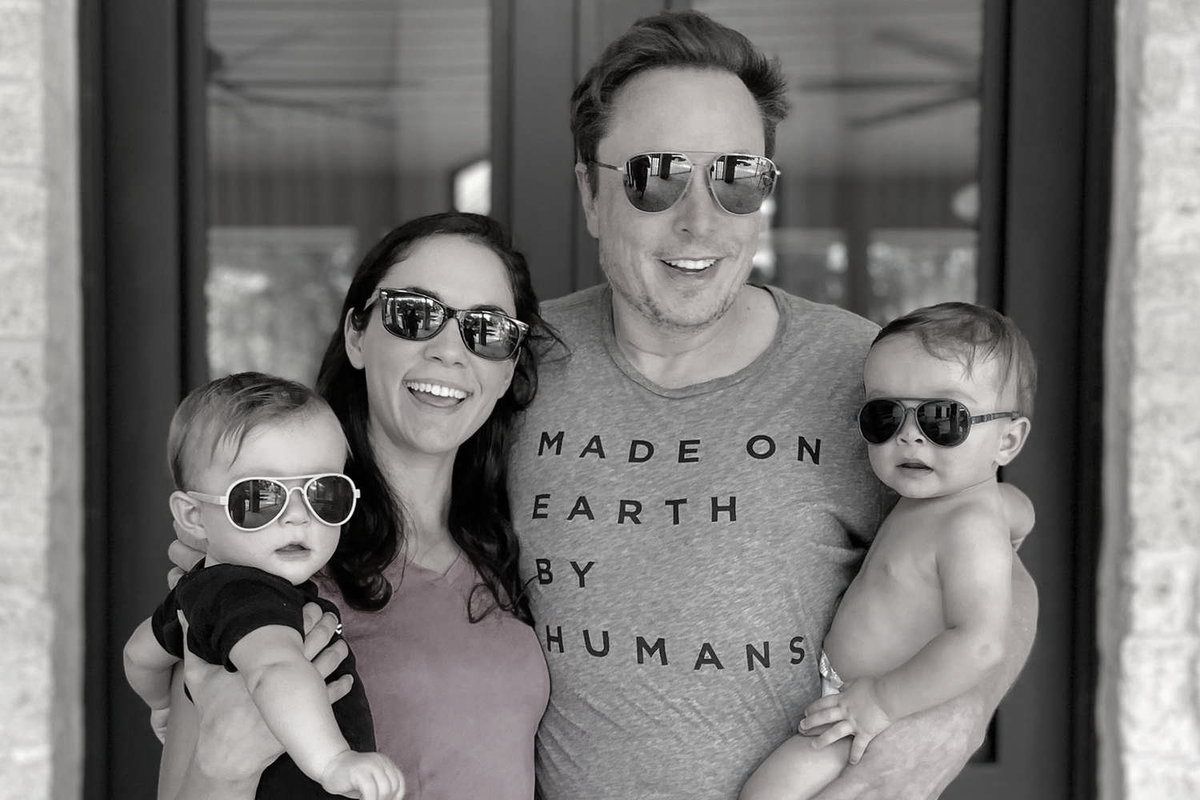
Musk reveals personal family insight: do his kids have Indian roots?
Elon Musk has surprised many by sharing one of the most personal details about his family, revealing a connection that links his children directly to India. The Tesla chief, who is known globally for his work in electric vehicles, space technology, and brain–computer interfaces, spoke candidly during a podcast with an Indian entrepreneur, offering insight into his partner’s heritage and his children’s lineage. Musk disclosed that his partner, Siobhan Zilis, is half Indian. Zilis, a Yale graduate and a senior executive at Neuralink, has long been an important figure in Musk’s circle, having previously worked with OpenAI and often being described as one of the most influential people in his professional and personal life. Several reports have even referred to her as the “most prominent of Musk’s mothers,” reflecting her unique position in his expansive family.
Musk also revealed that one of his twin sons with Zilis carries the middle name Sheekchar, inspired by Nobel Prize-winning astrophysicist Subrahmanyan Chandrasekhar. Chandrasekhar’s groundbreaking research on stellar evolution earned him the Nobel Prize in Physics in 1983, and Musk’s decision to honor him through his son’s name adds a cosmic dimension to his family story, especially given Musk’s lifelong fascination with space and astrophysics. When asked whether Zilis had any direct connection to India beyond ancestry, Musk explained that she was adopted as a baby and raised in Canada. Her biological father, according to what Musk knows, was an exchange student, though he admitted he does not know every detail about her origins. What Musk emphasized clearly was that Zilis was born to a Punjabi mother and a Canadian father, creating a family lineage for his children that stretches across India, Canada, and the United States.
The conversation then shifted toward parenthood, a topic Musk often speaks about with unmistakable passion. When the host mentioned he did not have children, Musk gently encouraged him, saying, “Well, maybe you should. You will not regret it.” He described parenthood as one of the most profound human experiences, speaking about the joy of receiving “a little creature that loves them, and they in turn love the baby.” He reflected on the marvel of watching a child develop from a tiny being who can neither talk nor walk into someone who forms their own thoughts, ideas, and identity. With a characteristic sweeping statement that blended philosophy with urgency, Musk added, “I think we fundamentally have to have kids or go extinct.”
For a man whose life is dominated by vast enterprises, futuristic visions, and groundbreaking technology, this revelation adds an unexpectedly personal and emotional chapter to his public story-one that begins in the United States, stretches into Canada, and now traces a direct and meaningful thread to India, all shared casually during a conversation about innovation, consciousness, and the future of humanity.