
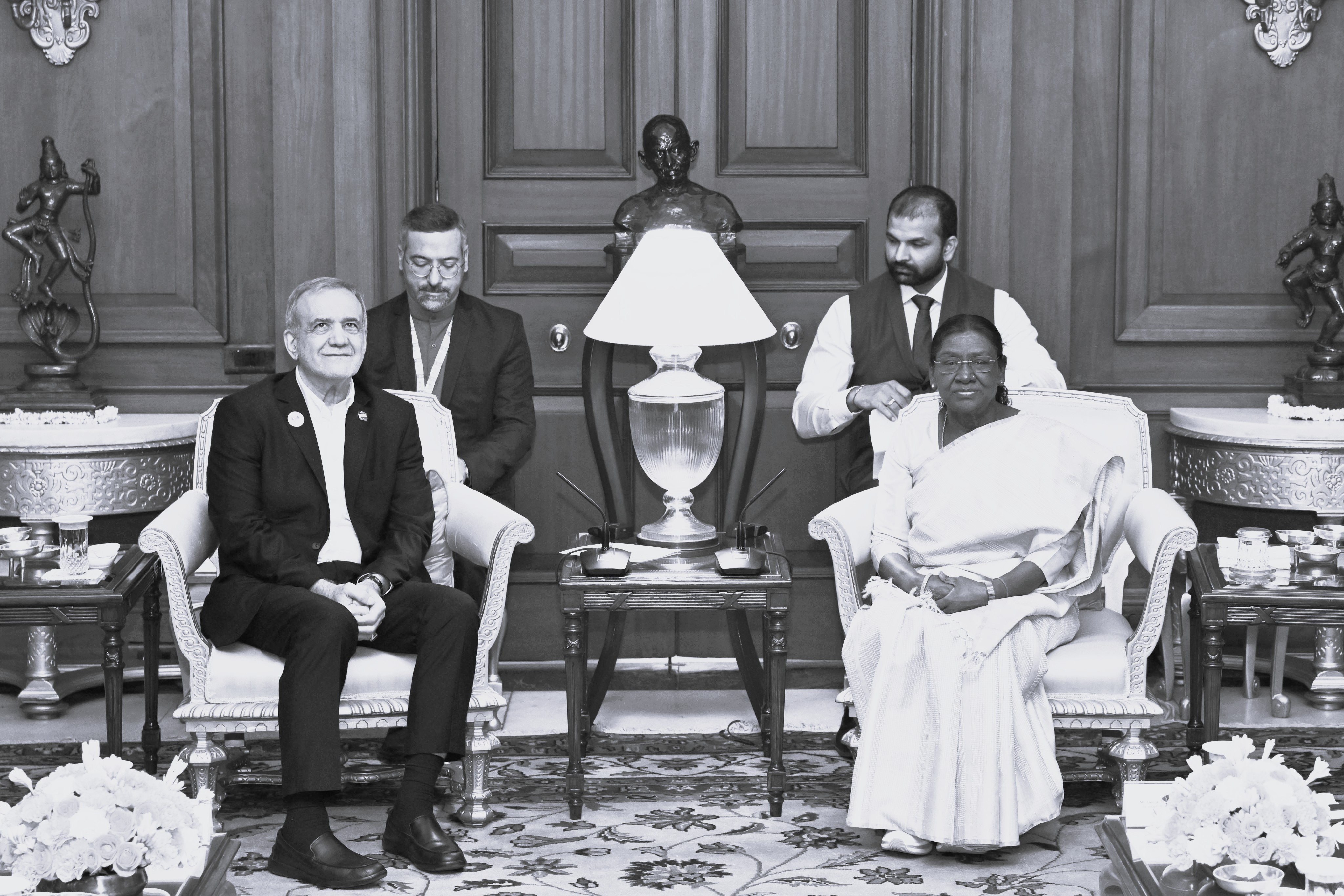
Murmu Meets Iran President Pezeshkian, Calls for Dialogue to End West Asia Conflict
President Droupadi Murmu on Saturday met Iranian President Masoud Pezeshkian at Rashtrapati Bhavan and reiterated India’s commitment to the pursuit of enduring peace in West Asia, calling for conflicts to be resolved through dialogue and diplomacy. The meeting came amid heightened regional tensions following fresh US airstrikes on Iranian targets and growing economic pressure on Tehran through sanctions.
Welcoming Pezeshkian on his first visit to India, Murmu appreciated Iran’s support during India’s BRICS presidency. The two leaders discussed the longstanding bonds of friendship between India and Iran, including their strong cultural and people-to-people ties, according to a Rashtrapati Bhavan statement.
Pezeshkian is in New Delhi for the 18th BRICS Summit, and his visit has coincided with intensified diplomatic engagement between India and Iran. A day earlier, he held talks with Prime Minister Narendra Modi, their second meeting in less than two weeks after their August 31 interaction at the Shanghai Cooperation Organisation summit in Bishkek. Modi reiterated India’s call for dialogue and diplomacy and stressed the importance of freedom of navigation and commerce and the safety of civilians, commercial shipping and seafarers.
The issue has particular significance for India because prolonged instability in West Asia could disrupt energy supplies and international trade. Any threat to the Strait of Hormuz, a crucial global energy corridor, could increase shipping, insurance and energy costs for import-dependent economies such as India.
Pezeshkian’s participation in BRICS also comes as Iran seeks deeper economic cooperation within the expanded grouping. Iran became a full BRICS member in January 2024, alongside Saudi Arabia, the UAE, Egypt and Ethiopia. At the New Delhi summit, BRICS leaders adopted a joint declaration calling for maximum restraint, dialogue and diplomacy and expressing concern over the escalation in the Middle East.
For India, the relationship with Tehran extends beyond the current crisis. Chabahar Port remains strategically important as India’s gateway towards Afghanistan and Central Asia, providing an alternative connectivity route that bypasses Pakistan. However, US sanctions on Iran and regional instability continue to complicate the project.
Pezeshkian has also advocated greater use of national currencies in BRICS trade and proposed a $10-billion joint reinsurance mechanism for infrastructure and energy projects, reflecting Tehran’s push for stronger economic ties outside Western financial systems.
The latest engagement highlights India’s delicate diplomatic balancing act between its longstanding ties with Iran and its strategic partnerships with the United States and Gulf countries. With West Asia remaining volatile, Murmu’s meeting reinforces New Delhi’s message that dialogue, diplomacy and de-escalation remain essential to achieving lasting regional stability.