
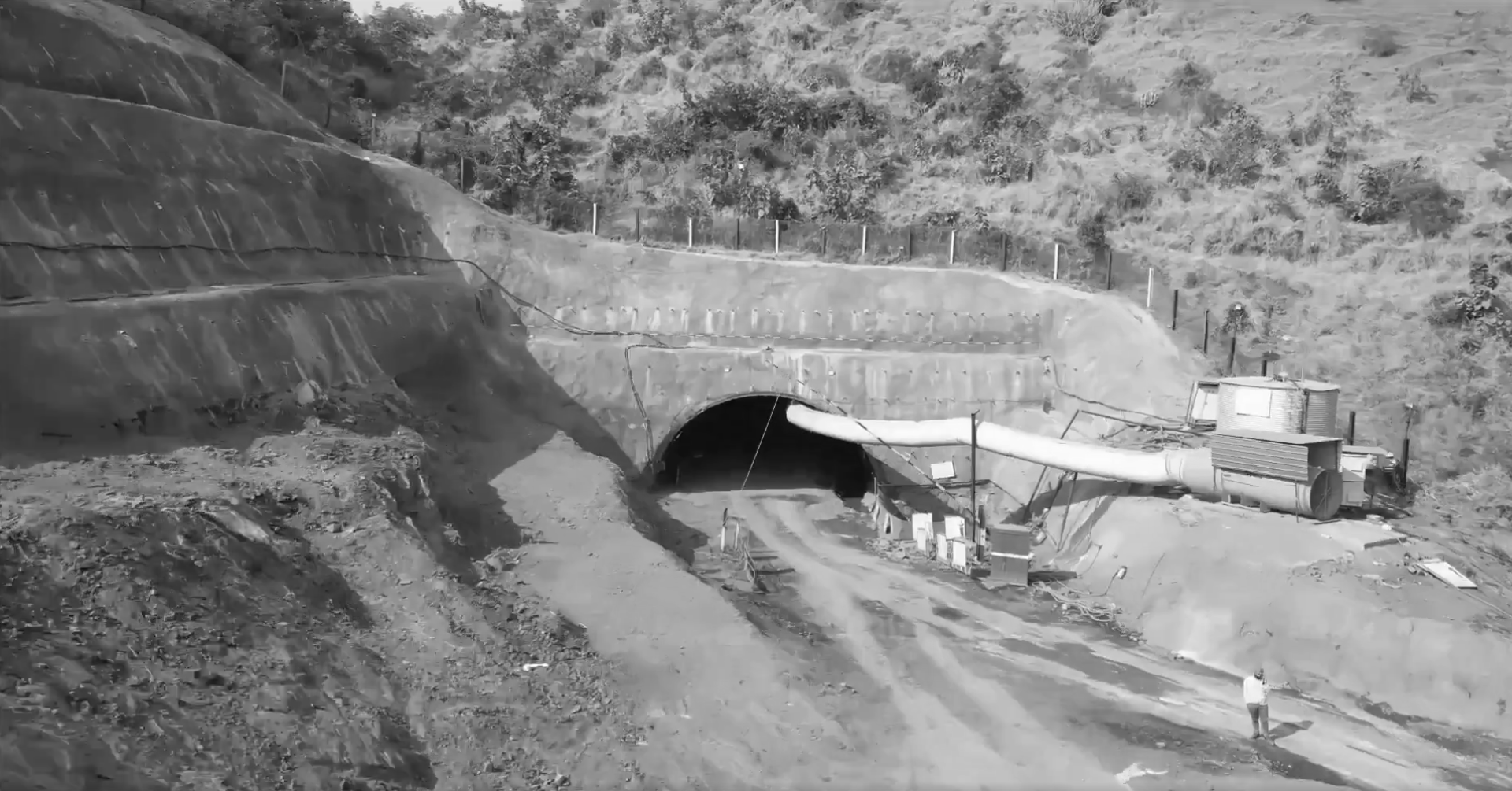
Mumbai-Ahmedabad Bullet train project hits key milestone with Palghar tunnel breakthrough
India’s first high-speed rail corridor, the Mumbai-Ahmedabad Bullet Train project , has achieved a major engineering milestone with the successful breakthrough of a key mountain tunnel in Maharashtra’s Palghar district, Railway Minister Ashwini Vaishnaw announced on Friday. The achievement marks renewed momentum for the ambitious infrastructure project that has faced multiple delays since its inception.
Speaking at a press conference, Vaishnaw said the breakthrough was achieved at Mountain Tunnel-5 (MT-5) , the first and longest among the seven mountain tunnels planned in Maharashtra. “This is a major milestone in the Bullet Train Project. In the entire corridor, there are seven mountain tunnels and one undersea tunnel,” he said.
The Mumbai-Ahmedabad High-Speed Rail Corridor, India’s maiden bullet train project, was formally launched in 2017 , with construction work beginning in phases thereafter. The corridor spans 508 kilometres , connecting key urban and industrial centres across Maharashtra, Gujarat and Dadra & Nagar Haveli.
Of the total alignment, 27.4 kilometres will pass through tunnels, including 21 km underground and 6.4 km of surface tunnels . The project includes eight mountain tunnels, seven in Maharashtra with a combined length of 6.05 km , and one in Gujarat measuring 350 metres .
MT-5 in Palghar measures 1.48 km (1.39 km excluding portals and hood) and is the first mountain tunnel to be completed. Earlier, in September 2025 , the project achieved another critical milestone with the completion of the first underground tunnel between Thane and Mumbai’s Bandra-Kurla Complex (BKC), nearly five kilometres long.
The corridor is being implemented by the National High-Speed Rail Corporation Limited (NHSRCL) , a special purpose vehicle jointly owned by the Government of India and the governments of Maharashtra and Gujarat .
India is receiving substantial financial and technical assistance from Japan for the project. The Japan International Cooperation Agency (JICA) is providing a concessional loan covering nearly 80% of the total project cost, along with access to Japanese Shinkansen technology , internationally regarded for its safety and precision.
The total estimated cost of the project stands at approximately ₹1.08 lakh crore . The trains are designed to operate at speeds of up to 320 kmph , with commercial operations expected around 300 kmph .
According to official estimates, over 60% of the project’s civil construction work has been completed, including viaducts, river bridges, and foundations across both states.
The project was initially targeted for completion by 2023 , but faced significant delays due to land acquisition challenges, environmental litigation, and administrative approvals, particularly in Maharashtra.
The current official timeline now targets phased completion by 2028 , with sections in Gujarat expected to become operational earlier.
Vaishnaw noted that prolonged delays during the tenure of the previous Maharashtra government led to changes in operational planning. “Normally, a corridor of this length would require two depots. However, due to delays in permissions and approvals, three depots had to be planned to ensure operational efficiency,” he said.
Last month, the project completed the launch of a 130-metre steel span , part of a 230-metre-long continuous steel bridge , over National Highway-64 and the Bharuch-Dahej freight rail line near Kanthariya village in Gujarat. The bridge, fabricated in Bhuj , weighs nearly 2,780 metric tonnes and has a design life of 100 years .
Built with advanced engineering techniques, the corridor features viaducts across nearly 85% of the route (465 km) to minimise land acquisition and environmental impact. So far, 326 km of viaduct work and 17 out of 25 planned river bridges have been completed.
The project has faced environmental protests, particularly in Maharashtra, over concerns related to mangrove destruction, land acquisition and urban ecology, especially around Mumbai’s BKC and Palghar regions. Environmental groups had earlier approached courts, resulting in temporary slowdowns. Authorities maintain that compensatory afforestation, elevated viaducts and mitigation measures have been incorporated to reduce ecological impact.
Once operational, the bullet train will reduce travel time between Mumbai and Ahmedabad to about two hours , compared to the current six to seven hours. Officials say the corridor will significantly boost business travel, tourism, logistics efficiency and regional economic integration, particularly across industrial hubs such as Surat, Vadodara, Bharuch and Thane.
The project is also expected to generate large-scale employment during construction and operations, while placing India among a select group of countries with operational high-speed rail systems.
With tunnelling breakthroughs, bridge launches and accelerating viaduct construction, the Mumbai-Ahmedabad Bullet Train project is now entering a decisive phaseone that could redefine long-distance rail travel and infrastructure development in India.