
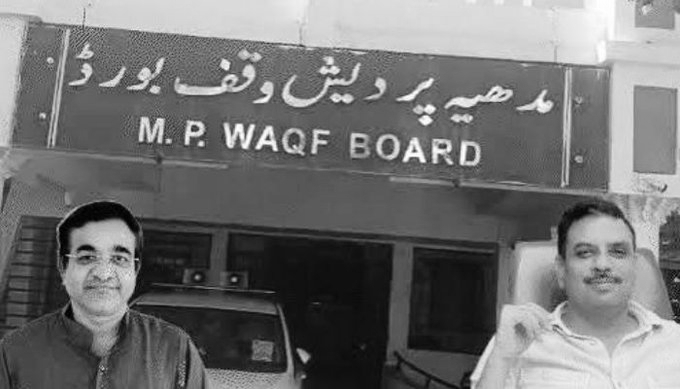
MP Becomes First State to Include 2 Hindus in State Waqf Board Under New Waqf Act
Well, that certainly did not take long. Madhya Pradesh has become the first state in the country to reconstitute its Waqf Board under the amended Waqf Act, 2025 , and in a move that is sure to generate its fair share of chatter, the board now includes two Hindu members for the first time ever. Nothing says smooth transition quite like reshaping a centuries old Islamic endowment body and immediately making headlines for who is not traditionally supposed to be on it.
Chief Minister Mohan Yadav wasted no time exercising powers under Section 13 of the amended Act, with a gazette notification appointing Sanwar Patel as chairman of the newly formed 10 member board. Joining him are Manoj Malpani from Indore and Animesh Bhargava from Raghogarh in Guna, both Hindu appointees whose inclusion officials are calling a historic step toward broader representation, though broader representation of what exactly remains a question worth asking.
The rest of the board reads like a fairly standard political roll call, featuring Najma Heptulla , MLA Atif Aqueel from Bhopal North, Faizan Khan, Fatema Choudhary, Shaista Sultan and Shabana Khan, alongside the Commissioner of Backward Classes and Minority Welfare thrown in for good measure. Quite the ensemble cast for what is supposed to be a straightforward property management body.
Government officials, predictably, are framing this as a triumph of efficiency, transparency and inclusiveness, insisting the reshuffle will help tackle long pending issues around encroachment and mismanagement of Waqf properties . Whether swapping in a couple of Hindu members magically solves decades of administrative tangles is a question nobody in the announcement seemed particularly eager to answer.
Unsurprisingly, public reaction has been anything but unanimous. Some have welcomed the move as a sign of healthy cooperation in a secular nation, while others have pointedly asked whether the new Hindu members actually possess any expertise in Islamic property law or whether their appointment is simply symbolic politics dressed up as reform. There is also the rather obvious concern that the voices of the board's Muslim members could end up sidelined in a body historically meant to serve the Muslim community's religious and charitable interests.
Supporters call it a masterstroke aimed at cleaning up years of alleged mismanagement, while critics see a state government eager to set a precedent for others to follow, whether or not that precedent was actually necessary. Either way,