
Mosquitoes in the Metropolis: Why India’s Cities Need a Stronger Health Defence
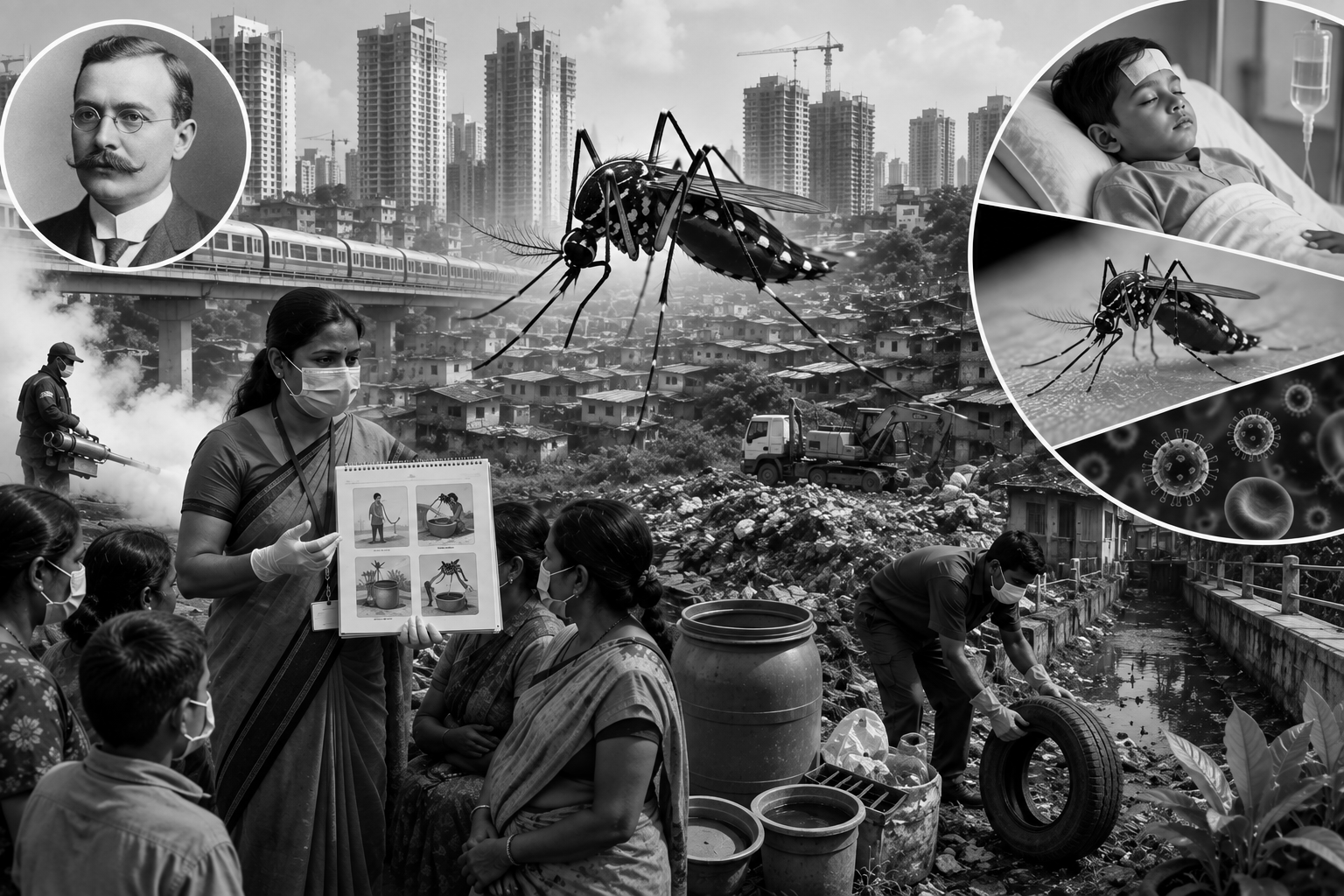
A mosquito may weigh only a few milligrams, but its impact on human health is enormous. Every year, dengue, malaria, chikungunya and Japanese encephalitis affect millions of people worldwide, placing pressure on families, hospitals and public-health systems. In India, the challenge is becoming particularly complex in rapidly expanding metropolitan areas, where urbanisation, construction, inadequate drainage, water storage and poor solid-waste management can combine to create favourable conditions for mosquitoes.
Observed every year on August 20, World Mosquito Day commemorates the landmark discovery made by British physician Sir Ronald Ross in India in 1897. While working in Secunderabad, Ross established the link between mosquitoes and malaria transmission by identifying developmental stages of the malaria parasite inside an Anopheles mosquito. His discovery transformed scientific understanding of malaria and later earned him the Nobel Prize in Physiology or Medicine.
Nearly 130 years later, the significance of that discovery has expanded. Mosquitoes transmit a wide range of viral and parasitic diseases. Dengue, chikungunya, Japanese encephalitis, Zika, West Nile fever and yellow fever are viral infections, while malaria is caused by Plasmodium parasites and lymphatic filariasis by parasitic worms. WHO estimates that vector-borne diseases account for more than 17% of infectious diseases worldwide and cause more than 700,000 deaths annually.
Why Cities Are Particularly Vulnerable
Dengue has traditionally been associated strongly with urban and semi-urban environments. WHO says the disease is found mainly in urban and semi-urban areas, where its principal vectors, Aedes aegypti and Aedes albopictus, live in close proximity to humans.
The problem is not simply the presence of garbage. Rather, it is what discarded waste can become after rainfall.
A plastic cup, bottle, food container, discarded tyre, tin or broken household item may appear harmless when dry. Once it collects water, however, it can become a potential mosquito breeding site. India's NCVBDC notes that Aedes mosquitoes can breed in a wide range of man-made or storage containers containing even small quantities of water.
This makes unmanaged solid waste particularly important in metropolitan environments. Open dumping sites, roadside garbage piles, construction debris and poorly maintained vacant plots can accumulate containers capable of retaining rainwater. When combined with clogged drains and waterlogging, these environments can create numerous breeding opportunities.
WHO's guidance on solid waste and health similarly notes that standing water associated with waste can favour vector-borne diseases such as malaria and dengue.
But the relationship needs to be understood correctly. Garbage itself does not infect people with dengue. An infected mosquito must transmit the virus through its bite. Waste becomes a public-health concern because it can help create the environment in which mosquitoes reproduce.
The Food-Safety Connection
Poor waste management can also contribute to another group of health problems, but these should not be confused with mosquito-borne diseases.
Food-borne and water-borne infections are generally transmitted through contaminated food or water rather than mosquito bites. Poor sanitation, unsafe water, improper food handling and inadequate waste disposal can increase exposure to pathogens responsible for diarrhoeal and other gastrointestinal diseases.
The same poorly managed urban environment can therefore create multiple health risks simultaneously. Garbage can attract flies and rodents, contaminate surroundings and contribute to water pollution, while containers within waste piles can retain water and support mosquito breeding.
WHO stresses that safe water, sanitation and hygiene are essential for preventing transmission of many infectious diseases. The distinction matters because controlling mosquitoes will not by itself prevent food poisoning or contaminated-water infections. Cities need integrated environmental-health management, combining vector control, sanitation, drainage, waste management and food and water safety.
Beyond Dengue
Dengue remains one of the most important mosquito-borne viral diseases facing India. WHO estimates that approximately half of the world's population is at risk of dengue, with an estimated 100–400 million infections occurring annually. The disease can range from mild illness to severe dengue involving bleeding, shock and organ impairment.
Chikungunya, also spread mainly by Aedes mosquitoes, can cause high fever and debilitating joint pain that may continue for weeks or months.
Japanese encephalitis, transmitted primarily by Culex mosquitoes, can cause inflammation of the brain and, in severe cases, death or permanent neurological complications.
India also continues to deal with malaria, which is transmitted by Anopheles mosquitoes and caused by parasites rather than viruses. Lymphatic filariasis is another mosquito-borne parasitic disease.
The diversity of these diseases explains why mosquito control cannot focus on a single species, neighbourhood or season. WHO identifies different mosquitoes including Aedes, Anopheles and Culex as vectors for different pathogens.
Climate Change Complicates the Picture
The urban mosquito problem is also being influenced by climate and weather patterns.
Rising temperatures, irregular rainfall and changing humidity can alter mosquito breeding and survival. Heavy rainfall can leave behind stagnant water, while water shortages can encourage households to store water in containers. If those containers remain uncovered, they can become breeding sites.
India's vector-control guidelines specifically emphasise eliminating breeding sources, properly covering stored water, managing rooftops and observing a weekly dry day to interrupt mosquito breeding.
The result is a complex cycle: extreme weather can increase water accumulation in some areas while encouraging water storage in others. Rapid construction and expanding settlements can add further breeding sites if drainage and waste systems fail to keep pace.
India's Public-Health Response
India's National Centre for Vector Borne Diseases Control (NCVBDC) coordinates efforts against major vector-borne diseases, including malaria, dengue, chikungunya, Japanese encephalitis and lymphatic filariasis.
The national response combines disease surveillance, diagnosis, treatment, vector control, health education and community mobilisation. Measures include detection and elimination of breeding sources, appropriate insecticide-based interventions and public awareness campaigns.
The challenge, however, cannot be addressed by government agencies alone. Municipal bodies are a critical part of mosquito control in cities. Regular garbage collection, scientific waste disposal, drain maintenance, removal of stagnant water and action against recurring dumping points can reduce environmental conditions that favour mosquito breeding.
ASHA Workers: The Frontline Beyond the Hospital
At the community level, ASHA workers provide an equally important layer of protection.
As a link between households and the formal healthcare system, trained ASHAs can contribute to fever surveillance, early identification, health education, malaria testing where authorised, treatment support and timely referral.
Their role becomes especially important in communities where people may delay visiting hospitals. An ASHA worker visiting households can identify people with fever, explain warning signs, encourage testing and reinforce preventive practices.
They can also educate families about covering water containers, removing stagnant water, using mosquito nets and repellents, and keeping surroundings clean.
In that sense, ASHAs do more than spread awareness. They help turn national vector-control policies into practical household action.
The Battle Begins Before the Bite
World Mosquito Day is therefore not merely a commemoration of Ronald Ross's historic discovery. It is a reminder that today's mosquito problem is deeply connected with how cities grow, how waste is managed, how water is stored and how communities respond to disease.
The answer is not simply more fogging after dengue cases appear. Effective prevention begins much earlier when a discarded container is removed before it fills with rainwater, when a drain is cleared before it becomes stagnant, when a household covers its water tank and when an ASHA worker identifies a fever case early.
For India's metropolitan cities, the message is particularly clear: mosquito control is also urban management.
Cleaner neighbourhoods, reliable drainage, scientific waste disposal, responsible water storage, stronger surveillance and informed communities must work together. The mosquito may be tiny, but defeating the diseases it carries requires coordinated action from municipal authorities, health workers, ASHAs and citizens alike.
Ultimately, one of the most effective weapons against the mosquito remains remarkably simple: do not give it a place to breed.