
More Women Joining Workforce, 39% of Indian Women Now Work, But Median Earnings Remain a Modest ₹15,000 a Month
India’s female workforce is expanding at one of its fastest rates in recent years, with 39 percent of women now engaged in some form of employment in 2025 , up sharply from 22 percent in 2017 , according to figures highlighted by Labour and Employment Minister Mansukh Mandaviya . The rise marks a major shift in workforce participation, but beneath the headline growth lies a more complex reality: more women are working, yet for many, incomes remain modest and employment is often informal.
Speaking on the latest employment indicators, Mansukh Mandaviya said the numbers reflect a transformative expansion in opportunities for women under changing economic conditions. The data suggests that millions of additional women have entered India’s labour ecosystem over the past eight years.
The Female Labour Force Participation Rate , which measures women either working or actively seeking work, has risen to 40 percent , while the Female Worker Population Ratio now stands at nearly 39 percent . At the same time, the Female Unemployment Rate has declined from 5.6 percent to 3.1 percent , indicating that more women actively seeking employment are now finding jobs.
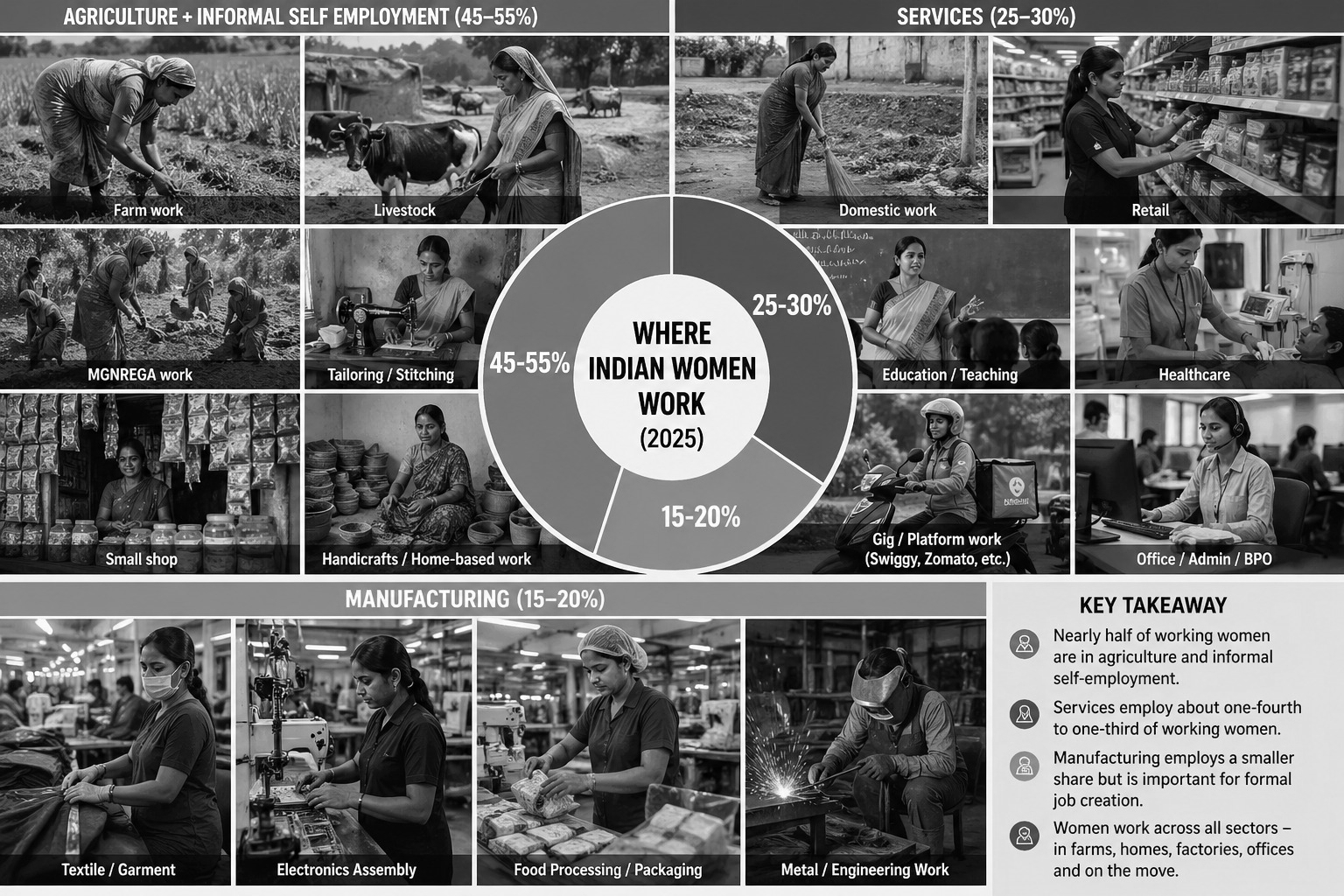
But “employment” in India extends far beyond formal office roles or salaried corporate positions. A large part of this increase is being driven by women working in agriculture, livestock, tailoring, domestic work, family enterprises, handicrafts, retail, MGNREGA labour, healthcare support, gig work, and self employment .
In rural India, women working on farms, in dairy, livestock care, or family businesses make up a substantial share of the rise. In urban India, growth is being seen in domestic work, education, healthcare, retail, platform based jobs, and office support services.
Broad estimates suggest that 45 to 55 percent of working women are still concentrated in agriculture and informal self employment , 25 to 30 percent in services , and 15 to 20 percent in manufacturing , including textiles, food processing, and assembly lines.
This means the jump from 22 percent to 39 percent does not necessarily indicate a doubling of formal, high paying jobs. Rather, it reflects broader workforce participation, often shaped by rising household expenses, self help groups, digital inclusion, gig platforms, and the need for supplemental income.
For many women, wages remain modest. Median monthly earnings are estimated around ₹10,000 to ₹15,000 , with rural workers often earning less and urban informal workers still concentrated in lower wage sectors. Formal salaried jobs, while growing, remain a smaller share of the total.
Mandaviya has framed the rise as a sign of empowerment supported by labour reforms, social security expansion, maternity protections, and legal recognition of gig and platform workers. Yet economists argue that India’s next challenge is not just increasing participation, but improving income quality, security, and long term economic mobility.
The shift is undeniable: more Indian women are joining the workforce than ever before, but the larger test now is whether this participation translates into better pay, dignity, and sustainable economic advancement.